Last updated:
How to evaluate BIM software: Complete guide to the architecture firm's 4 phase process

TL;DR: Understanding how to evaluate BIM software is the starting point: architecture firms follow a structured 4-phase process averaging 6 months. Exploration (weeks 1 to 4), a live pilot project (weeks 5 to 16), a leadership presentation (weeks 17 to 20), and budget approval and rollout (weeks 21 to 26). Enterprise firms with stakeholder or compliance blockers regularly extend to 12 months. The sale doesn't happen at the demo. It happens when an internal champion presents a convincing business case to the CFO and board.
By the numbers
- 49% of architecture professionals now use AI tools at work, a fivefold increase since 2020 when fewer than one in ten used AI, per the NBS Digital Construction Report 2025 (a UK-focused survey of 550+ construction professionals; the figure reflects any AI tool use, not necessarily daily integration).
- The average enterprise SaaS sales cycle is 12+ months, with a six-month minimum for enterprise deals, according to Focus Digital's 2025 industry research.
How to evaluate BIM software: what does the 4-phase process look like?
Architecture firms don't buy software. They evaluate it, pilot it, present it internally, and then buy it. That distinction matters more than most vendors realize. Understanding the process is the difference between a smooth 6-month adoption and one that stalls at month 12.
Based on direct interviews with architecture firm IT directors and practice managers, including a detailed onboarding session with a mid-size Canadian architecture firm in April 2026, here is what the process looks like from the inside. If you're weighing your options, the best BIM software for architects all go through this same evaluation gauntlet.
Phase 1: How do architecture firms first test new BIM software? (Weeks 1 to 4)
Phase 1 is not a feature evaluation. It's a viability filter. The goal is to figure out whether a tool is worth presenting internally, not whether it's the best tool on the market.
"The phase one would be like if we're doing something like this, where we would kind of play with it, get tutorials," the IT Director at a mid-size Canadian architecture firm explained. "And then if we think it's something that's a viable thing, it would then go to phase two."
During Phase 1, individual team members experiment independently. They run tutorials, test on non-critical projects, and answer three questions:
- Does this fit our existing workflow?
- Can our team learn it without dedicated training time?
- Does it solve a problem we have right now?
If the answer to any of those is no, the tool gets dropped. No formal review. No vendor feedback. BIM software for architects that requires more than two to three sessions before delivering visible value rarely advances past this stage. Architecture firms carry active project loads, and the opportunity cost of evaluating the wrong tool is real billable hours lost. For small architecture firms especially, this first filter is where budget discipline starts.
Phase 2: What does a BIM software pilot look like? (Weeks 5 to 16)
Phase 2 is a live production project. Real clients, real deadlines, real stakes. Firms typically purchase 5 licenses for a small team and run a full project from kickoff to a deliverable milestone using the new tool.
"We'd probably buy like 5 licenses to work as a team so that we could do a project like a real one instead of just playing," the IT Director said. "That would be almost not a test pilot but it is our company like doing a real project with it."
The pilot phase has four components:
- License purchase: 5 seats, typically month-to-month during evaluation
- Project selection: A project starting fresh, not mid-stream
- Workflow establishment: Internal templates, standards, and team protocols built for the new tool
- Deliverable milestone: The pilot runs through a concrete output such as a schematic design package or RFP response
The pilot creates the case study the firm needs to justify broader adoption. No pilot results means no board presentation. No board presentation means no purchase.
One bottleneck that catches people off guard: the pilot must use a fresh project. Mid-stream projects create friction, confound evaluation results, and disrupt existing client deliverables. If the firm doesn't have a suitable new project in the pipeline, the evaluation pauses. Often for one to two months.
Phase 3: How do architecture firms build a business case for leadership? (Weeks 17 to 20)
After the pilot, the IT Director or Practice Manager builds a formal business case and presents to firm leadership. The person evaluating the tool almost never has the authority to buy it.
"I'd have to come up with a financial plan of what it means," the IT Director explained. "So okay we're thinking it's gonna be 15 or 20 licenses, I'm just picking a number, so it'll be this much so that we can build it into our budget."
The leadership presentation requires four components:
- Pilot results: What worked, what didn't, and measurable outcomes from the live project
- Implementation plan: How the tool will roll out across teams and project types
- Financial projection: License count, annual cost, training budget, and support costs
- Timeline: When adoption scales and when the firm expects ROI
The CFO reviews the financial projection against annual budget cycles. If the presentation happens in Q3, the tool may not be funded until the next fiscal year. That alone can add three to six months to the timeline with no action from either side.
Phase 4: What happens after architecture firms approve new software? (Weeks 21 to 26)
Budget approval does not mean immediate deployment. After the CFO and board approve, the firm still needs to finalize contract terms and license count, schedule team training sessions, migrate firm-specific templates and standards into the new tool, and identify the first projects for wider rollout.
"Timeline wise, probably like 6 months is a timeline that I think is achievable of where we could pilot with a project and then put together so that with the intent that then by the end of the quarter we would be able to have that contract in place," the IT Director said.
The 6-month timeline assumes no blockers. In practice, most evaluations hit at least one of the delays below.
What slows down BIM software adoption in architecture firms?
Several factors consistently stretch the 6-month timeline to 12 months or beyond. Each one is predictable and, in most cases, addressable before it becomes a blocker.
Project pipeline gaps. The pilot must start fresh. Mid-stream projects disrupt deliverables and produce unreliable results. Firms with active new-project pipelines can source a pilot within four to six weeks. Firms in slow periods wait. Practice managers cite this as the single most common reason a 6-month evaluation stretches to 12.
Junior staff resistance. AI-powered BIM tools trigger a specific anxiety: junior architects worry they are being automated out of their roles. "Our junior staff is worried about: are we strategically trying to replace them?" the IT Director said. "I'm like no no we're not. It's not a decision maker. It helps you gather the information to make a better decision." Firms that address this directly during Phase 2 move forward with fewer disruptions. Firms that don't find staff underusing the tool, which undermines the Phase 3 business case.
Multi-stakeholder approval chains. The typical sign-off chain involves the IT Director evaluating technical feasibility, the CEO reviewing strategic fit, the CFO approving the budget, the board giving final authorization, and project team leaders committing to pilot. Any single stakeholder can pause the process. Anyone who's been through enterprise procurement knows the drill.
Security and compliance reviews. For firms working on government contracts, healthcare facilities, or NDA-protected commercial projects, enterprise security requirements are a hard gate. The IT department vets data handling and encryption standards, compliance certifications (SOC 2 Type 2, ISO 27001, CMMC Level 1), data ownership terms, and infrastructure compatibility. BIM software without SOC 2 Type 2 is blocked outright by most enterprise IT departments regardless of product quality.
See how Snaptrude handles every phase of this pilot and approval process from day one.
How does Snaptrude fit into this evaluation process?
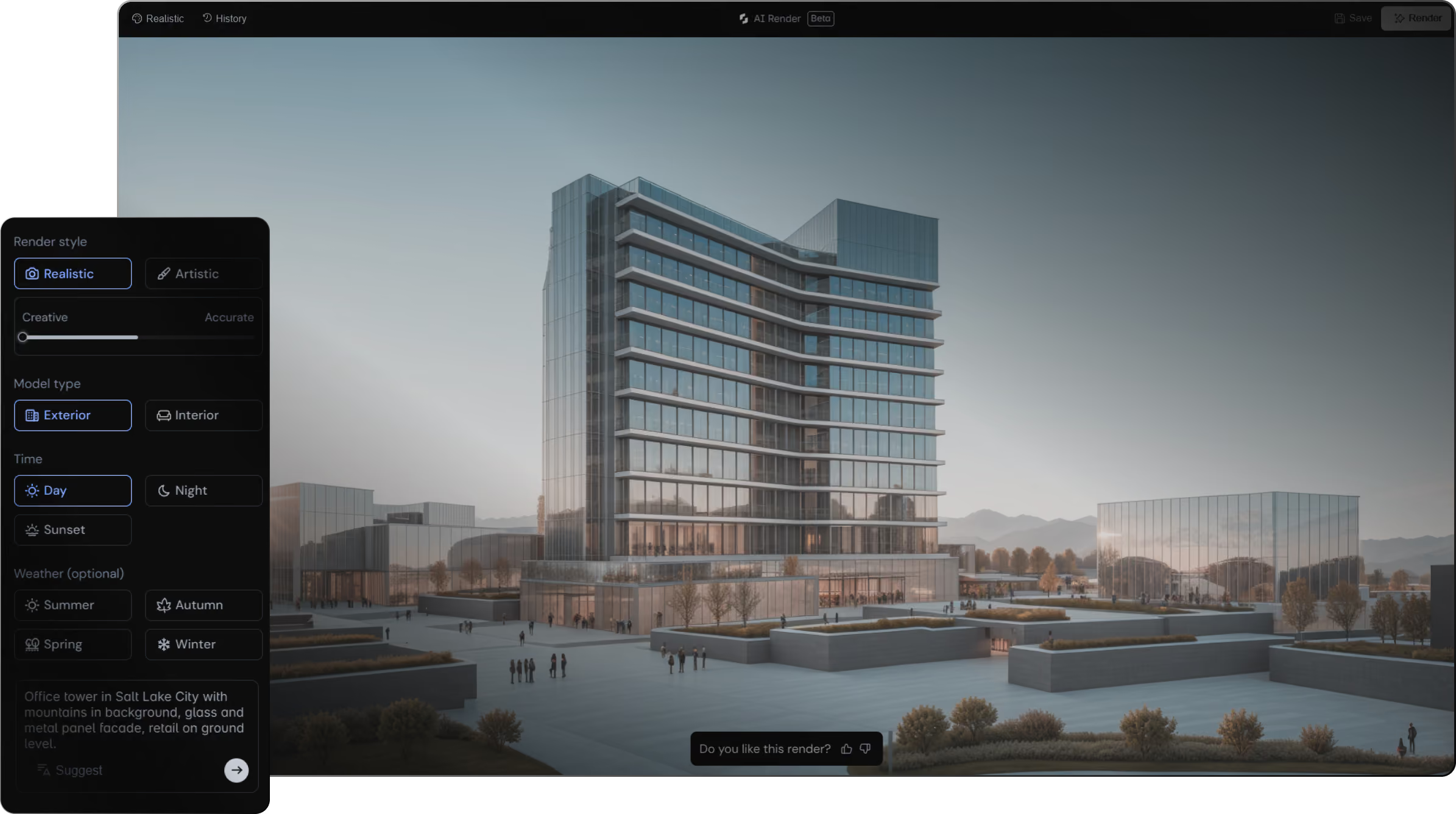
Snaptrude is an AI-powered, cloud-native BIM design tool built for architects. Unlike Revit, which requires desktop installation and weeks of onboarding before a pilot team can work productively, or SketchUp, which lacks BIM-grade data continuity, Snaptrude is designed to reduce friction at every phase of this evaluation process.
In Phase 1, Snaptrude's free trial delivers visible output from the first session. Upload an RFP or site brief, and the AI runs site analysis, generates a buildable envelope, and produces a program model without configuration. A mid-size Canadian architecture firm reported compressing two days of RFP research into a single AI-assisted session.
In Phase 2, the cloud-native platform requires no desktop installation or IT configuration. A five-person pilot team can begin collaborating on a live project the same day licenses are activated.
In Phase 3, Snaptrude provides ROI documentation, security compliance evidence, and case study materials formatted for internal business case presentations.
In Phase 4, Snaptrude holds SOC 2 Type 2, ISO 27001, and CMMC Level 1 certifications, clearing enterprise IT security reviews for NDA projects, healthcare facilities, and federal agency work. For firms currently on Revit, the top Revit alternatives all follow this same evaluation arc before any firm-wide rollout.
Phase comparison: BIM software evaluation timeline
| Phase | Timeline | Key activity | Decision gate |
|---|---|---|---|
| Exploration | Weeks 1 to 4 | Free trial, tutorials, individual testing | Is it viable enough to pilot? |
| Pilot project | Weeks 5 to 16 | 5-license live project, workflow development | Does it produce results on a real project? |
| Leadership presentation | Weeks 17 to 20 | Business case, ROI model, implementation plan | Will leadership fund it? |
| Budget approval | Weeks 21 to 26 | Contract, training, firm-wide rollout planning | Contract signed |
Frequently asked questions
Q: How to evaluate BIM software for an architecture firm?
A: Learning how to evaluate BIM software starts with a structured 4-phase process: exploration (weeks 1 to 4), a live pilot project on a real client engagement (weeks 5 to 16), a formal leadership presentation with a business case (weeks 17 to 20), and budget approval with firm-wide rollout (weeks 21 to 26). Success depends on securing a suitable pilot project, addressing junior staff concerns early, and clearing enterprise security reviews. Cloud-native BIM tools can compress Phase 1 significantly.
Q: How long does it take for an architecture firm to adopt new BIM software?
A: The standard timeline is 6 months across four phases: exploration, a live pilot project, a leadership presentation, and budget approval with rollout. Firms that hit blockers, including no suitable pilot project, a failed security review, or multi-stakeholder approval delays, regularly extend to 12 months. Cloud-native BIM tools can shorten Phase 1 by delivering visible output from the first session.
Q: Who has authority to approve BIM software purchases in an architecture firm?
A: The final purchase decision rests with the CFO and board, not the IT Director or practice manager who ran the evaluation. The evaluating team builds and presents the business case; the CFO approves the budget; the board gives final authorization. This multi-stakeholder structure is why the process takes months rather than weeks, and why internal champions matter more than vendor demos. Cloud-native BIM tools that provide ready-made ROI documentation help close the gap.
Q: What security certifications does BIM software need to pass enterprise IT reviews?
A: Enterprise firms require SOC 2 Type 2 at minimum, which demonstrates security controls for data handling. Firms on international projects additionally require ISO 27001. Firms with US federal agency clients require CMMC Level 1. BIM software missing these certifications is blocked at the IT review stage regardless of product quality. Snaptrude holds SOC 2 Type 2, ISO 27001, and CMMC Level 1, clearing enterprise security reviews for government, healthcare, and NDA-protected work.
Q: What metrics do architecture firms use to justify BIM software purchases?
A: Firms build their business case around four categories: time savings per project phase, billable hour efficiency from reduced coordination time, revenue impact from capacity to take on more RFPs without adding headcount, and cost comparison of annual license fees versus projected hours saved. A clear ROI model is required before the CFO will approve the budget. The strongest vendor evaluations include pre-built ROI documentation and case study materials to support internal presentations.
Q: What makes Snaptrude different from legacy BIM tools like Revit during software evaluation?
A: Snaptrude eliminates the two biggest Phase 1 blockers with legacy software: desktop installation and slow onboarding. Revit requires weeks of setup before a pilot team is productive; Snaptrude delivers visible output in the first session, with no IT configuration required. A pilot team of five can begin a live client project the same day licenses are activated, compressing the entire 6-month evaluation timeline.
Q: How does Snaptrude handle enterprise security and compliance reviews?
A: Snaptrude holds SOC 2 Type 2, ISO 27001, and CMMC Level 1 certifications, satisfying the security requirements of enterprise IT departments, government contractors, and healthcare facility firms. These certifications cover data handling, encryption standards, and data ownership terms. Firms working on NDA-protected commercial projects, federal agency work, or international commissions can clear IT security review without manual vetting of Snaptrude's infrastructure.