Last updated:
BIM Software for Architects: Reclaim 30+ Hours Monthly From RFP Work

TL;DR Senior architects burn 25-30% of billable capacity on RFP responses generating no revenue. Four principals x 30 hours monthly x $250/hr = $360,000/year in acquisition overhead. Snaptrude's BIM software for architects compresses RFP response time from 30 hours to under 5 by automating feasibility studies, cost estimation, and program documentation - but the business case also requires restructuring who does the work.
By the Numbers
- Average RFP win rate is 45% across industries, with SMBs averaging 42%, Bidara
- 25-hour average RFP response with SMBs responding fastest at 20 hours, enterprise averaging 30+ hours, Loopio
- Architecture firms report median utilization rate of 82.4%, but non-billable work drives actual capacity below 70%, Monograph 2024
- Senior architects spend 6.6% of billable hours on non-compensated services, RIBA Business Benchmarking
- AI-powered proposal tools reduce 25-hour RFP responses to under 5 hours, recovering 20 hours per proposal, QorusDocs
The Hidden Business Cost of RFP Response
Every architecture firm claims to want more projects. None of them acknowledge that their most qualified architects are spending a quarter of their time acquiring those projects.
Here's the actual math. Your firm has four senior principals. Each bills at $250 per hour. Each spends an average of 30 hours per month on RFP work: initial response, design concepts, cost estimates, presentation graphics, and client coordination before the fee is ever negotiated. That's 4 people x 30 hours x $250 per hour x 12 months = $360,000 per year in senior architect time devoted to RFP responses.
Your RFP win rate is 45%, industry standard. That means you're responding to roughly 11 RFPs per year to win 5 projects. Your actual cost per acquisition is $360,000 divided by 5 projects = $72,000 per project.
Now compare this to your project economics. If the average fee for a won project is $150,000 to $200,000, your acquisition cost represents 36-48% of the first-year fee. That's higher than your typical marketing budget. It's also higher than reasonable cost-of-acquisition for most professional services.
The real problem: nobody measures this. RFP hours aren't tracked separately. They get lumped into "business development" or buried in overall utilization numbers. Without measurement, there's no accountability, no incentive to improve, and no visibility into what's actually happening.
Senior Architects Aren't the Right People for RFP Work
The secondary problem: your best architects are the worst people to assign to RFPs. The architects who can do RFP work fastest are exactly the architects who should be managing projects, mentoring junior staff, and maintaining client relationships. By routing all RFP work through your most experienced people, you're removing them from the activities that compound your firm's institutional knowledge and profit margin.
A mid-level architect with five years of experience can produce a competent RFP response. It might take them 40 hours instead of 30. But they're not losing revenue because their billable rate is lower. More importantly, they're developing skills they'll use on every project they manage.
Your senior principal working a RFP response is trapped in a knowledge-transfer failure. They're not learning anything. They're just running the same process again. They could be in client meetings that only they can handle, reviewing junior architect work, or thinking about the firm's five-year direction.
The firms that solve this problem restructure how RFP work flows. A business development coordinator screens RFPs and flags the ones worth pursuing. A mid-level architect produces the response with senior principal review (2 hours, not 30). Cost estimation uses historical data and parametric models, not new feasibility studies. The total time investment drops from 30 hours to 8 hours per RFP.
How Snaptrude Reduces RFP Production Time
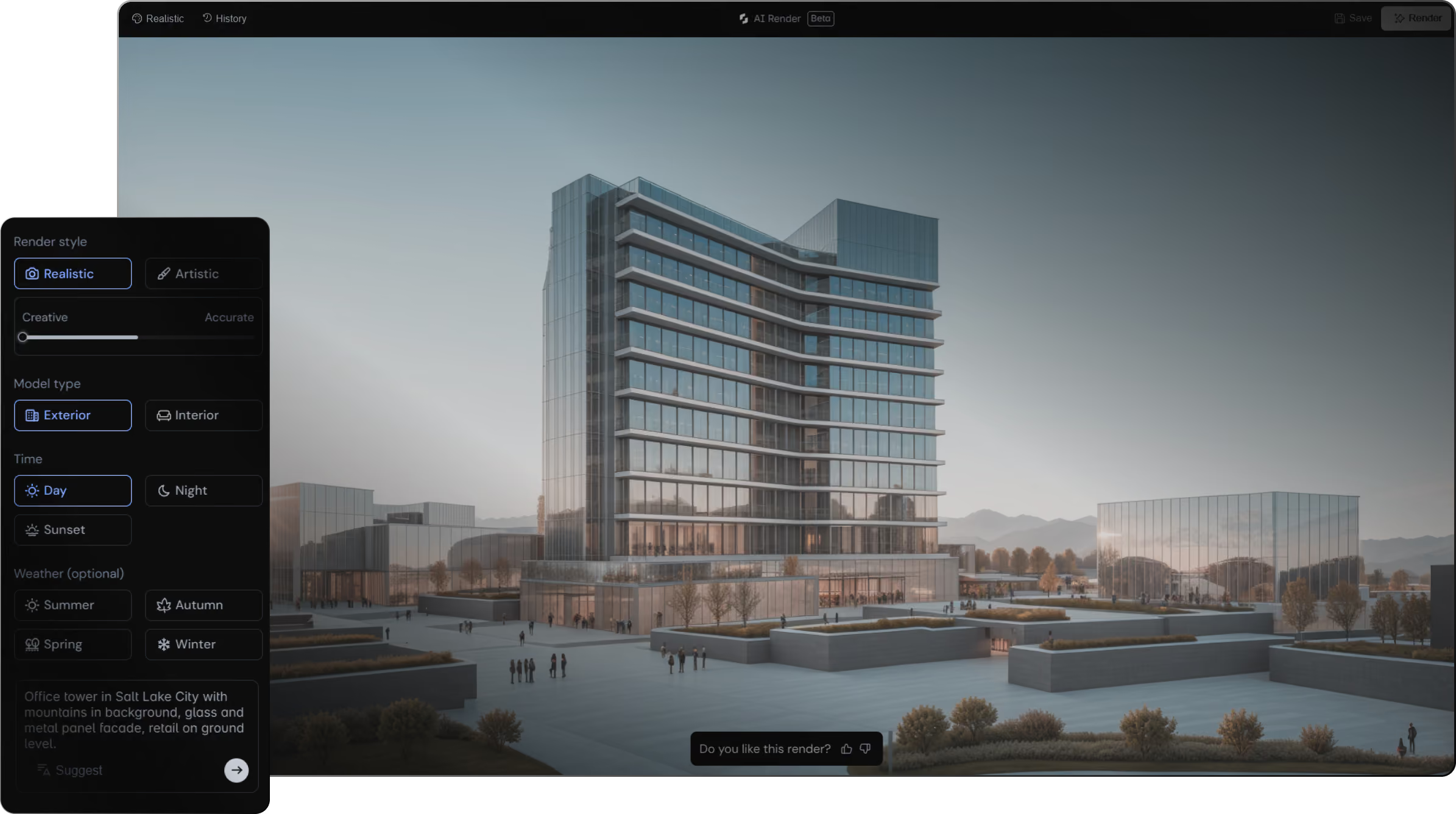
Snaptrude is an AI-powered, cloud-native BIM design tool for architects. Unlike Revit, which requires full detailed modeling for feasibility studies, Snaptrude enables mid-level architects to generate massing-level feasibility studies in 2-3 hours, complete with automatic area calculations, program compliance checks, and cost estimation. Here's the workflow: the business development coordinator passes the RFP requirements to a mid-level architect. The architect inputs site dimensions, program requirements (GFA, unit count, use mix), and zoning constraints. Snaptrude's AI generates three massing alternatives. The architect selects the most compliant option, refines it in 30 minutes, and Snaptrude calculates: total GFA, FAR compliance, unit count, parking requirement, preliminary cost estimate. Export the results to a presentation template. Senior principal reviews in 1 hour. That's 4.5 hours total, compared to 30 hours in traditional workflows.
The RFP response doesn't require detailed design intent or full coordination. It requires credible feasibility and cost estimation. Snaptrude delivers that with a fraction of the traditional labor. Try Snaptrude free
Measuring True RFP Cost With BIM Software for Architects
Start here: audit your RFP process for the next three months. Track hours by title and seniority level. Capture every RFP submitted, won, and lost.
At the end of three months, calculate these numbers:
- Total hours by seniority level
- Total billable opportunity cost (hours x billing rate)
- Number of RFPs submitted and number won
- Cost per acquisition (total cost divided by wins)
- Lifetime client value for won projects
Most firms discover their acquisition cost is 20-40% of the lifetime client value for first projects. Once you have measurement, you can make decisions. If RFP acquisition costs are reasonable (under 20% of lifetime value), your issue is pure workflow efficiency. If acquisition costs are high (over 30%), you need to change your bid-no-bid criteria and invest in BIM software for architects that accelerates response time.
The Workflow Question: Automation vs. Strategic Repositioning
There's a temptation to frame this as a pure workflow problem: "If we could just do RFPs faster, we'd win more projects with less overhead." This is half-right. Yes, standardized templates, reusable presentation assets, and parametric feasibility studies can cut RFP time from 30 hours to 8 hours. Snaptrude's AI program generator and parametric cost models enable this.
But the business case is different. Even at 8 hours per RFP with a 45% win rate, you're still spending $8,000 per win in senior architect time if you're using senior architects. The math only works if you've restructured who does the work and how senior time is allocated. In 2026, competitive firms have already made this shift.
Reclaiming Senior Architect Time
The firms that solve this problem don't just optimize RFP workflow. They restructure the entire business development function. They hire dedicated business development professionals whose job is not to be architects who also do business development, but to be business development professionals who understand architecture.
They also build reusable assets: a library of case studies, a portfolio of cost models by building type, standard presentation templates that can be customized in 2 hours instead of 20. These assets are built once and improve with each RFP.
Most importantly, they protect senior architect time for work that only senior architects can do. Senior architects appear in the final client conversation. They review feasibility studies that mid-level architects have prepared. They make the go-no-go decision on pursuing an RFP. But they don't spend 30 hours per month in the RFP response production process.
The consequence: senior architects spend more time on client management, project leadership, and firm direction. The firm wins more projects per RFP because the final pitch is delivered by the person who'll actually lead the work.
Comparison: Traditional vs. AI-Powered RFP Workflow
FAQ
Q: How do I know if my firm is spending too much on RFP work?
A: Compare your cost per acquisition (total RFP hours x billing rate divided by wins) to your lifetime client value. If acquisition cost is under 15% of lifetime value, you're efficient. Between 15-30% is reasonable. Over 30% suggests either your win rate is too low, your target project fees are too small, or senior architects are doing work that shouldn't require their billable rate.
Q: Should we stop pursuing RFPs with low win probability?
A: Yes. If historical data shows you win less than 30% of RFPs in a certain category, calculate whether the expected fee justifies the response cost. If your win rate is actually 12%, you'd submit 8 RFPs to win one project - potentially costing more to acquire than the project generates. Focus effort on sectors where your win rate is 50%+ or fees are higher.
Q: How do we restructure who does RFP work without alienating senior architects?
A: Position it as an opportunity, not a removal. Instead of "we're removing you from RFP work," frame it as: "Your time is now worth $250/hour. We're allocating those hours to client leadership and proposal strategy. A mid-level architect will produce the feasibility study (their $120/hour value), and you'll review and present (your $250/hour value)." Firms that execute this transition report improved senior architect retention and higher closing rates.
Q: Can AI tools really cut RFP time from 30 hours to under 5 hours?
A: AI can handle parametric feasibility studies, cost estimation, and initial program validation. What remains is human judgment: determining design direction, defining strategic value for this client, and preparing the senior architect for the client conversation. That's typically 4-6 hours. A 25,000-SF office feasibility study typically takes 8-10 hours of manual modeling in Revit. Snaptrude's AI generates viable massing options in 30 minutes, cost estimates in 20 minutes, and presentation graphics in 15 minutes.