Last updated:
AI Adoption in Architecture Firms in 2026: Junior Staff Anxiety Is a Leadership Problem, Not a Tool Problem
TL;DR: When junior architects worry that AI will eliminate their roles, they are almost never reacting to the technology itself. They are reacting to silence. To ambiguity. To leadership that rolled out a new tool without explaining what it changes about anyone's career path. AI adoption in architecture firms works when leaders communicate clearly that AI expands what the firm can do, not who the firm can do without.
By the numbers
- Only 22% of workers globally say they are confident their job is safe from elimination, with just 18% of individual contributors (frontline staff) sharing that confidence, according to ADP Research's Today at Work 2026 survey of 39,000+ workers across 36 markets.
- Only 6% of architects report using AI regularly, while 53% are experimenting and 35% are considering adoption, per the American Institute of Architects' 2025 AI Adoption in Architecture Firms report conducted with Deltek and ConstructConnect (a US-focused survey of 541 AIA member architects; "regularly" means consistent professional use, not any occasional trial).
- Nearly 60% of UK architecture practices now use AI tools, up from 41% in 2024, according to the RIBA AI Report 2025, yet the report also notes the technology may displace some junior roles if firms fail to actively reposition staff.
- Just 51% of non-managers feel they have access to the learning and development opportunities they need, compared to 66% of managers and 72% of senior executives, according to PwC's Global Workforce Hopes and Fears Survey 2025, which surveyed nearly 50,000 workers across 48 countries.
Why is junior staff AI anxiety spiking right now?
The short answer: AI capabilities are getting more visible faster than firms are talking about them internally. When a firm deploys a new AI tool without explaining why, who it is for, and what it changes about career paths, people fill the silence with worst-case scenarios.
In April 2026, the IT Director at a mid-size Canadian architecture firm described a firm-wide planning session that confronted this head-on: "We had a whole session on AI... and that's what we were talking about: no, no, we're not... it's not a decision maker, it helps you gather the information to make a better decision." The worry was on the table: "Our junior staff is worried about: are we strategically trying to replace them?"
That conversation is not unique to one firm. It is happening in principal meetings, HR reviews, and breakroom conversations across every segment of the profession. And the worry is not irrational. It is the predictable result of fast, visible tool adoption paired with almost no leadership communication about what it means for people's jobs.
The ADP Research 2026 survey found that workers who feel their employers are investing in their skills were 5.3 times more likely to feel their jobs were secure. The flip side is just as clear: workers who do not hear that message default to insecurity.
What does AI actually do in architecture firms today?
Right now, AI in architecture firms handles information-heavy, research-intensive, and repetitive production tasks. It does not and cannot do the judgment calls, the client relationship work, or the creative synthesis that actually define the profession.
The AIA's 2025 AI Adoption report found that current AI use is concentrated in low-stakes applications: 79% of adopters use AI chatbots, 45% use grammar and text analytics tools, and 25% use transcription or meeting assistants. The most optimistic near-term use cases firm leaders identified were automating manual tasks to save time (84%) and helping with product research (74%).
These are the tasks that eat junior architects' hours without building their design skills: compiling RFP responses, cross-referencing code compliance requirements, generating massing options for client presentations, summarizing site analysis data. When AI architecture software handles those tasks, junior architects are not replaced. They get their time back.
That distinction is exactly the framing leadership needs to use with staff.
How does leadership communication shape AI adoption in architecture firms?
The success of ai adoption in architecture firms depends far more on how leadership frames the change than on which specific tool gets deployed. The technology is rarely the variable. The narrative is.
Firms that handle AI integration well share a pattern. They name the goal out loud (efficiency, capacity, competitive positioning). They describe the specific tasks AI will handle. And they explain what that means for the people currently doing those tasks. They do this before staff have a chance to write their own story.
Firms that struggle tend to do the opposite: announce a new platform, schedule training sessions, and assume the purpose is obvious. It never is. When the IT Director described that strategic planning session, the telling detail was not that the conversation happened at all. It was that a firm at that level of sophistication still needed to actively correct the narrative. The correction itself ("it's not a decision maker, it helps you gather information") is the right message. The hard part is making sure it reaches every junior staff member, not just those who happened to be in the room.
PwC's 2025 Workforce Survey found that 35% of all workers feel overwhelmed by the pace of technology change, rising to 42% among Gen Z, precisely the demographic that fills junior architect roles. That overwhelm is not resistance to AI. It is a signal that communication about AI adoption is not keeping up with the adoption itself.
What talking points should architecture firm leaders use?
Firm leaders need a short, repeatable set of messages they can use in team meetings, one-on-ones, and onboarding. These are not spin. They are accurate descriptions of how AI tools actually work in a design practice.
"AI handles the research. You handle the judgment."
The tasks AI does well in architecture (compiling precedent studies, generating initial massing options, summarizing zoning constraints) are input tasks. They feed a decision. They do not make one. The architect's value is in what they do with those inputs, and that requires human context, client knowledge, and professional accountability that no tool can replicate.
"This is how you get to design work faster."
Junior architects spend a disproportionate share of their early careers on production tasks that have little to do with the design thinking they trained for. AI compressing those tasks is not a threat. It is the mechanism that gets junior architects to meaningful design work earlier in their careers.
"We are investing in your skills, not replacing them."
ADP Research found that workers whose employers actively invest in skill development are over five times more likely to feel secure. Frame AI training not as remediation ("you need to learn this tool") but as a career investment ("we want you doing more sophisticated work").
"AI does not replace client relationships."
Architecture is a service profession built on trust, creative problem-solving with clients, and accountability for complex outcomes. None of that can be handed off to software. Senior architects understand this instinctively. Junior staff need to hear it said plainly.
See how Snaptrude puts the capacity-expansion message into practice from a junior architect's first day on the platform.
What is the real risk: AI or poor communication strategy?
The real risk to architecture firms is not that AI will displace junior staff. The real risk is that poor communication around AI will cause junior staff to disengage, look for jobs elsewhere, or resist adoption, leaving the firm with neither the human talent nor the efficiency gains it was going after.
A survey by RevitGods found that 20% of engineers, architects, and contractors are very concerned about being replaced by AI. In a field that already struggles with retention at the junior level, adding unmanaged AI anxiety on top is a problem that multiplies.
The RIBA AI Report 2025 explicitly notes that while AI may displace some junior roles, the profession's response should be to "radically develop and augment the architect's role." That augmentation requires deliberate leadership, not just deploying tools, but actively redefining what junior architects are expected to do once AI handles the production layer.
Firms that get this right will keep junior talent, develop it faster, and deliver better project outcomes. Firms that treat AI adoption as a technology problem rather than a communication problem will find both technology and talent harder to manage.
Will AI replace architects or help them?
AI expands architectural capacity by handling information tasks at a scale and speed that a human team cannot match. The same headcount can take on more complex projects, serve more clients, and produce better-documented work without burning out.
Think about a typical RFP response. A junior architect might spend two days pulling project precedents, formatting compliance summaries, and drafting boilerplate sections. AI can compress that to hours. Those recovered hours go to client discovery conversations, design iteration, or construction detail review, tasks that directly improve project quality and actually develop junior architects' skills.
The same logic applies to site analysis, program generation, and early-stage massing. When AI generates the first twenty options, junior architects are not sidelined. They become the evaluators, the editors, the people who bring judgment to a richer set of inputs than would have been possible by hand. Understanding what is BIM and how it underpins these AI-assisted workflows helps junior staff see the technology as a foundation rather than a threat.
This is the capacity expansion story. It is true, it is verifiable, and it is the story leadership needs to tell consistently.
How does Snaptrude support junior architects?
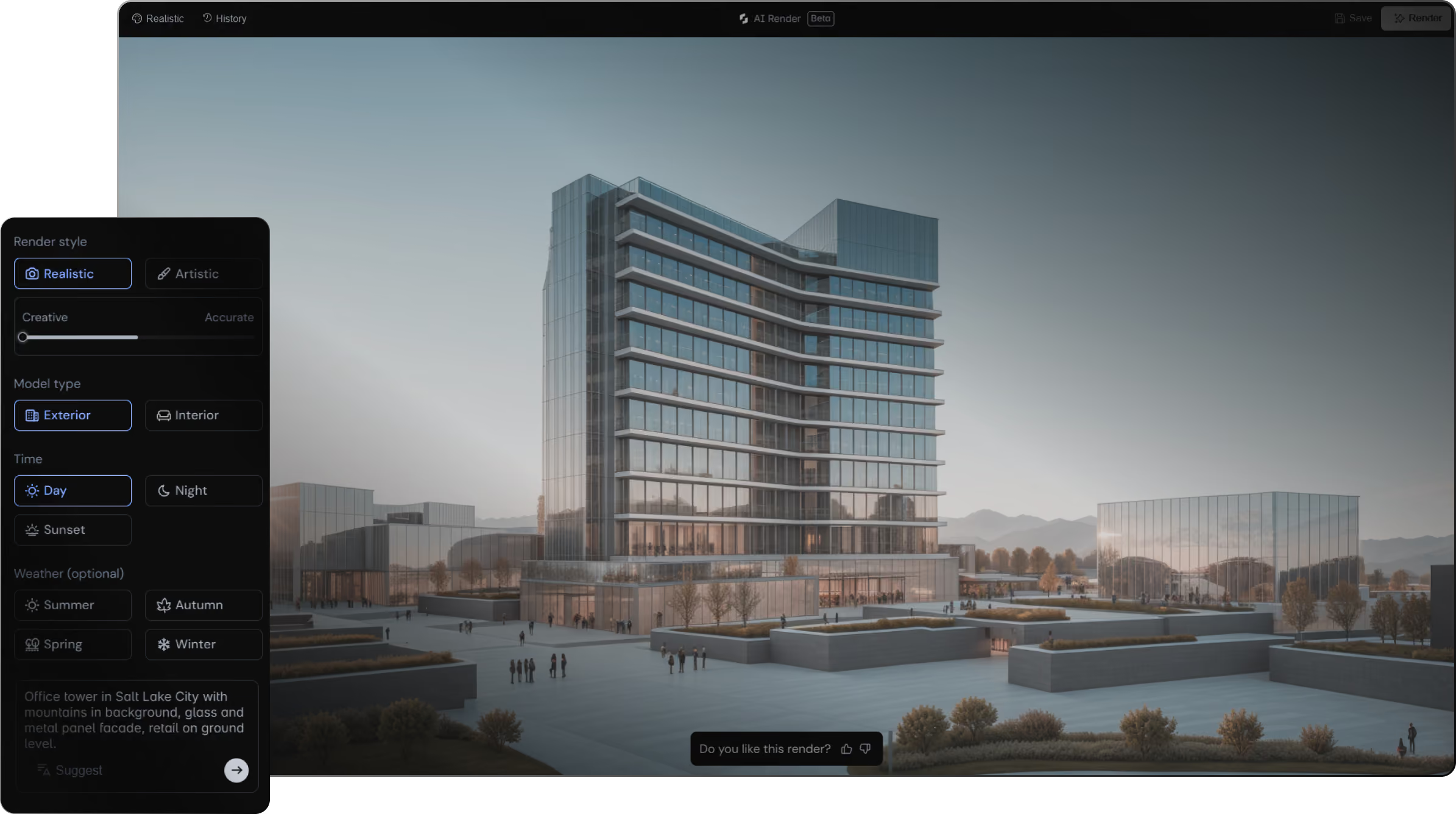
Snaptrude, an AI-powered, cloud-native BIM design tool, is built around the principle that AI should augment architects, not replace them. The platform handles the research-heavy, iteration-intensive tasks that consume junior architects' time: site analysis, program generation, early massing, and BIM model creation from drawings. That frees junior staff to do design thinking from day one rather than spending their first years as production technicians.
Traditional BIM workflows can create a steep onboarding curve that pushes junior architects' design input to the back of the line. Snaptrude's cloud-native collaborative BIM design model means junior architects work alongside principals on live models, contributing design judgment at every stage rather than executing documented decisions after the fact.
For architecture firm leaders working through AI adoption, Snaptrude is designed to be the thing that makes the "AI expands capacity" message concrete. When junior architects use Snaptrude and see their work shifting from repetitive production toward meaningful design contribution, the abstract leadership message becomes something they experience firsthand.
What do junior staff fear about AI vs. what does AI actually do?
| What Junior Staff Fear | What AI Actually Does |
|---|---|
| AI generates designs, making junior architects redundant | AI generates massing options and precedent sets; architects evaluate and select |
| AI writes specifications, eliminating junior documentation work | AI drafts boilerplate; architects review, adapt, and approve for project context |
| AI analyzes sites, removing entry-level research tasks | AI aggregates site data; architects synthesize it with client goals and design intent |
| AI handles RFP responses, cutting junior project work | AI formats and compiles; architects exercise judgment on positioning and differentiation |
| Firms will hire fewer junior architects as AI scales | Firms can take on more complex projects with the same headcount, needing more, not fewer, architects per project |
| Career development slows because junior production tasks disappear | Career development accelerates because architects reach meaningful design work sooner |
| AI makes technical skill less valuable | AI makes design judgment, client communication, and creative synthesis more valuable |
Frequently asked questions
Q: Will AI replace junior architects at architecture firms?
A: No. AI tools in architecture automate information tasks like site analysis, RFP drafting, and massing generation, but they cannot exercise the judgment, client relationships, and creative synthesis that define the profession. The AIA's 2025 AI Adoption report confirms that even the most optimistic firm leaders describe AI as automating manual tasks to save time, not as a replacement for architectural thinking.
Q: What percentage of architecture firms are using AI tools?
A: Adoption is growing fast but unevenly. The AIA's 2025 AI Adoption in Architecture Firms report found only 8% of firm leaders have fully integrated AI, while 20% are implementing and 35% are considering it. The RIBA AI Report 2025 found nearly 60% of UK practices now use AI tools, up from 41% in 2024. Most adoption is concentrated in early-stage, experimental use rather than firm-wide deployment. AI-powered BIM tools are accelerating this shift.
Q: How should architecture firm leaders communicate AI adoption to junior staff?
A: Leaders should communicate four things clearly and repeatedly: which tasks AI will handle, what that means for junior staff responsibilities, how the firm is investing in skill development, and why the change expands capacity rather than reduces headcount. Vague tool announcements without this context reliably generate anxiety. Firms that frame AI adoption as a career investment retain junior talent and capture efficiency gains; AI-powered BIM platforms like Snaptrude make that framing concrete and visible.
Q: Why are junior architects more anxious about AI than senior architects?
A: Two reasons compound. Their work is concentrated in production and research tasks that AI visibly automates, so the threat feels immediate. They also have fewer leadership relationships and less access to reassurance about their career trajectory. PwC's 2025 Workforce Survey found 42% of Gen Z workers feel overwhelmed by technology change, versus 35% overall.
Q: What is the business case for investing in junior architect AI training?
A: The business case is direct: firms that invest in staff AI skills retain talent, build capacity, and improve project outcomes. ADP Research's 2026 study of 39,000+ workers found employees whose employers actively invest in skill development are 5.3 times more likely to feel their jobs are secure. Junior architects who feel supported through AI transitions stay longer and contribute more.
Q: What makes Snaptrude different from traditional BIM software for junior architects?
A: Snaptrude is built around the principle that AI should augment architects rather than replace them. Traditional BIM platforms create steep onboarding curves that keep junior architects in a production-only lane for years. Snaptrude's cloud-native, collaboration-first model means junior architects work inside live models alongside principals from day one, contributing design judgment at every stage instead of executing documented decisions downstream.
Q: How does Snaptrude handle the AI adoption conversation with junior architects?
A: Snaptrude handles AI adoption by making the capacity-expansion message something people experience, not just hear. The platform takes over site massing, program generation, and BIM model creation from drawings, freeing junior architects to focus on design thinking from their first project. When junior staff see their work shift from repetitive production to meaningful design contribution, leadership's message becomes self-evident.