Last updated:
LOD Hopping: Reimagining BIM Workflows for Continuous Design in Snaptrude
Three years ago at Snaptrude, we began building something foundational to how we think architectural software should work. Internally, we call it the universal graph.
At first glance, it powers features like parametric walls. But beneath that surface lies a deeper shift in how architects move between conceptual design, massing, and detailed BIM modeling. That shift is what we call LOD hopping.
For architects working in BIM, this is a structural change (pun intended) in how design evolves from early-stage exploration to production-level detail, and back again.
The hidden inefficiency in architectural BIM workflows
Architects are trained to think fluidly. Early-stage design happens quickly. At LOD 100, you sketch spaces, explore adjacencies, test proportions, and iterate freely. The model is lightweight, responsive, and open-ended.
When the client approves a direction, the workflow shifts. The same design now needs to exist at LOD 300. Walls require defined assemblies. Floors, slabs, and cores must be resolved. Doors and windows need families. Materials are assigned. Schedules are structured.
In most BIM software, that transition feels less like refinement and more like reconstruction. The geometry may appear similar, but the underlying data model demands a new level of specificity that often forces designers to restate their intent in a different format. Days are spent translating the concept into a production-ready BIM model.
The friction increases when changes occur after detailed modeling has already begun. Value engineering reduces square footage. A zoning update affects setbacks. A revised program shifts circulation. At that stage, modifying a highly detailed BIM model can cascade into complex adjustments across joins, hosted elements, annotations, and schedules.
The deeper you go into LOD 300, the harder it becomes to explore again.
LOD hopping: a continuous model from concept to BIM
Snaptrude's approach to architectural design software is built around the idea that the model should remain continuous across levels of detail.
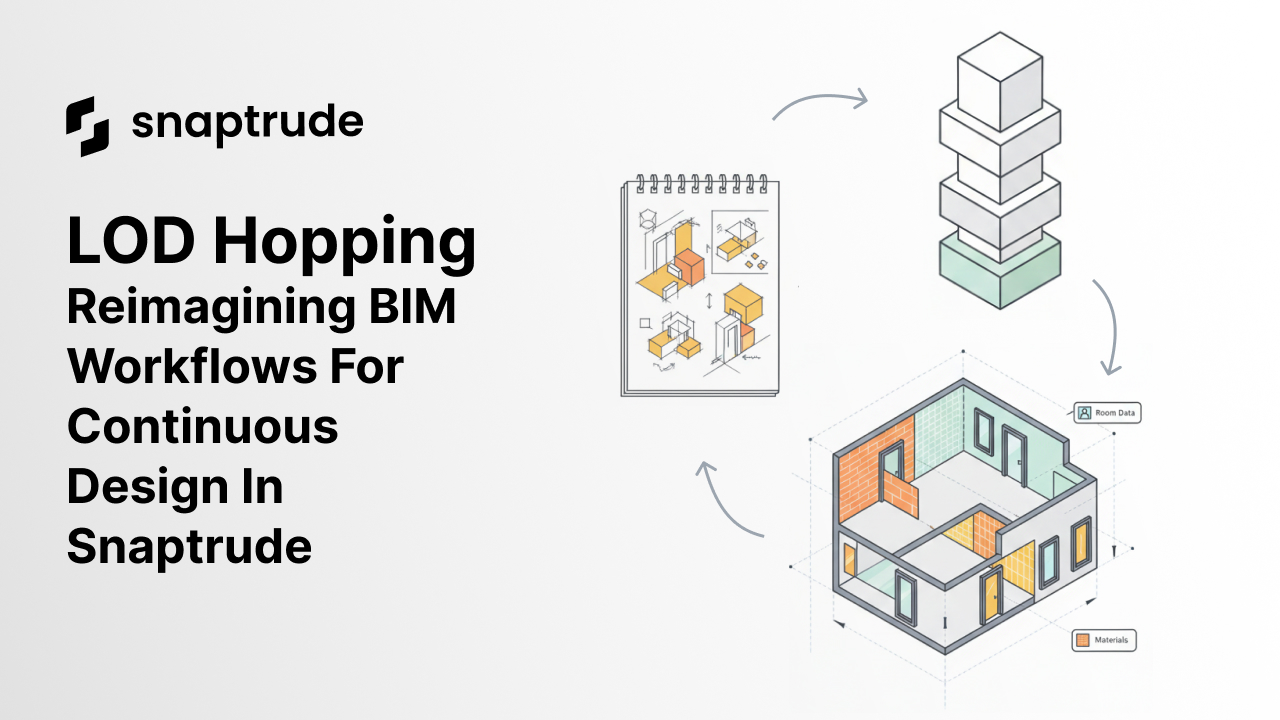
In Design mode, architects draw and edit single-line spaces that behave like LOD 100 representations. These spaces are optimized for fast iteration, early-stage design, feasibility studies, and conceptual planning.
When switching to BIM mode, those same spaces resolve into a fully detailed LOD 300 BIM model. Walls, slabs, floors, junctions, windows, doors, materials, and room data are generated from the same underlying structure. The transition from sketch to BIM is not a rebuild, but a resolution.
The key innovation is that the movement works in both directions.
If the layout needs to change after BIM detailing has started, architects can move back to LOD 100, rethink the spatial organization, explore new adjacencies, and test alternatives quickly. When ready, the model resolves upward again, reconstructing walls, openings, and related elements while preserving BIM data.
This bidirectional movement between LOD 100, LOD 200, and LOD 300 transforms how design teams respond to change. Iteration remains accessible even after production-level modeling begins.
The universal graph underneath
LOD hopping is powered by Snaptrude's universal graph, a parametric model that connects masses, rooms, walls, slabs, and openings as part of one system.
Conceptual spaces and BIM elements are not isolated layers. They are different expressions of the same data structure. Because of this, changes at one level of detail propagate intelligently across the model.
This foundation supports:
- Continuous movement between LOD 100, 200, and 300
- Reduced rework during value engineering
- Faster layout revisions in detailed BIM
- Stronger alignment between architectural programming and spatial modeling
- Seamless integration with AI-driven design workflows
In a cloud-based BIM environment, this continuity becomes even more powerful. Real-time collaboration, architectural programming, AI-assisted design, and detailed modeling all operate on the same connected model.
Designing without penalty
Architectural design is inherently iterative. Yet traditional BIM workflows make late-stage exploration costly.
LOD hopping lowers that barrier. It keeps the model flexible even after detailed documentation has begun. Teams can continue refining layouts, responding to client feedback, and exploring alternatives without feeling locked into previous decisions.
For firms balancing early-stage feasibility, schematic design, and production BIM, this creates a more resilient workflow. The model adapts as the design evolves.
The universal graph has been in development for three years. LOD hopping is one of the first major outcomes of that work. It demonstrates what becomes possible when conceptual design and BIM are no longer treated as separate phases, but as continuous states of the same model.
More to come.
If you are exploring how AI, cloud BIM, and modern architectural workflows are evolving, you can read more on the Snaptrude blog here: