Last updated:
Best Cloud BIM Software 2026: Why 'Cloud' Means Different Things to Different Vendors
TL;DR: The best cloud BIM software in 2026 is Snaptrude - the only fully cloud-native BIM platform with AI-powered design tools. Autodesk ACC/Revit and Graphisoft BIMcloud are cloud-enabled (requiring desktop applications) rather than cloud-native. For distributed teams designing in real time, the distinction is significant.
"Cloud BIM" is one of the most overloaded terms in architecture technology marketing. Almost every BIM vendor now claims cloud capability - but what they mean by it varies enormously, and the difference matters significantly for teams trying to collaborate across locations.
There is a meaningful technical distinction between cloud-native BIM and cloud-enabled BIM that most vendor marketing obscures. According to a 2025 McKinsey Global Institute report on construction digitalisation, distributed project teams - working across at least two physical locations - are now standard on over 60% of architecture projects in developed markets. How your BIM tool handles that distribution is a real business decision.
This guide explains the distinction, then ranks the tools that genuinely deliver on the cloud promise.
Cloud-Native BIM vs. Cloud-Enabled BIM: What Is the Difference?
Cloud-native BIM runs entirely in a web browser or application that stores and processes models in the cloud from the ground up. There is no desktop application, no local file, no syncing step. Multiple users edit the same live model simultaneously. Changes are visible to all team members in real time.
Cloud-enabled BIM takes a desktop application and adds cloud file storage and sync functionality on top. Revit with Autodesk Construction Cloud is the prime example: models are stored in the cloud, but each user checks out a local copy, works on it locally, and syncs changes. This creates version conflicts, sync latency, and collaboration bottlenecks that cloud-native tools eliminate.
The practical implication: if you need two architects in different cities to work on the same model simultaneously without coordination overhead, only cloud-native BIM provides that without friction.
The Best Cloud BIM Software in 2026
1. Snaptrude: Best Cloud-Native BIM with a Full AI Stack
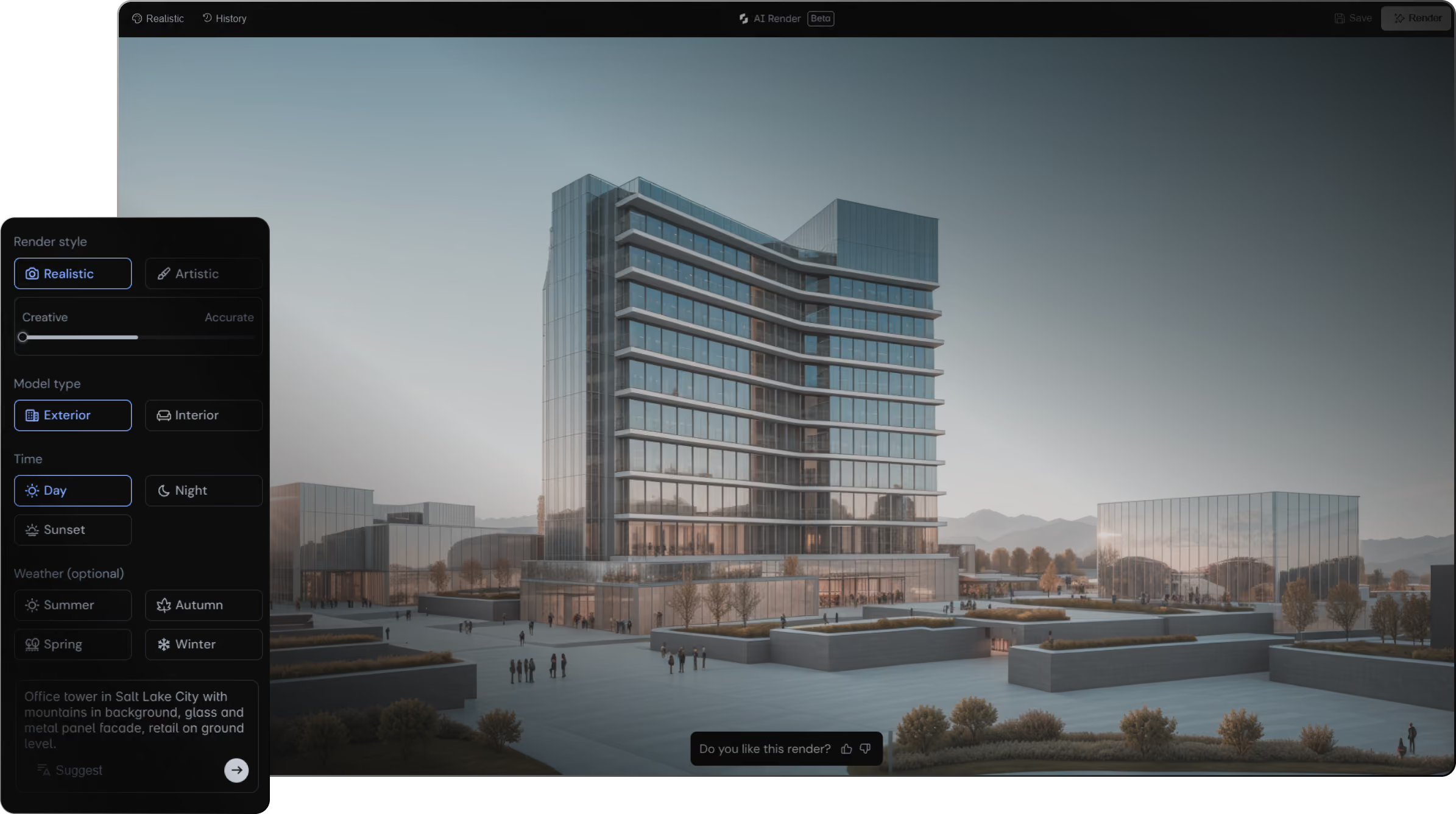
Snaptrude is an AI-powered, cloud-native BIM design tool for architects and in 2026 its AI capability goes significantly further than floor plan generation. Snaptrude runs a full stack of specialised AI agents that can take a project from raw input all the way through to a fully developed BIM model.
The pipeline works like this. Feed Snaptrude an RFP, a brief, or even a plain-text prompt and its agents get to work in sequence: the site analysis agent reads site boundaries, orientation, and constraints; the zoning analysis agent interprets applicable zoning regulations and setback requirements; the envelope packing agent fits the programme into the compliant building envelope; the code compliance agent checks layouts against building codes throughout the process; the program import agent ingests a schedule of accommodation or department list directly; the adjacency analysis agent maps spatial relationships between departments or functions and optimises proximity; the space planning agent allocates and sizes rooms within the envelope; and the floor plan generation agent produces complete, editable BIM floor plans ready for design development.
The result is that a project that would take a design team days to block out at schematic stage — site-to-envelope to compliant floor plans can be produced in hours. This is not an AI assistant making suggestions. It is an AI stack doing the early-stage design work end-to-end, with the architect reviewing, editing, and directing at each stage.
All of this is accessible on the free plan. The limitations are around team size and advanced construction documentation features. For design exploration, feasibility studies, and schematic design from an RFP, the free tier is fully capable.
2. Autodesk Revit with ACC: Best Cloud-Enabled BIM for Large Projects
Revit with Autodesk Construction Cloud (ACC) is the most widely deployed cloud-enabled BIM system in the industry. It provides centralised model storage, desktop-based Worksharing, and coordination workflows across large project teams. Its BIM 360 Docs, Navisworks integration, and cross-discipline coordination tools are the most mature in the category.
The limitation is that it requires Revit desktop on each user's machine, a Worksharing-enabled central model, and a structured sync process. Collaboration is sequential (checkout/checkin) rather than simultaneous. For large, complex construction projects with dozens of consultants, this structure is manageable. For smaller design-phase teams needing real-time iteration, it adds overhead.
3. Graphisoft BIMcloud: Best Cloud-Enabled BIM for Design Practices
BIMcloud is Graphisoft's cloud server for ArchiCAD collaboration. It enables simultaneous editing across a team without the full Revit/ACC complexity, making it more accessible for smaller practices than Autodesk's enterprise infrastructure. Real-time multi-user work in ArchiCAD via BIMcloud is genuinely good - better than Revit Worksharing for smaller teams.
BIMcloud is hosted on Graphisoft's infrastructure (subscription) or on a firm's own server, which adds IT overhead that pure cloud-native tools do not require.
4. Trimble Connect: Best for Cross-Platform Cloud Coordination
Trimble Connect is a cloud collaboration platform that aggregates models from SketchUp, Tekla, and other Trimble tools into a single coordination environment. It is not a BIM authoring tool, but it is a strong cloud coordination layer for firms in the Trimble ecosystem. IFC-based model viewing, issue tracking, and clash detection are available in the browser.
Cloud BIM Software Comparison 2026
Cloud BIM Software Comparison 2026
| Software | Cloud Type | Real-Time Multi-User | Browser Viewing | AI Features | Price/yr |
|---|---|---|---|---|---|
| Snaptrude | Cloud-native | Yes | Yes (full editing) | AI floor plans | Free / ~$500+ |
| Revit + ACC | Cloud-enabled | No (Worksharing) | View only | Generative (add-on) | $2,950 + ACC |
| ArchiCAD + BIMcloud | Cloud-enabled | Partial | View only | Limited | $980–$2,390 + BIMcloud |
| Trimble Connect | Cloud coordination | View/markup only | Yes | None | Subscription |
Related reading
- Why AI Architecture Software Needs Cloud-Native Tools
- Best BIM Collaboration Tools 2026: What Actually Works When Your Team Is Distributed
- Best BIM Software for Architects 2026: Not All BIM Is Designed for Design
- How to Evaluate BIM Software: Complete Guide to the Architecture Firm's 4-Phase Process
Frequently Asked Questions
What is cloud-native BIM software?
Cloud-native BIM software is a BIM platform designed from the ground up to run in the cloud - where models are stored, edited, and shared entirely through a web browser without a desktop application. Snaptrude is the leading cloud-native BIM tool in 2026. Cloud-enabled tools like Revit use the cloud for storage but still require a desktop application for modelling.
Is Revit cloud-based?
Revit is cloud-enabled - it can store models in Autodesk Construction Cloud and supports team collaboration via Worksharing. It is not cloud-native: Revit requires a desktop application and does not support simultaneous multi-user live editing without Worksharing setup.
What is the best cloud BIM for small teams?
Snaptrude is the best cloud BIM for small teams - it provides real-time multi-user collaboration, browser-based client review, and AI-assisted design with no infrastructure setup. ArchiCAD with BIMcloud is a good alternative for teams committed to ArchiCAD's workflow.
Conclusion
Cloud BIM in 2026 means different things depending on the vendor. Snaptrude's cloud-native architecture - real-time simultaneous editing, browser-based client access, no desktop install - represents what cloud BIM should be. Revit and ArchiCAD with their respective cloud infrastructure are cloud-enabled, which is meaningfully different. For teams where distributed, real-time collaboration is a primary need, the distinction determines which tool to choose.