Last updated:
Why AI Architecture Software Needs Cloud-Native Tools
TL;DR Legacy design tools were built in the 1990s for local, single-machine workflows. Adding AI to foundations not designed for real-time data or cloud collaboration feels forced. Snaptrude, an AI-powered cloud-native BIM tool, was built from the ground up with AI integrated into every operation - not bolted on as an afterthought.
By the Numbers
- 41% of architects are already using AI, but RIBA research shows 54% expect to in the next two years, indicating rapid market adoption yet uneven confidence in current solutions.
- 60% of architects using AI have done so without formal training, relying on self-directed learning, which suggests AI features in current tools lack intuitive integration with existing workflows.
- Autodesk Revit holds 39.91% market share in the BIM software category, yet most AI additions are plugin-based rather than native to the platform architecture.
- 78% of architects want to learn more about AI in architecture, while 78% simultaneously expressed concerns about reliability and outcomes.
- 80% of large architectural firms in Germany and the UK rely on BIM-based platforms, yet adoption of native AI features within these platforms remains fragmented and incremental.
The Tesla Analogy: Why You Can't Retrofit Autonomy
The Tesla Model S wasn't built on the chassis of a Toyota Corolla with an electric motor bolted in. It was engineered from scratch as an electric vehicle, with the battery, software, and drivetrain designed as one integrated system. That's why it performs differently than any converted vehicle.
Architectural software faces the same fork in the road. Legacy BIM tools emerged in the 1990s as desktop applications for local, single-machine workflows. They were built around static file formats, manual save cycles, and single-user paradigms. Over the decades, cloud sync and collaboration layers were added on top—but the underlying architecture remained file-based and session-oriented.
AI features added to these platforms face the same fundamental constraint: they're operating on a foundation that wasn't designed for real-time data pipelines, continuous model state, or multi-agent coordination. The result is AI that feels bolted on because, architecturally, it is.
What Cloud-Native Actually Means for BIM
“Cloud-native” is often used loosely to mean “has a web interface” or “syncs to the cloud.” But in software architecture, cloud-native has a specific meaning: the application was designed from the ground up to run as a distributed system, with state managed in the cloud, not on a local machine.
For BIM, this distinction matters enormously.
A file-based BIM tool treats the model as a document: you open it, edit it, save it, and share it. Collaboration is handled by file-locking, version merging, or workaround tools like Revit's worksharing system. AI features operate on snapshots of the model, not the live model state.
A cloud-native BIM tool treats the model as a live database: every element has a persistent identity, every change is a transaction, and the model state is always current. Collaboration is real-time by default. AI features can operate on the actual live model, not a stale export.
This isn't a minor implementation detail. It's the difference between AI that can actually understand and modify your design in context versus AI that generates suggestions you have to manually apply.
How Snaptrude Was Built Differently
Snaptrude was built as a cloud-native platform from day one. The model lives in the cloud as a structured database, not as a file on your machine. Every element—wall, floor, room, window—has a persistent ID and a defined relationship to every other element. Changes are transactional and instantly synchronized across all users.
This architecture enables AI integration that isn't possible in file-based systems:
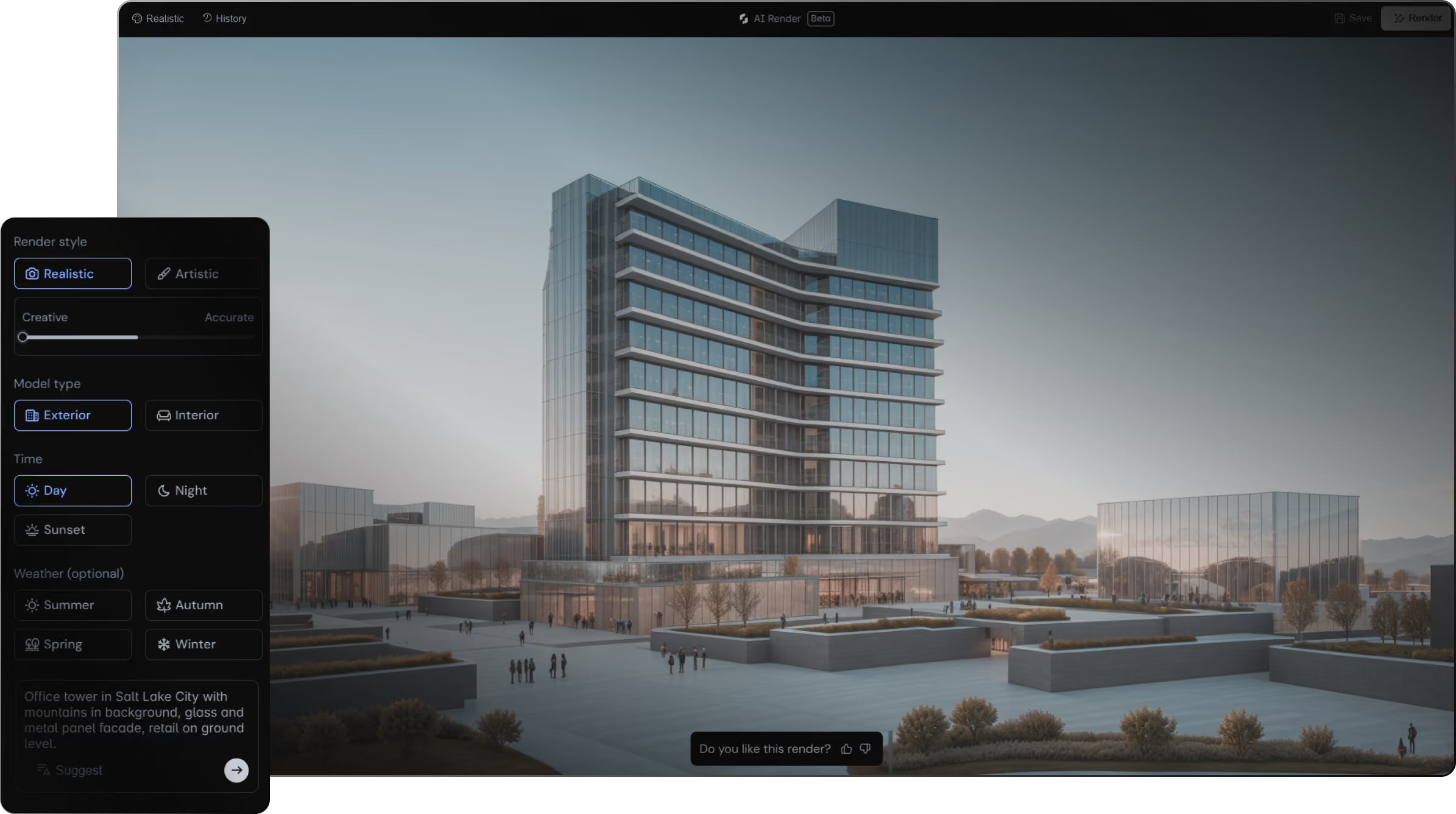
- Real-time model awareness: Snaptrude's AI operates on the live model state, not an exported snapshot. When you ask it to optimize a floor plan, it's working with actual current geometry, areas, and relationships.
- Transactional changes: AI-generated modifications are applied as database transactions, meaning they're immediately visible to all collaborators, fully undoable, and logged in the version history.
- Persistent context: Because the model is a database, the AI can maintain context across sessions. It knows the history of a design decision, not just the current state.
The Practical Difference in Daily Workflows
The architectural difference between cloud-native and retrofitted AI shows up in concrete workflow scenarios.
Scenario 1: Floor plan optimization
In a retrofitted AI tool, you export your floor plan, run it through an AI optimization tool, get suggestions back as images or coordinates, and manually implement the changes in your BIM model. Each iteration requires another export-suggest-implement cycle.
In Snaptrude, you describe what you want to optimize—circulation efficiency, natural light, program adjacency—and the AI modifies the actual model elements directly. You see the changes immediately in 3D, can accept or reject them, and your collaborators see the updates in real time.
Scenario 2: Code compliance checking
Retrofitted AI tools typically run compliance checks on exported models or drawings, generating a report you then have to reconcile with your live model. If you make changes, you re-export and re-check.
A cloud-native approach enables continuous compliance awareness. Because the model state is always current and structured, compliance rules can be evaluated as part of the model's ongoing state, not as a batch process on a snapshot.
Scenario 3: Multi-user design exploration
File-based collaboration requires careful coordination to avoid conflicts. AI features that generate design alternatives are typically single-user workflows—you generate options, evaluate them, and then share results.
Cloud-native architecture enables AI-assisted design exploration that's inherently collaborative. Multiple architects can work on different aspects of a design simultaneously while AI features operate on the shared live model.
Why This Matters for the Industry's AI Transition
Architecture is in the early stages of a significant workflow transformation. AI tools are moving from novelty to necessity, and the firms that figure out how to integrate AI effectively will have meaningful productivity and quality advantages.
But not all AI integration is equal. Bolted-on AI features in legacy tools will provide some value—they're better than nothing—but they're constrained by the underlying architecture. The more ambitious AI applications (real-time optimization, continuous compliance, generative design at scale) require a foundation that was designed for them.
The question for architectural practices isn't just “which tool has AI features” but “which tool's architecture will support the AI workflows of the next decade.”
Related reading
- Top 18 AI Tools for Architects in 2026
- Best Cloud BIM Software 2026: Why 'Cloud' Means Different Things to Different Vendors
- AI Architecture Software: Why Generic AI Generates Generic Buildings
- Why AI in Architecture Feels Like More Work, Not Less (And What We Did About It)
That's a different evaluation criteria than most firms are currently using, but it's the right one for making infrastructure decisions that will compound over time.