Last updated:
The double data entry tax: Why architecture firms maintain two models during schematic design
TL;DR: Architecture firms rarely choose between Revit vs SketchUp. They run both tools at the same time, alongside Excel program spreadsheets, creating a triple-redundancy workflow that eats 15-20 hours per week in manual reconciliation. The real cost is not the software licences. It is the design exploration that never happens because teams are too busy keeping models in sync.
By the numbers
- The global construction and engineering industry loses more than $177 billion annually to rework, with 22% of that rework directly traceable to inaccurate or inaccessible project information, according to a joint study by PlanGrid and FMI Corporation.
- Autodesk Revit holds 37.63% market share in the BIM and architectural design software category, making it the dominant platform in the sector, per 6sense technology intelligence data.
- Trimble SketchUp surpassed one million active subscribers in November 2024, confirming that SketchUp operates at significant scale alongside Revit in the AEC market.
- Construction professionals spend more than 14 hours per week on non-optimal activities such as searching for files, resolving formatting conflicts, and reconciling outdated documents, according to Autodesk's Connected Construction report drawing on FMI research.
- BIM adoption reduces design errors by 50-60% and rework costs by 40-50% compared to fragmented workflows, per a 2024 research study published on ResearchGate examining BIM's impact on project time and cost.
What does the Revit vs SketchUp debate actually look like in practice?
The Revit vs SketchUp debate gets the problem wrong. Most architecture firms do not choose one tool over the other. They use both, simultaneously, for different purposes at different stages of the same project.
The result is not a clean workflow. It is a fragmented parallel-track system where the same information lives in three places at once: a SketchUp massing model, an Excel program spreadsheet, and a Revit model that is perpetually catching up with the other two. The BIM software evaluation process for architecture firms starts with understanding exactly this fragmentation problem.
This is not a niche inefficiency. It is the default operating mode for the majority of practices in North America and Europe. And it carries a cost that most firms absorb without ever putting a number on it.
The IT Director of a Canadian architecture firm described it bluntly: "For architecture projects we often, well, we used to do conventional methods for programming. Like checking out using Excel sheets and kind of labeling it and checking if all the areas, the program areas are matching."
That sentence describes a reconciliation loop. Program data in Excel, geometry in SketchUp, documentation in Revit. Update one, and the other two fall out of sync immediately. Every design iteration triggers a manual update cycle across all three environments. That cycle is the double data entry tax.
Why do architecture firms run SketchUp and Revit at the same time?
Each tool solves a different problem well. Neither solves both.
SketchUp is fast. Architects use it for early massing studies because the interface rewards speed and intuition. You can test five different massing configurations in the time it takes to set up a single Revit family. That low friction makes it genuinely useful for schematic design exploration, client presentations, and quick site studies.
Revit is rigorous. It produces the coordinated documentation, schedules, and parametric data that the rest of the project delivery process requires. Consultants, contractors, and planning authorities all expect Revit deliverables from a certain project scale upward. You cannot cut it from the workflow without losing the data structure the rest of the project depends on.
So firms run both. A project architect sketches massing in SketchUp, refines it through several client review cycles, then hands geometry to a BIM coordinator who recreates the building from scratch in Revit. Meanwhile, the program spreadsheet in Excel has been updated twice during client reviews. None of those updates show up in either model automatically.
The recreation step is where the double data entry tax becomes visible. And it is not a one-time cost at project handoff. It recurs every time the design changes, which in schematic design happens constantly.
How much time does the double data entry tax actually cost?
The 15-20 hours per week figure that practitioners commonly cite covers a cluster of related activities: manual geometry recreation in Revit, area schedule reconciliation against the Excel program, coordination calls to identify which version of the model is current, and rework to correct errors introduced during the translation between tools.
That estimate aligns with broader industry research. FMI Corporation found that construction professionals spend more than 14 hours per week on non-optimal activities, a figure that holds specifically for project teams managing disconnected data environments. For architecture firms where the disconnection begins at the design stage, the weekly cost is likely higher.
Translated to annual cost: 15 hours per week at a blended billing rate of $150 per hour is roughly $117,000 per year, per project team, in unrecoverable time. Time that cannot be billed, reinvested in design quality, or redirected to business development.
But the less obvious cost is design exploration. When a project team knows that every design change triggers a multi-hour manual reconciliation cycle across SketchUp, Excel, and Revit, the rational response is to reduce the number of design iterations. Options that should be tested never get explored. Alternatives that might produce a better outcome for the client never reach the table because the operational cost of exploring them is too high.
That is the second tax that fragmented Revit vs SketchUp workflows impose: a constraint on creativity that does not show up in project accounting but is real in design outcomes.
What is the real problem with using Excel for program management?
Excel is not the problem in isolation. The problem is that Excel exists as a separate silo from the 3D model. When program data lives in a spreadsheet and geometry lives in a SketchUp or Revit file, the two representations of the same project are structurally disconnected.
Say the client increases the gross floor area target for Level 3 offices by 200 square metres. That change requires manual updates in at least three places: the Excel schedule, the SketchUp massing model (if it is still active), and the Revit model. If those updates happen sequentially rather than simultaneously, there is always a window where the models disagree. In a busy practice, that window can last days or weeks.
The Canadian IT Director's description captures what this looks like in day-to-day work: teams spending hours checking whether area totals in the spreadsheet match the areas in the model, labeling discrepancies, and working backward to identify which source is correct. This is not value-adding work. It is reconciliation labor created entirely by the structural separation between program data and geometry.
Architecture programs are not static documents. They change through client reviews, planning feedback, cost management exercises, and design development. Each change runs through the reconciliation loop again. Optimizing the Revit workflow during schematic design is one approach, but it does not kill the spreadsheet silo.
See how Snaptrude handles bidirectional program sync and eliminates the double data entry loop from the first day of schematic design.
Does BIM software solve the Revit vs SketchUp problem on its own?
Not automatically. The common assumption is that adopting Revit fully, retiring SketchUp from the early design workflow, solves the fragmentation problem. In practice, this assumption fails for two reasons.
First, Revit's interface penalizes early-stage exploration. The parametric model structure that makes Revit powerful in later design stages makes it slow and resistant to the kind of rapid, iterative massing work that schematic design requires. Architects who try to use Revit as their primary tool from day one report that the interface friction suppresses design iteration, pushing them toward premature commitment to their initial massing decisions. Anyone who has tried to do quick massing studies in Revit knows the feeling.
Second, Excel rarely disappears from program management even in Revit-first firms. Revit's scheduling tools produce area schedules, but the program itself, the client's requirement list with targets, priorities, and commentary, lives in a spreadsheet outside Revit. Keeping that spreadsheet in sync with the Revit model requires the same manual reconciliation loop, just without SketchUp in the mix.
The BIM software market is growing in response to these limitations. The global BIM market was valued at USD 9.12 billion in 2025 and is projected to reach USD 27.12 billion by 2034, at a CAGR of 12.90%, driven in significant part by demand for tools that reduce coordination overhead (Fortune Business Insights). That kind of growth does not happen in markets where the status quo works. Understanding architectural programming and area management helps firms quantify how much the double data entry tax is actually costing them.
How does Snaptrude eliminate the Revit vs SketchUp problem?
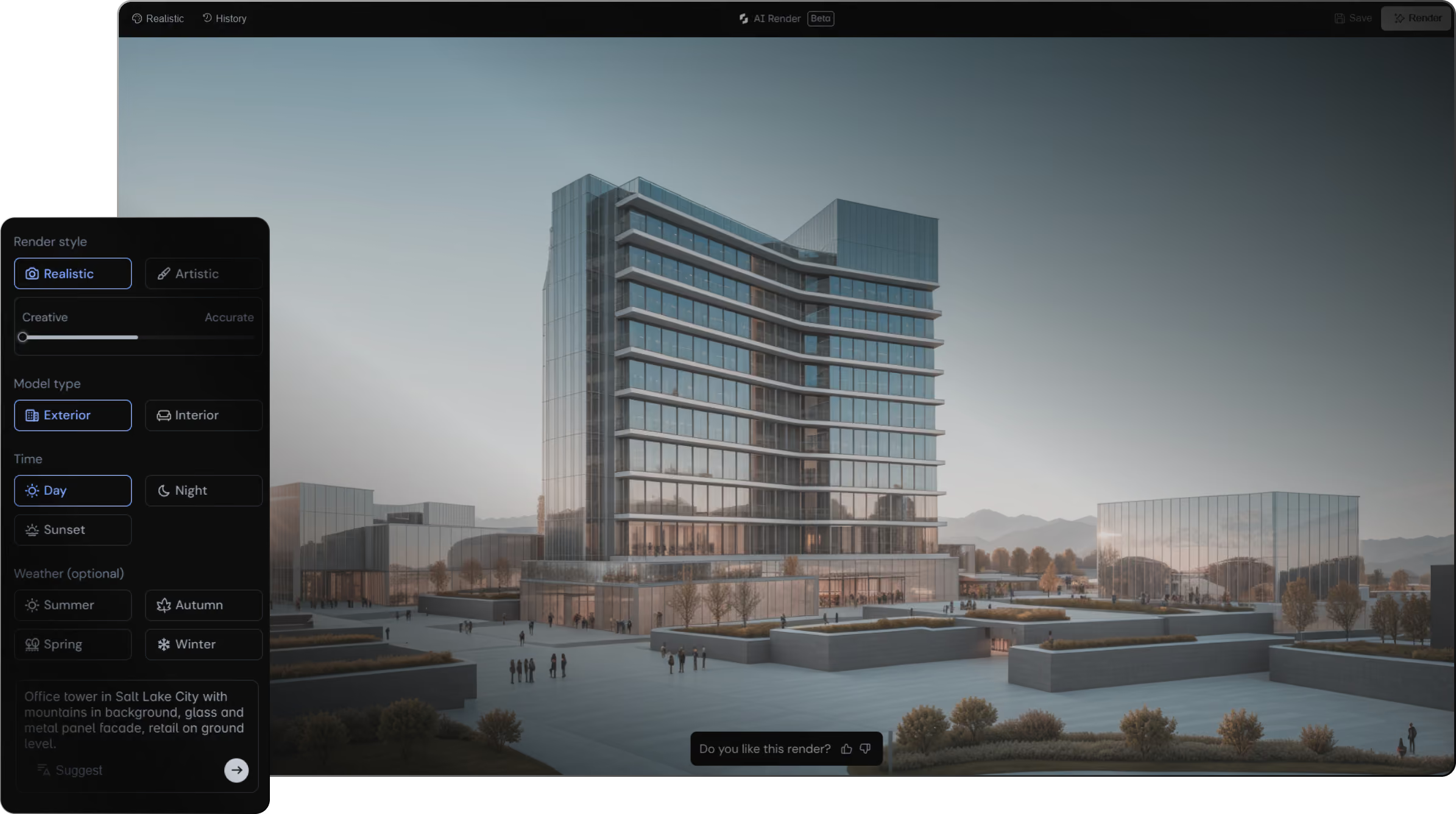
Snaptrude, an AI-powered, cloud-native BIM design tool, is built around a different premise: program data, 3D geometry, and documentation should stay synchronized from day one of schematic design, not reconciled manually after the fact.
In a Snaptrude workflow, room sizes updated in a linked spreadsheet regenerate the 3D model automatically. Design iterations made in the 3D environment immediately update area schedules and program comparisons. The SketchUp-style fluidity that architects need for early massing exploration is available within the same environment that produces Revit-compatible BIM output. There is no handoff moment where geometry has to be recreated from scratch in a different tool, because the geometry was never in a different tool to begin with.
The practical outcome is that the double data entry tax goes away. Teams spend the hours they used to lose to reconciliation on design work instead. The design exploration that never happened because of operational cost becomes feasible because the cost has been removed.
For firms evaluating the Revit vs SketchUp question, Snaptrude reframes it: the choice is not which tool to use for which phase, but whether you want a workflow where phases are disconnected from each other at all.
How do Revit, SketchUp, and Snaptrude compare?
| Feature | Revit | SketchUp | Snaptrude |
|---|---|---|---|
| Early massing speed | Slow (high setup overhead) | Fast (intuitive interface) | Fast (cloud-native, low friction) |
| BIM output quality | High (industry standard) | Low (not a BIM tool) | High (Revit-compatible export) |
| Program / area sync | Manual (schedules only) | None (no data model) | Automatic (bidirectional sync) |
| Design iteration speed | Low | High | High |
| Excel / spreadsheet integration | Manual import | None | Bidirectional live link |
| Collaboration | File-based (VPN / BIM 360) | File-based or Trimble Connect | Real-time cloud collaboration |
| Learning curve | Steep | Shallow | Moderate |
| Best fit | Documentation and CDs | Concept and massing | Schematic design through DDs |
| Handles full project lifecycle | Yes, with add-ons | No | Yes |
| Eliminates double data entry | No | No | Yes |
Frequently asked questions
Q: Is Revit better than SketchUp for architecture?
A: Neither tool is universally better; they serve different purposes. Revit is the industry standard for BIM documentation, coordination, and parametric data management. SketchUp is faster for early massing exploration and concept visualization. Most firms run both in parallel, which creates a costly reconciliation loop. Cloud-native BIM tools now offer a single environment that handles both stages without the translation overhead.
Q: Why do architects use SketchUp if they already have Revit?
A: Revit's interface is optimized for parametric, data-rich modeling, which makes it slow for the rapid iteration schematic design demands. SketchUp's simpler interface lets architects test multiple massing configurations quickly. The tradeoff is that SketchUp produces no BIM data, so any geometry must be manually recreated in Revit. That recreation step is the core of the double data entry tax that fragments most architecture firm workflows.
Q: How many hours per week does the Revit vs SketchUp workflow waste?
A: Architecture teams running parallel SketchUp, Excel, and Revit workflows typically report 15 to 20 hours per week lost to manual reconciliation: geometry recreation, area schedule cross-checking, version control, and coordination calls. This aligns with FMI Corporation's finding that construction professionals lose more than 14 hours weekly to non-optimal information management. For design teams, the less visible cost is the design exploration that never happens because of this overhead.
Q: Does switching from SketchUp to Revit solve the data synchronization problem?
A: Partially, but not completely. Retiring SketchUp removes one layer of the reconciliation loop, but the program spreadsheet in Excel typically persists as a separate data silo. Revit produces area schedules, but the client-facing program document with targets and priorities still lives outside the model. Manual reconciliation between Revit and Excel continues unless the firm adopts a platform that integrates spreadsheet data directly with the 3D model.
Q: Do small architecture firms really need BIM software, or is SketchUp sufficient?
A: For projects above a certain scale or complexity, BIM deliverables are increasingly required by clients, contractors, and planning authorities, making SketchUp alone insufficient. But a full Revit workflow carries disproportionate overhead for small firms: steep licensing costs, training demands, and IT infrastructure. Cloud-native BIM tools are designed to give small practices BIM capability without that burden, which is why only 25% of small and medium firms currently use integrated software suites.
Q: What makes Snaptrude different from Revit and SketchUp for schematic design?
A: Snaptrude, an AI-powered, cloud-native BIM design tool, is built around continuous synchronization: program data, 3D geometry, and documentation stay linked from day one of schematic design. Unlike Revit, Snaptrude's interface is low-friction enough for rapid massing exploration. Unlike SketchUp, it produces Revit-compatible BIM output directly. There is no handoff moment where geometry must be recreated in a separate tool, so the double data entry tax goes away entirely.
Q: How does Snaptrude handle the Excel program spreadsheet problem?
A: Snaptrude connects the program spreadsheet directly to the 3D model through bidirectional sync: a room size updated in the linked spreadsheet automatically regenerates the relevant geometry, and adjusting geometry updates the area schedules instantly. This eliminates the structural disconnection between data and model that forces manual reconciliation in fragmented Revit and SketchUp workflows. Teams reclaim the hours previously lost to cross-checking and redirect them to design.