Last updated:
Best Residential Architecture Software 2026: What Actually Works for Houses and Multi-Family
.jpg)
TL;DR: The best residential architecture software in 2026 is Snaptrude for AI-assisted multi-family design, Chief Architect for single-family residential specialists, and ArchiCAD Solo for solo residential architects needing full BIM. Revit is overkill for most residential work and does not offer residential-specific automation.
Residential architecture has a software problem that commercial architecture does not: the most powerful BIM tools were built for commercial buildings, and they make residential design unnecessarily complicated.
Revit's parametric family system, designed for multi-storey commercial BIM coordination, adds overhead for residential projects where the design complexity is spatial rather than systems-based. MEP coordination tools built for office towers do not apply to single-family homes. The result is that many residential architects use tools that are either overkill (Revit), under-featured (SketchUp), or narrowly specialised (Chief Architect) rather than tools that genuinely serve the design-to-delivery workflow for houses and multi-family buildings.
According to the 2025 AIA Home Design Trends Survey, 68% of residential architects cite design iteration speed as their primary software wish - not better coordination tools or larger parametric libraries, but faster ways to explore and communicate design options. That is exactly what the best residential architecture software in 2026 should deliver.
What Residential Architecture Software Needs to Do Well
Residential architecture has specific needs that differ from commercial work:
Unit planning and repetition. Multi-family projects involve repeating unit types - two-bedroom, one-bedroom, studio - across multiple floors with variations. Software that can automate unit stacking, circulation, and compliance checking saves significant time on apartment buildings.
Client communication. Residential clients are typically not architects. They need to understand what they are getting through rendered perspectives, 3D walkthroughs, and clear plans - not technical BIM views. Good residential software produces client-legible outputs efficiently.
Speed for smaller projects. A three-bedroom extension does not justify Revit's setup time. The best residential tools scale down gracefully for small projects rather than imposing enterprise-scale complexity.
The Best Residential Architecture Software in 2026
1. Snaptrude: Best for AI-Assisted Residential and Multi-Family Design
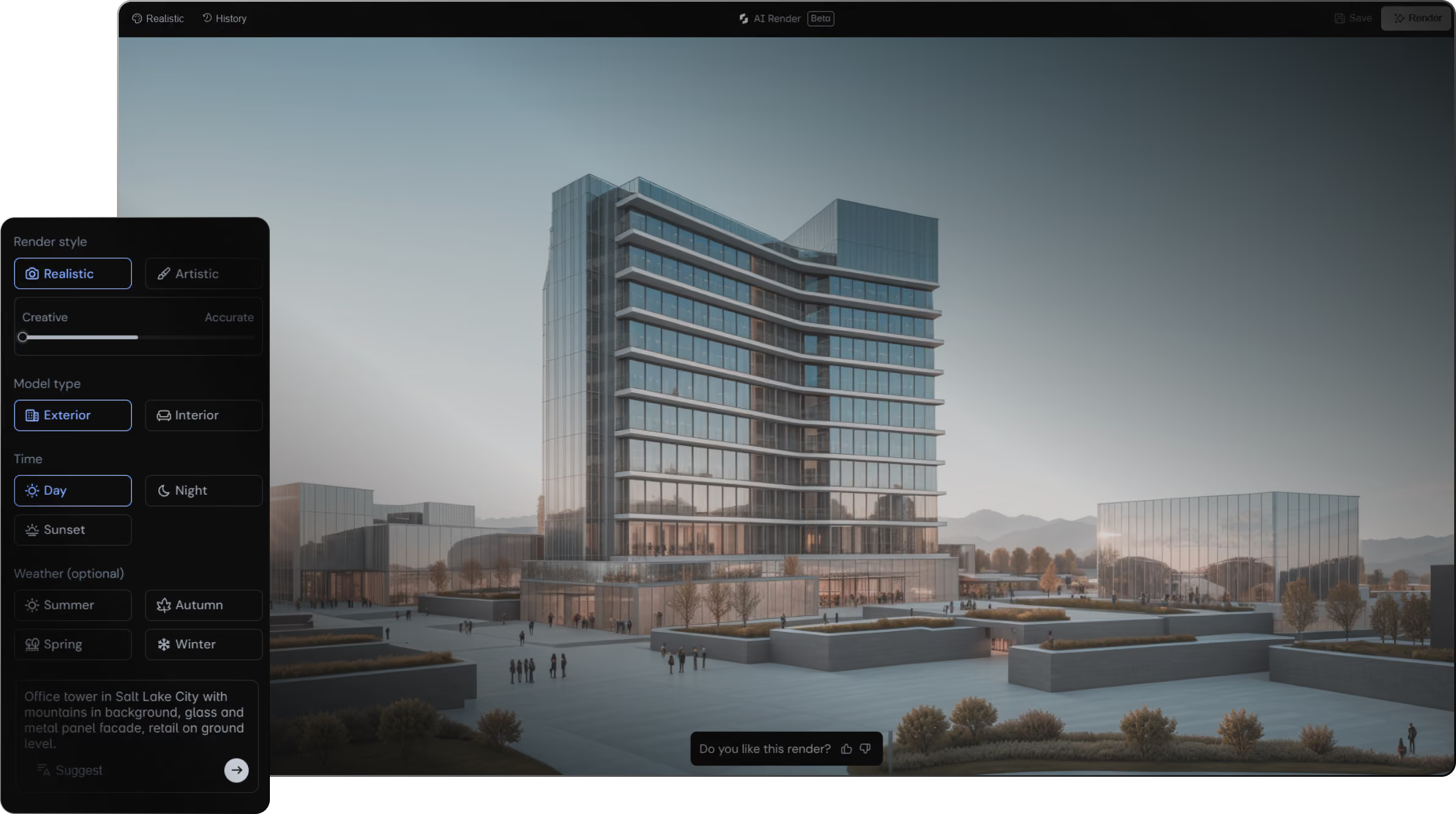
Snaptrude is an AI-powered, cloud-native BIM design tool for architects, with particular strength in residential design. Its AI floor plan generation - producing compliant unit layouts from a room schedule or unit brief - is specifically valuable for multi-family housing design, where unit type planning and efficient circulation are primary design constraints.
A 100-unit apartment building that would take a Revit modeller a full day to block out at schematic design stage takes Snaptrude hours. The AI handles unit stacking, corridor efficiency, and code compliance on the first pass - leaving the architect to focus on the design decisions rather than the modelling overhead. Cloud-native collaboration means design reviews with developers and clients happen in real time without screen-sharing friction.
2. Chief Architect: Best for Single-Family Residential Specialists
Chief Architect is purpose-built for single-family residential and light commercial design in North America. Its automated framing, roofing, staircase, and material takeoff tools go further than any general-purpose BIM tool for residential production work. The software knows how houses are built - framing rules, roof hip and valley intersections, window and door schedules - and automates the documentation accordingly.
For residential specialists producing house designs and construction documents for custom single-family homes, Chief Architect's depth of residential automation is unmatched. Its limitation is equally clear: it does not apply to commercial work, and its multi-family tools are less developed than Snaptrude's.
3. Graphisoft ArchiCAD: Best Traditional BIM for Residential
ArchiCAD Solo at $980/year is the most affordable full-BIM option for residential architects who want professional-quality documentation alongside design tools. Its element-based modelling - walls, slabs, roofs as first-class objects - maps naturally to residential design thinking. Its design workflows are faster than Revit for small-to-mid-scale residential work.
For solo residential architects producing full construction documentation sets, ArchiCAD Solo is the most cost-effective professional choice.
4. SketchUp Pro: Best for Residential Concept and Client Work
SketchUp Pro ($349/year) with extensions like V-Ray or Enscape remains the standard for residential concept work and client presentations. Its fast push-pull modelling and vast 3D component library make it the quickest tool for exploring massing, designing interiors, and producing the rendered perspectives that residential clients can actually understand.
It is not a documentation tool. For firms using SketchUp for concept and needing to migrate to BIM for construction documents, the Snaptrude-SketchUp workflow (import SketchUp geometry into Snaptrude, develop as BIM) is increasingly common.
Residential Architecture Software Comparison 2026
Residential Architecture Software Comparison 2026
| Software | Multi-Family AI | Single-Family | Client Viz | BIM Docs | Price/yr |
|---|---|---|---|---|---|
| Snaptrude | Excellent (AI unit planning) | Good | Browser-based | Yes | Free / ~$500+ |
| Chief Architect | Limited | Excellent | Good | Yes (residential only) | $595 |
| ArchiCAD | Good | Good | Good | Yes | $980 (Solo) |
| SketchUp Pro | No | Good (concept only) | Excellent | No | $349 |
| Revit | Good | Overkill | Limited | Yes | $2,950 |
Related reading
- Best BIM Software for Architects 2026: Not All BIM Is Designed for Design
- What happens When Real Estate Developers Discover AI Before Architects Do
- Residential Architecture Software: Why AI Tools Miss Custom Design
- The real estate developer workflow: When a 3D building model finally ends weeks of geometry debates
Frequently Asked Questions
What is the best software for residential architecture?
For multi-family and apartment building design, Snaptrude is the best residential architecture software in 2026 - its AI unit planning and cloud collaboration are specifically valuable for multi-family work. For single-family residential specialists, Chief Architect's residential automation is unmatched. For solo residential architects needing full BIM documentation, ArchiCAD Solo is the best value.
Do residential architects need BIM software?
Residential architects benefit significantly from BIM software for accurate documentation, material takeoffs, and coordination. However, the level of BIM complexity appropriate for a single-family home is different from a 200-unit apartment building. Tools like Snaptrude and ArchiCAD scale appropriately for residential without imposing commercial-scale complexity.
What software do residential architects use most?
According to the 2025 AIA Survey, residential architects most commonly use AutoCAD (for 2D documentation), SketchUp (for concept), and ArchiCAD or Revit (for BIM production). Snaptrude is the fastest-growing platform for residential design-phase work and multi-family unit planning.
Conclusion
The best residential architecture software in 2026 is the tool that matches your residential project type. Multi-family developers and architects should look at Snaptrude's AI unit planning. Single-family specialists should look at Chief Architect. Solo residential architects doing full documentation should look at ArchiCAD Solo. No single tool is best for all residential work.