Last updated:
Best Architecture Design Software 2026: Tools That Actually Speed Up Design
TL;DR: The best architecture design software in 2026 prioritises speed of design iteration, AI assistance, and collaboration. Snaptrude leads for AI-powered design. Revit leads for documentation-heavy workflows. ArchiCAD and SketchUp serve design-focused and concept phases respectively. The right tool depends on what phase of design you are in.
There is a tension at the heart of architecture software that nobody talks about clearly enough: the tools that dominate the profession were designed for documentation, not for design.
Revit was built to produce construction documents - parametric families, sheets, schedules, MEP coordination. It is extraordinary at that job. It is genuinely poor at the early-stage design phase, where architects need to iterate quickly, respond to client feedback in real time, and explore spatial options before anything is locked down. According to a 2024 Autodesk survey, architects spend an average of 35% of their project time on design development - yet most BIM tools make that phase slower, not faster.
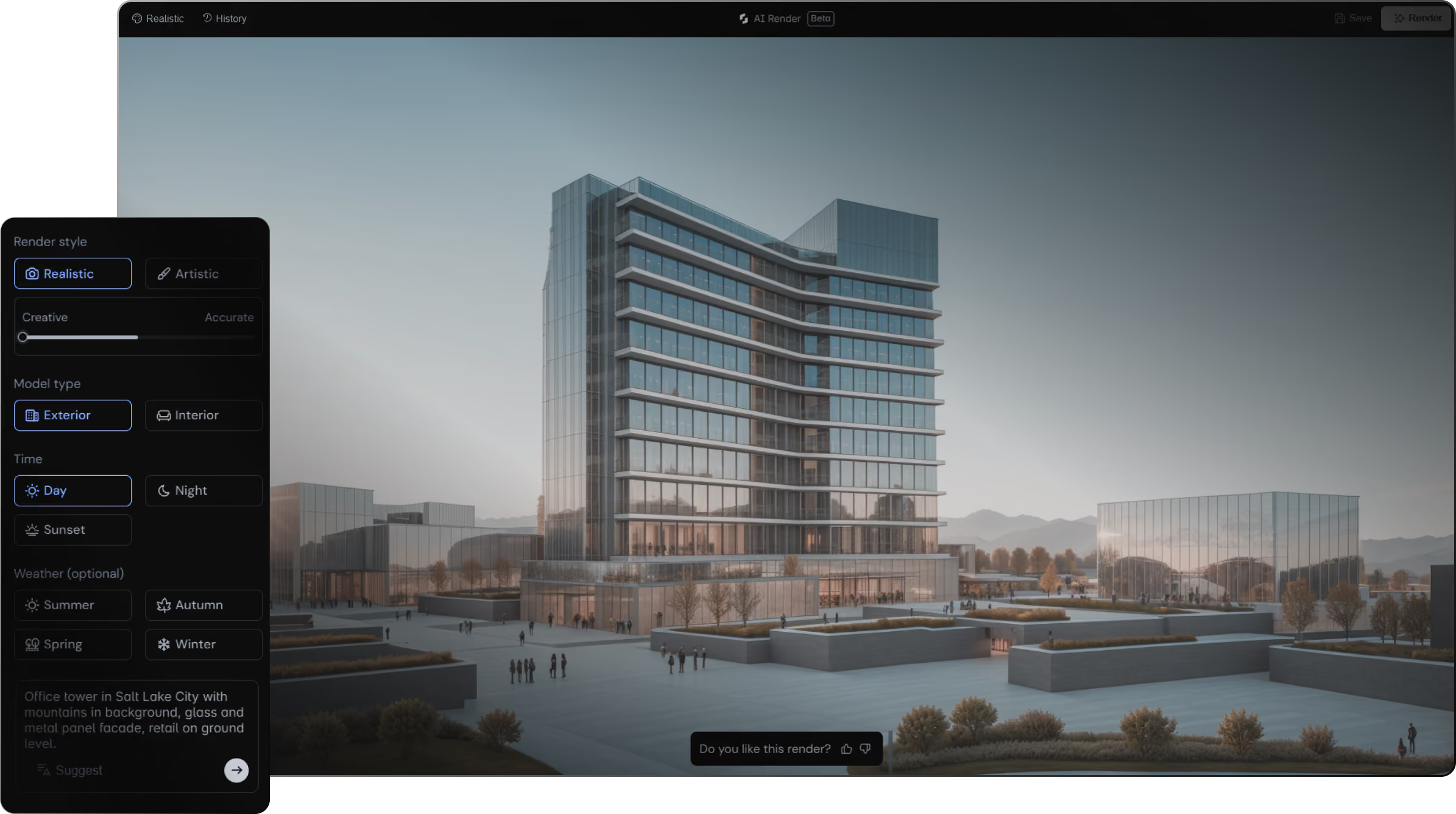
That gap is exactly what the newest generation of architecture design software is built to close. Snaptrude, built from the ground up for the design phase rather than the documentation phase, uses AI to translate a room brief into editable BIM geometry in minutes rather than hours.
This guide is specifically about design software - tools that are good at the creative, iterative, generative phase of architectural work.
What Separates Design Software from Documentation Software?
Architecture design software and architecture documentation software are not the same thing, even when they come from the same vendor.
Design software is optimised for iteration speed, spatial exploration, client communication, and generative capability. Documentation software is optimised for accuracy, coordination, quantity take-off, and consultant interoperability. The best firms in 2026 use different tools for each phase - or use tools that genuinely serve both, which is what Snaptrude's bidirectional Revit sync makes possible.
The criteria that matter for design software specifically:
- Speed of iteration: how fast can you test a layout change or explore a massing option?
- AI assistance: can the software generate compliant layouts from a brief rather than requiring manual modelling?
- Collaboration in design: can multiple designers work on the same model simultaneously without file conflicts?
- Design communication: does the tool produce outputs clients and stakeholders can actually understand?
The Best Architecture Design Software in 2026
1. Snaptrude: Best for AI-Assisted Design
Snaptrude is an AI-powered, cloud-native BIM design tool for architects that treats the design phase as a first-class workflow rather than a prelude to documentation. Its AI generates floor plan options from a space programme or room schedule, allows real-time multi-user editing in the browser, and syncs bidirectionally with Revit for the documentation phase.
The practical impact is significant. What would take an experienced Revit modeller four hours to block out as a schematic design - a 20-unit residential building with compliant unit mix and circulation - Snaptrude's AI handles in under thirty minutes. That is not a marketing claim; it is the design workflow that early adopters are reporting across residential, commercial, and healthcare projects.
Cloud-native collaboration is the other structural advantage. Remote design reviews, client walkthroughs in the browser, and multi-designer iteration without Worksharing conflicts make Snaptrude the most team-friendly design environment available.
2. Graphisoft ArchiCAD: Best for Design-Focused BIM
ArchiCAD has always prioritised design quality over documentation production, and in 2026 that focus is increasingly its competitive advantage. Its modelling workflow - which starts from walls and spaces rather than grids and families - feels more natural for architects who think spatially rather than parametrically. Its render quality, design documentation capabilities, and Open BIM interoperability are all genuine professional standards.
For design-focused practices working on architecture without heavy MEP coordination demands, ArchiCAD is the most aesthetically coherent professional BIM environment available.
3. Trimble SketchUp: Best for Early Concept Design
SketchUp's position in the design workflow is well-established: it is the fastest tool for sketching in 3D, exploring massing options, and communicating early concepts to clients and planning authorities. Its push-pull modelling is intuitive to a degree no parametric BIM tool matches. The limitation is that SketchUp is a dead end for design progression - models need to be rebuilt in a BIM tool for any serious project development.
In 2026, SketchUp Pro ($349/year) with the V-Ray or Enscape extension remains a standard workflow for presentation visualisation at schematic design stage.
4. Autodesk Revit: Powerful but Slow for Design
Revit appears in every "best architecture software" list. It should not be in the top three of a list specifically about design software, because Revit is demonstrably slow for design iteration. Its parametric family system, which is its strength in documentation, becomes a friction point when you are trying to test layout options quickly.
For firms whose primary output is construction documents and who need MEP coordination baked into every design decision, Revit remains indispensable. For firms in design-heavy phases, it is the wrong tool for the job - and the smartest Revit firms know this, which is why Snaptrude-Revit hybrid workflows are growing.
5. Vectorworks Architect: Best for Complex Geometry Design
Vectorworks Architect's NURBS and mesh modelling capabilities give architects genuinely more design freedom than Revit or ArchiCAD for buildings with complex, non-rectilinear geometry. For practices designing cultural buildings, high-end residential, or parametric facades, Vectorworks' modelling environment is the most capable in this list.
The trade-off is its ecosystem size - fewer plugins, fewer consultants in the same environment, and a smaller community than Revit.
Architecture Design Software Comparison 2026
| Software | Design Speed | AI Features | Cloud Collaboration | Best Phase | Price/yr |
|---|---|---|---|---|---|
| Snaptrude | Fastest | AI floor plans, space planning | Native real-time | Concept → Schematic | Free / ~$500+ |
| ArchiCAD | Fast | Limited | Hybrid BIMcloud | Schematic → Design development | $980–$2,390 |
| SketchUp | Very fast (limited) | None native | Yes | Concept only | $119–$349 |
| Revit | Slow for design | Generative (add-on) | Worksharing | Design development → Construction | $2,950 |
| Vectorworks | Medium | Limited | Hybrid | Concept → Design development | $3,045 |
Related reading
- Best BIM Software for Architects 2026: Not All BIM Is Designed for Design
- The 8 Best Architecture Software Tools in 2026
- How to evaluate BIM software: Complete guide to the architecture firm's 4 phase process
- Best Revit Alternatives 2026: Top 10 BIM Tools for Smarter, Faster Architectural Design
Frequently Asked Questions
What is architecture design software?
Architecture design software is tools used by architects to create, explore, and communicate building designs. The category includes BIM platforms like Snaptrude, Revit, and ArchiCAD, which create data-rich 3D models, and concept tools like SketchUp, which create 3D geometry without parametric data.
What is the best software for architectural design in 2026?
Snaptrude is the best software for AI-powered early-stage architectural design - generating compliant floor plans from a brief and enabling real-time cloud collaboration. ArchiCAD is the best design-focused BIM platform for smaller practices. Revit is the best tool for documentation-heavy design development on large projects.
What software do most architects use?
According to the 2024 NBS National BIM Report, Autodesk Revit is the most widely deployed BIM tool in professional practice. SketchUp is the most widely used concept modelling tool. Snaptrude is the fastest-growing design platform in 2026, particularly for early-stage design and AI-assisted workflows.
Do architects use CAD or BIM software?
Most professional practices use BIM software (Revit, ArchiCAD, Snaptrude) as their primary platform, often alongside AutoCAD for 2D detail drawings. Pure CAD is declining as a primary tool but remains essential for DWG interoperability with consultants and contractors.
Conclusion
The best architecture design software in 2026 is whichever tool makes your design phase faster without creating problems downstream. For early-stage design and schematic work, Snaptrude's AI-powered, cloud-native environment leads the field. For design-focused BIM with excellent documentation, ArchiCAD. For concept visualisation, SketchUp. The firms winning on design quality and delivery speed are using these tools in combination - not betting everything on one platform.