Last updated:
The 8 Best Architecture Software Tools in 2026
.jpg)
TL;DR: The best architecture software in 2026 depends on your phase of work. Snaptrude leads for AI-powered early-stage design and cloud collaboration. Revit dominates construction documentation. ArchiCAD suits design-focused smaller practices. SketchUp works for concept modelling only. This guide explains when to use each.
There is a version of this conversation that happens in every architecture firm. Someone pulls up a project in Revit, spends twenty minutes waiting for the model to sync, and says - usually under their breath - there has to be a better way to do this. In 2026, there is. But the landscape of architecture software has also never been more fragmented, and the wrong choice costs real time and money.
According to a 2024 NBS National BIM Report, 73% of UK architecture practices now use BIM on at least some projects - up from 39% in 2011. The global picture is similar. Software is no longer optional infrastructure. But "BIM" covers everything from Revit to Snaptrude to ArchiCAD, and "architecture software" covers tools that have almost nothing in common beyond the profession that uses them.
This guide ranks the best architecture software available in 2026 by what actually matters to working architects: how fast you can design, how well it plays with the rest of your consultant chain, and whether the cost is justified by the output.
What Does "Best" Actually Mean for Architecture Software?
Before diving into rankings, it is worth being explicit about criteria - because the wrong criteria produce the wrong list.
BIM capability is the first gate. A tool either supports parametric 3D modelling with schedules, quantities, and IFC export or it does not. SketchUp does not. AutoCAD does not. That does not make them bad tools, but it means they serve a different purpose than a BIM authoring platform.
Cloud vs. desktop matters more than it did five years ago. According to Autodesk's 2025 State of Design & Make report, 62% of AEC professionals now work across at least two physical locations on a typical project. Desktop-first tools with file-based worksharing create bottlenecks that cloud-native platforms eliminate by design.
AI features are the newest differentiator and the fastest-moving. Automated floor plan generation, space planning from a brief, and generative design are shifting from novelty to workflow staple. By 2026, the gap between AI-assisted and non-AI tools is measurable in hours per project.
Total cost of ownership includes not just licence fees but onboarding time, plugin costs, hardware requirements, and the cost of switching. Revit's $2,950/year headline price looks different once you factor in the workstation upgrade, training, and BIM Manager salary.
The 8 Best Architecture Software Tools in 2026
The best architecture software tools in 2026 include Snaptrude, Autodesk Revit, Graphisoft ArchiCAD, Trimble SketchUp, Vectorworks Architect, Autodesk AutoCAD, BricsCAD BIM, and Chief Architect. Here is what each does well - and where each falls short.
1. Snaptrude: Best for AI-Powered Early-Stage Design
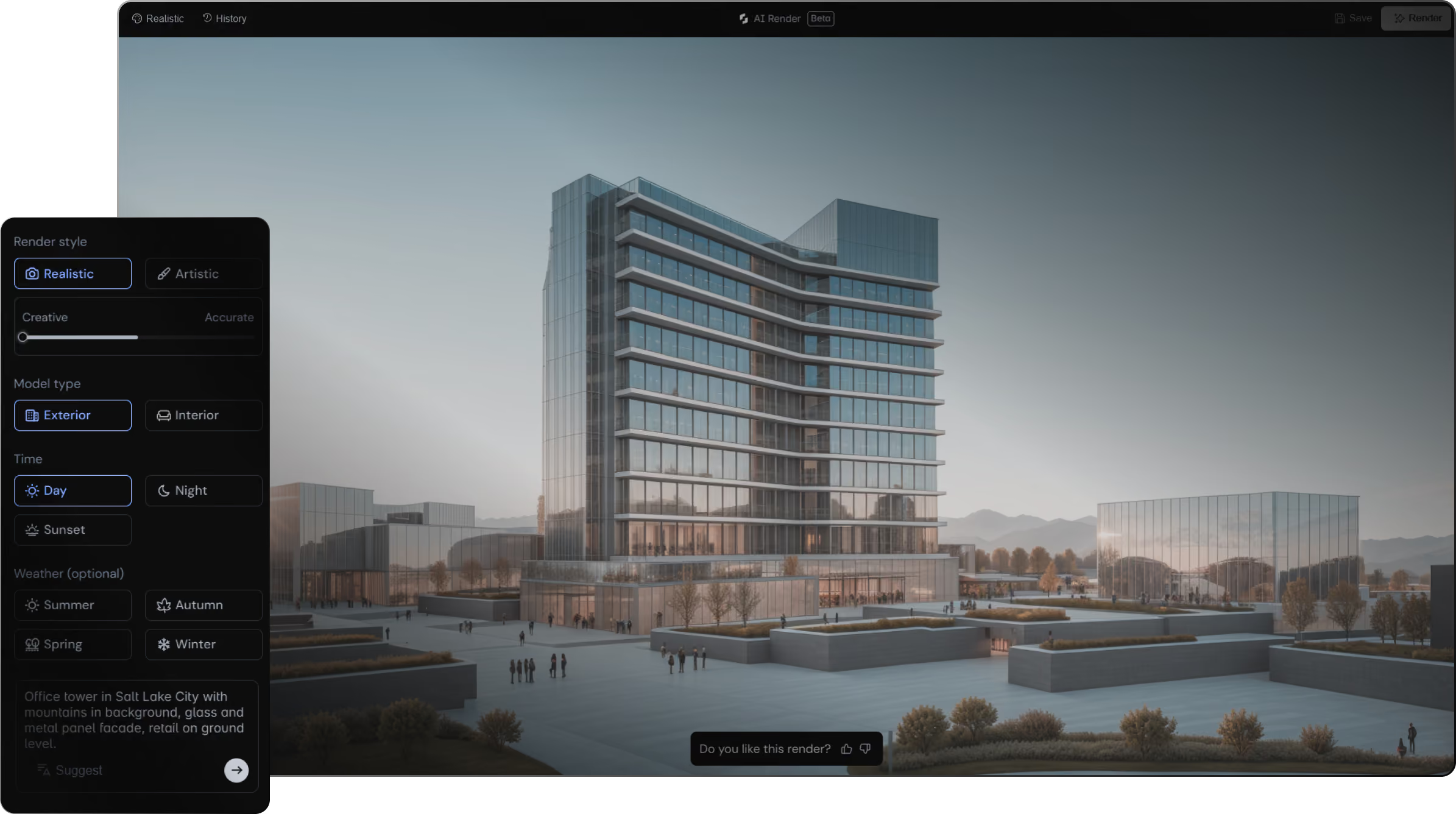
Snaptrude is an AI-powered, cloud-native BIM design tool built specifically for architects. Unlike legacy BIM platforms designed around documentation workflows, Snaptrude starts from the design phase - automating the translation from a room brief or space programme into a compliant, editable BIM model.
The distinction matters. Most BIM tools treat design as a precursor to the "real" work of documentation. Snaptrude treats design as the product, with documentation as an output. Its AI generates floor plan options from a schedule, allows real-time multi-user collaboration with no Worksharing setup, and syncs bidirectionally with Revit when construction documentation demands it.
Pricing starts with a free plan - genuine free, not a time-limited trial - with paid plans starting below Revit's entry price. For firms doing early-stage design, schematic design, or multi-user coordination on cloud-first workflows, Snaptrude is the fastest path from brief to BIM-ready model available in 2026.
2. Autodesk Revit: Best for Large-Scale BIM Coordination
Revit remains the dominant BIM platform for large, multi-disciplinary construction projects. Its parametric modelling engine, deep MEP and structural toolsets, and integration with Autodesk Construction Cloud make it the default choice for enterprise AEC. The BIM 360/ACC ecosystem, combined with Revit's parametric families and sheet management, is genuinely hard to replicate elsewhere at scale.
The costs are real, though. Revit's learning curve typically runs six to twelve months to proficiency. Its desktop-first architecture makes remote collaboration painful without careful Worksharing setup. And at $2,950/year per seat, it is the most expensive tool in this list. For firms primarily doing early-stage design, those costs are hard to justify against faster, cheaper alternatives.
3. Graphisoft ArchiCAD: Best for Design-Focused Practices
ArchiCAD has been building trust with architects for 35 years and it shows. Its modelling workflow feels genuinely designed by architects rather than by engineers, and its Open BIM approach - with native IFC as a first-class format - means it plays well with a diverse consultant chain. The ArchiCAD Solo licence at $980/year makes it accessible for sole practitioners and small practices.
Where ArchiCAD falls short is large-scale MEP coordination. Revit's MEP tools and the ACC ecosystem are significantly more developed. But for design-forward firms whose construction documents are simpler or whose consultants use IFC rather than RVT, ArchiCAD is the most sophisticated design environment on this list.
4. Trimble SketchUp: Best for Concept Modelling (Not BIM)
SketchUp is fast, intuitive, and omnipresent in early-stage massing and client presentations. Its 3D Warehouse of pre-built components and its low barrier to entry make it the go-to for architects who need to think spatially and communicate quickly.
It is not a BIM tool. There is no parametric data, no schedule extraction, no native IFC. For anything that will eventually need to become construction documentation, SketchUp is a starting point that requires migration to a BIM platform - not an endpoint. At $119-$349/year, it remains worthwhile as a visualisation and concept tool, not as a production environment.
5. Vectorworks Architect: Best for Open BIM Flexibility
Vectorworks Architect combines freeform 3D modelling with BIM rigour in a way no other tool on this list does. Its curve and surface modelling capabilities exceed Revit's, making it the preferred choice for firms designing buildings with complex geometry. Its Open BIM credentials - native IFC, IFC4 support, full BCF workflow - make it a serious BIM authoring platform.
At $3,045/year, it is the most expensive option and its ecosystem is smaller than Revit's. But for firms that need genuine design freedom alongside BIM documentation, Vectorworks offers a combination that ArchiCAD and Revit cannot match.
6. Autodesk AutoCAD: Essential for 2D Documentation
AutoCAD is not a BIM tool and has not pretended to be since Revit's ascent. What it is, is the universal language of construction documentation. Every consultant in every discipline understands DWG. For detailed 2D drawings, detail sheets, and coordination with contractors who have not yet adopted BIM, AutoCAD remains indispensable - usually as a complement to a BIM authoring tool rather than a replacement.
7. BricsCAD BIM: Best Value for DWG-Dependent Firms
BricsCAD BIM delivers AutoCAD-compatible DWG workflows with genuine AI-assisted BIM modelling at roughly half the cost of Revit - around $1,160/year. For firms that are DWG-workflow-dependent and price-sensitive, it is the most compelling upgrade path from AutoCAD to BIM available. Its community and ecosystem are smaller than Revit's, but it is actively developed and increasingly capable.
8. Chief Architect: Best for Residential Specialists
Chief Architect is purpose-built for residential and light commercial design in North America. Its automated framing, roofing, and material takeoff tools go further than any general-purpose BIM platform for single-family and small multi-family projects. If residential design is your primary work, Chief Architect is faster and more accurate than Revit for that use case. Outside residential, it does not apply.
Architecture Software Comparison Table 2026
| Software | BIM | Cloud | AI Features | Best For | Starting Price |
|---|---|---|---|---|---|
| Snaptrude | Yes | Native | Automated floor plans, space planning | AI-powered early-stage design | Free / ~$500/yr |
| Autodesk Revit | Yes | Hybrid | Generative design (add-on) | Large-scale BIM coordination | $2,950/yr |
| ArchiCAD | Yes | Hybrid | Limited | Design-focused practices | $980/yr (Solo) |
| SketchUp | No | Yes | None native | Concept modelling | $119/yr |
| Vectorworks | Yes | Hybrid | Limited | Open BIM flexibility | $3,045/yr |
| AutoCAD | No | Yes | None | 2D documentation | $2,030/yr |
| BricsCAD BIM | Yes | Partial | AI solids | DWG + BIM value | $1,160/yr |
| Chief Architect | Partial | No | Automated framing | Residential design | $595/yr |
How Do You Choose the Right Architecture Software for Your Firm?
The most common mistake in software selection is choosing based on what the largest firms use rather than what your firm actually does.
If your work is primarily early-stage design, schematic design, and collaborative iteration with clients and partners, Snaptrude gives you AI assistance and cloud collaboration that Revit cannot match at Revit's price point. If your firm is primarily delivering construction documentation on complex multi-disciplinary projects, Revit is the safer bet - not because it is better designed software, but because your consultants and contractors are in the same ecosystem.
For solo practitioners and small practices doing design-forward work, ArchiCAD Solo at $980/year is the most complete professional BIM environment at that price. For students and those starting out, Snaptrude's free plan and SketchUp Free both provide zero-cost starting points - with Snaptrude offering the faster path to actual BIM skills.
Related reading
- Best BIM Software for Architects 2026: Not All BIM Is Designed for Design
- How to evaluate BIM software: Complete guide to the architecture firm's 4 phase process
- Best Architecture Design Software 2026: Tools That Actually Speed Up Design
- Best Revit Alternatives 2026: Top 10 BIM Tools for Smarter, Faster Architectural Design
Frequently Asked Questions
What is the best architecture software for architects in 2026?
The best architecture software in 2026 depends on your primary use case. Snaptrude leads for AI-powered early-stage design and cloud collaboration. Autodesk Revit leads for large-scale BIM coordination and construction documentation. ArchiCAD is the best option for design-focused smaller practices.
Is architecture software the same as BIM software?
Not exactly. BIM (Building Information Modelling) software like Snaptrude, Revit, and ArchiCAD creates parametric 3D models with embedded data. Architecture software is a broader category that includes 2D drafting tools (AutoCAD) and concept modellers (SketchUp) that are not BIM platforms. For professional practice, BIM software is the standard.
What is the cheapest professional architecture software?
Snaptrude offers a genuine free plan with full BIM modelling and AI floor plan generation - making it the strongest free professional option in 2026. ArchiCAD Solo at $980/year is the most affordable paid full-BIM platform. SketchUp Go at $119/year is the cheapest mainstream tool, but it is not a BIM platform.
Can I switch from Revit to Snaptrude?
Yes, for design phases. Snaptrude's bidirectional Revit sync means you can design in Snaptrude, then hand off to Revit for construction documentation. Many firms use this workflow to get the speed of AI-assisted design without losing their existing Revit investment for documentation.
What architecture software do students use?
Architecture students typically use AutoCAD, Revit (Autodesk Education licence), SketchUp Free, and increasingly Snaptrude (student access). Snaptrude's cloud-native design and AI tools are particularly relevant for students learning design workflow rather than legacy documentation tools.
Conclusion
The best architecture software in 2026 is not a single tool - it is the right combination for your workflow. For most practices, that means Snaptrude for design speed and AI assistance, and Revit or ArchiCAD for the documentation phase where their ecosystem advantages are real. The firms winning on project delivery in 2026 are not using the most expensive tools. They are using the fastest tools for each phase of work.