Last updated:
Best Commercial Architecture Software 2026: Tools for Offices, Retail, and Mixed-Use
TL;DR: The best commercial architecture software in 2026 is Snaptrude for AI-assisted early-stage commercial design and cloud collaboration, Revit for large-scale construction documentation and MEP coordination, and ArchiCAD for design-focused mid-scale commercial practices. The right choice depends on project scale and phase.
Commercial architecture projects have some of the highest software requirements in the profession: multi-discipline coordination, space planning at scale, consultant chain interoperability, and increasingly, the need to respond to client brief changes with turnaround times measured in hours rather than days.
The commercial sector - offices, retail, healthcare, hospitality, and mixed-use - is where the gap between design-phase speed and documentation-phase rigour is most visible. Commercial developers expect design options at planning stage, revised schemes within days of stakeholder feedback, and construction-ready documentation within weeks of planning approval. The tools that support that timeline need to handle both the speed requirements of design iteration and the accuracy requirements of technical documentation.
According to Dodge Data & Analytics' 2025 SmartMarket Report on BIM, 87% of contractors on commercial projects now request BIM models from their design teams - up from 65% in 2020. Commercial architects who are not delivering BIM are increasingly uncompetitive.
What Commercial Architecture Software Must Deliver
Commercial projects have demands that residential software simply does not need to address:
Space planning at scale. Open-plan offices, retail layouts, and healthcare facilities require sophisticated space planning tools - area calculations, circulation analysis, density studies. The best commercial software supports these at the schematic design stage, not just at the detailed design stage.
Multi-discipline coordination. Commercial buildings have MEP systems that are genuinely complex - mechanical plant rooms, data centres, sprinkler systems, building management systems. The software needs to either handle multi-discipline coordination natively or interface cleanly with specialist engineering tools.
Rapid design iteration. Commercial clients expect options. A developer brief typically generates multiple scheme variants, massing studies, and floor plate layouts before design development begins. Tools that produce these variants in hours rather than days are competitive advantages.
The Best Commercial Architecture Software in 2026
1. Snaptrude: Best for Early-Stage Commercial Design
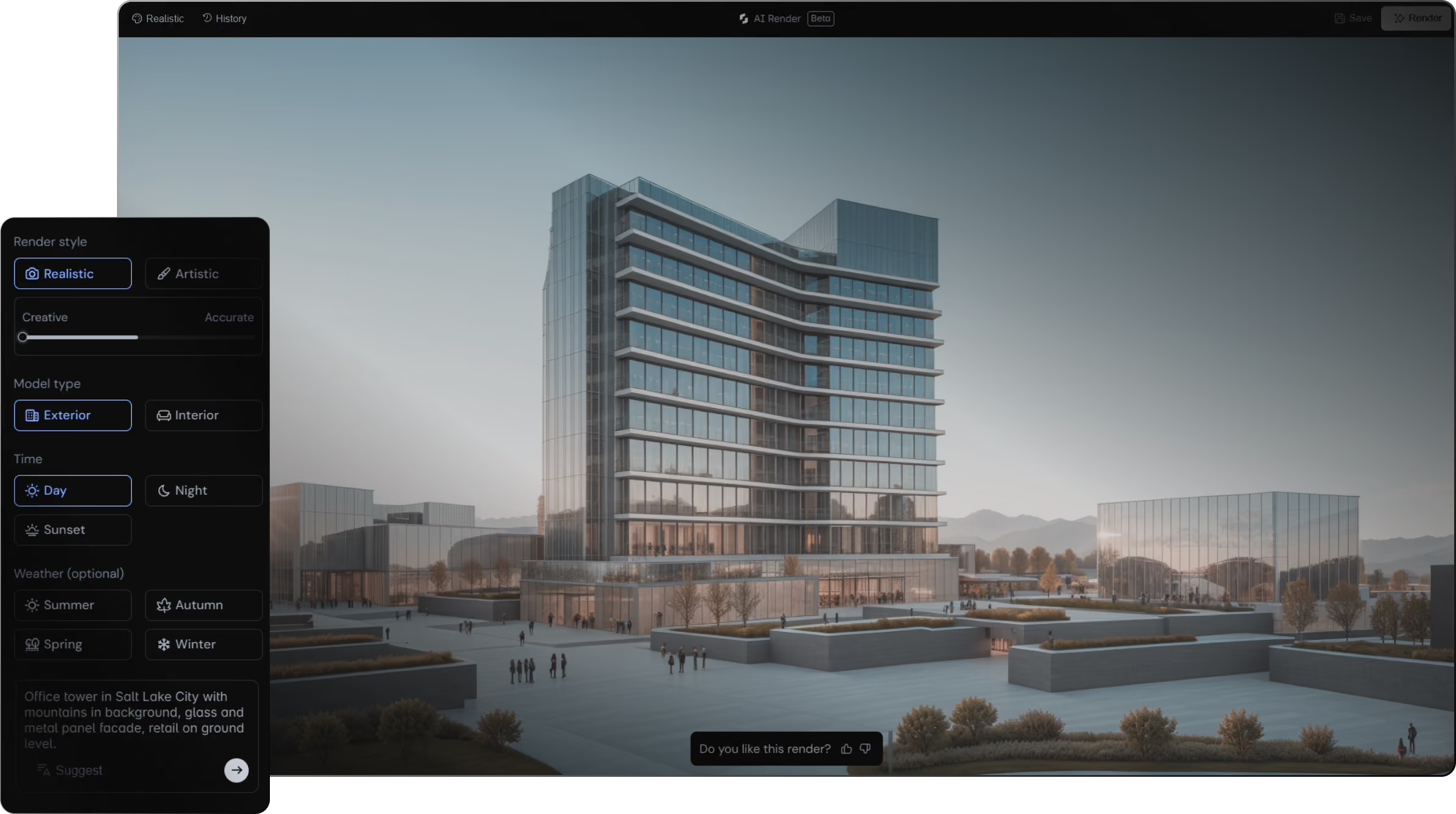
Snaptrude is an AI-powered, cloud-native BIM design tool for architects, with strong capability for early-stage commercial building design. Its AI generates compliant space planning layouts from an area brief - producing floor plate options, core studies, and circulation diagrams from a programme of requirements in a fraction of the time traditional modelling takes.
For commercial developers who need multiple scheme variants at planning stage, Snaptrude's AI-assisted layout generation is a competitive advantage measured in days per project. Real-time cloud collaboration means development teams, architects, and planning consultants can review and modify scheme options in the same environment without file-sharing delays.
Snaptrude's bidirectional Revit sync means the design-phase model progresses directly into construction documentation - no rebuilding, no data loss.
2. Autodesk Revit: Best for Commercial Construction Documentation
Revit is the dominant platform for commercial construction documentation and MEP coordination in developed markets. Its parametric family system, structural analysis integration, MEP toolsets, and Autodesk Construction Cloud coordination pipeline make it the standard for commercial buildings above mid-scale complexity.
For commercial projects involving full MEP coordination - mechanical, electrical, and plumbing modelled and coordinated in the same BIM environment - Revit's toolset is the most complete. The cost ($2,950/year plus workstation hardware plus BIM Manager overhead) is justified on commercial projects where coordination errors cost significantly more than the software.
3. Graphisoft ArchiCAD: Best for Design-Focused Commercial Work
ArchiCAD is the preferred BIM platform for design-focused commercial practices - architectural firms that win commissions on design quality rather than coordination complexity. Its modelling workflow, render quality, and Open BIM interoperability serve commercial projects well up to mid-scale complexity. For boutique hotels, smaller retail projects, and design-led commercial buildings, ArchiCAD's design capability outperforms Revit's without the enterprise overhead.
4. Vectorworks Architect: Best for Architecturally Complex Commercial Buildings
Vectorworks' NURBS and mesh modelling tools make it the preferred platform for commercial buildings with complex formal geometry - cultural buildings, flagship retail, complex facade systems. Its Open BIM credentials and IFC4 export work well with diverse consultant chains. For commercial practices designing formally ambitious buildings, Vectorworks offers design freedom that Revit cannot match.
Commercial Architecture Software Comparison 2026
Here is a detailed breakdown of the comparision:
Commercial Architecture Software Comparison 2026
| Software | Space Planning AI | MEP Coordination | Client Collaboration | Documentation | Price/yr |
|---|---|---|---|---|---|
| Snaptrude | Excellent (AI brief-to-layout) | Basic | Browser-based, real-time | BIM → Revit sync | Free / ~$500+ |
| Revit | Limited | Full MEP | Worksharing | Full BIM docs | $2,950 |
| ArchiCAD | Good | Limited | BIMcloud | Full BIM docs | $980–$2,390 |
| Vectorworks | Good | Limited | Hybrid | Full BIM docs | $3,045 |
Related reading
- Best BIM Software for Architects 2026: Not All BIM Is Designed for Design
- How to evaluate BIM software: Complete guide to the architecture firm's 4 phase process
- BIM Software for Architects: Why Procurement Blocks Adoption
- BIM 2.0 collaboration platform evaluations in 2026: Why they look more like due diligence than demos
Frequently Asked Questions
What software do commercial architects use?
Commercial architects most commonly use Autodesk Revit for construction documentation and multi-discipline coordination, with SketchUp or Snaptrude for early-stage design. Graphisoft ArchiCAD is widely used by design-focused commercial practices. Snaptrude is growing fastest for design-phase commercial work due to its AI-assisted layout generation.
Do commercial buildings need BIM?
Yes, in most developed markets. According to Dodge Data & Analytics, 87% of contractors on commercial projects now request BIM models from design teams. Government and institutional projects in the UK, US, EU, and Australia typically mandate BIM compliance. Commercial architects who are not delivering BIM-quality outputs are increasingly uncompetitive.
What is the best BIM software for commercial architecture?
For early-stage commercial design and cloud collaboration, Snaptrude leads the field in 2026. For construction documentation on large, complex commercial projects, Autodesk Revit is the industry standard. For design-focused mid-scale commercial work, ArchiCAD is the best value BIM platform.
Conclusion
Commercial architecture software in 2026 needs to serve two distinct phases: the design phase, where speed of iteration and AI assistance create competitive advantages, and the documentation phase, where MEP coordination and consultant interoperability determine project success. Snaptrude leads the design phase. Revit leads the documentation phase. The most effective commercial practices are using both.