Last updated:
Architecture Design System: Reuse Without Rigid Templates
TL;DR
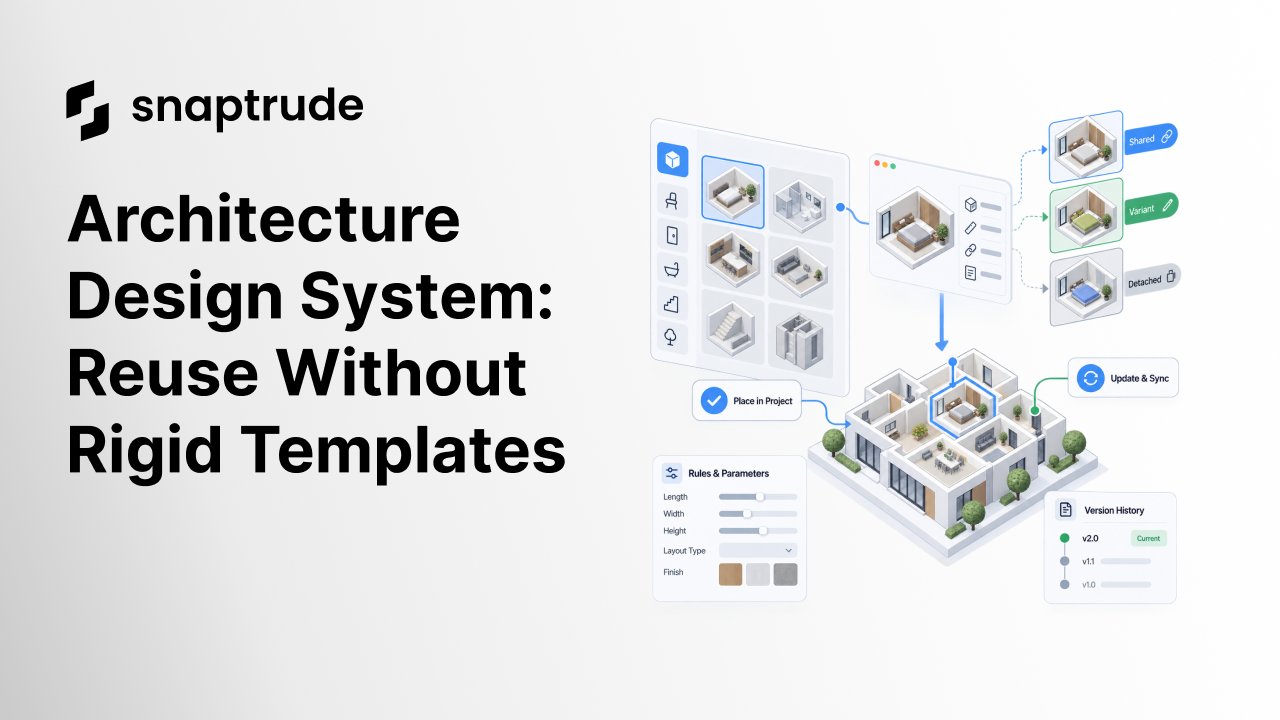
An architecture design system is a governed library of reusable spatial and geometric components. Each component carries intent, parameters, interfaces, instance rules, tests, and ownership. It gives teams a trusted starting point without turning previous work into a rigid template. Reuse succeeds when designers can see what stays linked, what may change, and how an exception is reviewed.
What is an architecture design system?
An architecture design system is a collection of reusable design components plus the rules that make them safe to use. A component might be a room layout, apartment unit, service core, circulation bay, façade module, parking pattern, or program block. The system explains why the component exists, which variables are permitted, how it connects to neighbors, what remains shared across instances, and how teams know it still works.
That differs from a conventional template. A template usually provides a starting file, naming standard, view setup, and default content. A design system treats reuse as an active relationship. It asks whether the reused element should update with its source, become a controlled variant, or detach as a project-specific copy.
The distinction matters because copying is easy. Trusting the copy is hard. A room arrangement taken from an old project may carry an unsuitable code assumption, clearance, furniture count, structural grid, service condition, or client preference. Without visible scope and status, yesterday’s solution becomes today’s hidden error.
See why rigid architecture software templates often fail in practice.
%20(2).jpg)
Which layers should an architecture design system contain?
Use five layers for every reusable component.
Intent prevents a component from becoming a generic answer to every project. Parameters turn a fixed block into an adaptable starting point. Interfaces expose dependencies that are otherwise discovered only after placement. Instance rules let a team manage change. Verification proves that reuse preserved usefulness rather than only appearance.
Give each component a stable identifier, human-readable name, owner, version, status, and last review date. Add a short change record. A designer should be able to answer: “What changed, why did it change, and do my placed instances inherit it?”
Avoid encoding every possibility. A good component has a bounded job. A service core may define circulation and shaft relationships without pretending to resolve final engineering. A hotel room module may preserve planning intent while leaving finish, structure, accessibility, and jurisdictional checks to the project team.
How should linked instances and editable copies work?
Use explicit states instead of one ambiguous “reusable” label.
The designer should choose the state consciously. Silent detachment makes later updates unreliable. Silent propagation is worse because a library change can alter project work without review.
When an update is available, show its scope before applying it. Compare geometry, parameters, classifications, schedules, views, and connected objects. Let the project owner accept, reject, or defer the change. If a placed module has local edits, the system should identify the conflict and preserve enough context for a human decision.
This is where firm knowledge becomes operational. Search can find a prior solution, but a design system states whether that solution is approved, adaptable, and compatible with the current project. See why organized firm knowledge matters for AI-assisted work.
How do you build an architecture module library?
Start with repeated work that already has a clear owner and visible review burden. Do not begin by collecting everything.
Import sources carefully. A PDF or CAD drawing can provide geometry and reference information, but it rarely carries reliable object meaning by itself. Clean layers, units, duplicates, coordinate assumptions, and linework before turning the source into reusable content. Then add the classifications, parameters, interfaces, and tests that make it a design-system component.
Review how architects can organize reusable digital assets.
How should teams test reusable design modules?
Test the behaviors designers depend on.
Place the component in a clean model and a representative project. Change each allowed parameter at its minimum, typical, and maximum condition. Test rotations, mirroring, level changes, hosting, adjacent geometry, and copied instances where relevant. Verify that invalid combinations fail visibly instead of producing plausible but broken geometry.
Then inspect information outputs. Do schedules count the component once and classify it correctly? Do names, types, areas, materials, and quantities remain understandable? Do plans and sections communicate the intended hierarchy? Does export preserve the receiving team’s required objects and properties?
Finally, test change. Update the source, compare a shared instance and a controlled variant, and confirm that local exceptions are neither erased nor hidden. Detach one copy and prove that it stops receiving updates. Deprecate a version and verify that existing projects remain traceable while new placement points to the approved replacement.
Record failures as system evidence. A component should not remain “approved” when a core interface or output no longer works. Review on a fixed cadence and after any material change to standards, code assumptions, source software, or project workflow.
When should a firm avoid reuse?
Do not reuse a component when its intent, evidence, or interfaces do not match the current problem. A familiar room type may be wrong for a different user population. A façade module may conflict with structure, climate, fabrication, or maintenance. A planning arrangement may embed an outdated regulation or operating assumption.
Reuse should accelerate comparison, not bypass judgment. Require a project-fit review that checks jurisdiction, client brief, site, accessibility, life safety, structure, building systems, environmental performance, and delivery method. The library can state known boundaries, but licensed professionals and specialist consultants remain responsible for project decisions.
Snaptrude supports concept modeling, program data, BIM objects, materials, quantities, schedules, drawings, visualization, collaboration, and several export formats. Those verified capabilities can support a reusable workflow, but the firm still owns component governance, approval, and project-fit testing.
FAQ: Frequently Asked Questions
Is an architecture design system the same as a BIM template?
No. A BIM template usually standardizes a starting file, views, naming, and default content. An architecture design system governs reusable design components and their behavior. It records intent, variables, interfaces, instance relationships, tests, ownership, and change history. A template can distribute the system, but it does not replace those rules.
What should a reusable room layout include?
Include the room’s intended use, applicable user group, dimensional parameters, entries, clearances, furniture or equipment assumptions, adjacency interfaces, accessibility and code boundaries, data fields, drawing behavior, and test cases. State which parts are shared and which may vary. Project teams must still validate jurisdiction, client requirements, structure, and building systems.
How many components should a firm create first?
Start with one small family of frequently repeated components whose owner and acceptance criteria are clear. The right number depends on review capacity, not archive size. A compact trusted set is more useful than hundreds of unverified copies. Expand only after teams can find, adapt, test, update, and retire the first set reliably.
Should design-system components update automatically?
Not without a visible project decision. Shared instances may receive approved updates, but the user should see the affected geometry, data, drawings, and dependencies before acceptance. Controlled variants and local overrides need conflict handling. Detached copies should remain independent. Silent propagation can change project work; silent detachment makes future maintenance misleading.
Can AI build an architecture design system from old projects?
AI can help find, compare, classify, and propose reusable patterns, but past project data does not prove current suitability. Human reviewers must remove private information, verify rights, identify stable intent, check code and client assumptions, define interfaces, and approve tests. Generated components should remain proposals until a responsible professional accepts them.
How can Snaptrude support reusable design work?
Snaptrude’s verified capabilities include program and BIM data, parametric concept modeling, materials, quantities, schedules, drawings, collaboration, and exports. These can help teams create and assess reusable content inside a connected workflow. The approved facts do not claim automatic governance for every firm standard, so define ownership, versioning, instance behavior, and project-fit review explicitly.
Try Snaptrude with one representative reusable design workflow.