Last updated:
The Template Paradox: Why Architects Ask for Templates and Then Don't Use Them
TL;DR Every architecture software demo includes the same moment: someone asks for templates, gets offered templates, and doesn't use them. This isn't architects being difficult. It's architects protecting their most valuable asset - their process. The firms that win with design software are the ones that treat it as infrastructure for their own standards, not a starting point borrowed from someone else's.
By the Numbers: Architecture Firm Structure and Software Adoption
- 75% of architecture firms in the US have fewer than 10 employees - meaning most firms operate as small practices with highly individualized workflows - AIA 2024 Firm Survey Report
- 61% of large architecture firms report using AI tools, compared to just 27% of small firms - AIA 2024 Firm Survey Report
- 48% of software users abandon onboarding if they don't see value quickly - OnRamp, 2025
Why Architects Ask for Templates They Don't Actually Want
In a recent Snaptrude demo, an architect who designs retail chain locations - Starbucks cafes, franchise fit-outs, dozens of nearly identical sites - asked for templates. You would expect this person to want pre-built layouts. Repeating layouts across dozens of sites sounds like exactly the use case templates solve.
But when templates were offered, the response was: "Every architect has their own process, their own project standards."
The process is the IP.
This architect already has templates. They have spent years refining wall assemblies for specific code requirements, material libraries calibrated to their contractor relationships, typical details that reflect their liability exposure. Their templates are their competitive advantage. Adopting someone else's means abandoning that advantage and taking on someone else's assumptions.
What "Standardization" Actually Threatens
Design software templates carry embedded assumptions: typical corridor widths, default ceiling heights, standard wall assemblies, material defaults. For an architect with established practice standards, every one of these defaults is a decision they have already made differently.
Using a generic template means either accepting those defaults and producing work that doesn't reflect their standards, or spending time overriding them - often more time than starting from scratch.
There is a deeper issue: design software is a creative medium. The tool shapes the work. Architects who have spent careers developing a design process know this instinctively. A template from someone else's process is a foreign constraint, not a time-saver. This is especially acute given that 75% of US architecture firms have fewer than 10 employees - small practices where every workflow decision is personal and firm-specific, not standardized across a department.
The template request in demos is not really about templates. It is about this question: "How quickly can I get to working my way?"
The Three Types of Standards Architects Need Software to Respect
Wall assemblies and construction systems. An architect's wall types encode years of decisions about cost, performance, buildability, and contractor availability. Snaptrude lets you define wall types with the same ease as drawing them - import your existing Revit wall systems or build new ones from scratch. Either way, you work with your standards.
Spatial and dimensional defaults. Corridor widths, room proportions, floor-to-floor heights - experienced architects have these calibrated to their project types. Software that forces you to fight these defaults on every project is software that costs you time instead of saving it.
Project structure and documentation standards. How a project is organized, what gets documented at each phase, how layers and categories are named - these are firm-specific and represent years of accumulated practice knowledge.
The design software that earns long-term adoption is the software that becomes infrastructure for these standards, not a replacement for them.
Why AI Makes the Template Problem Worse - and How to Fix It
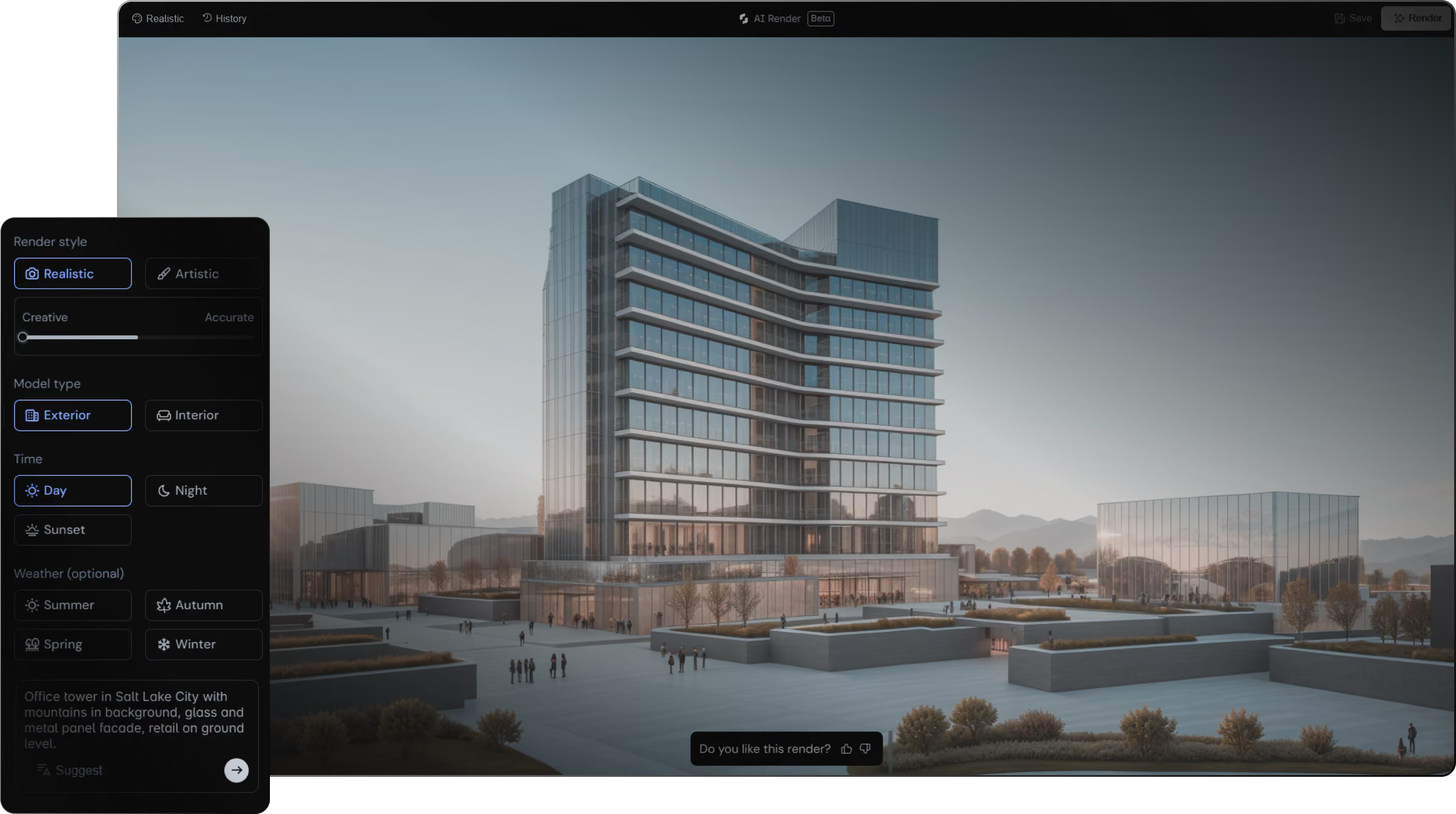
AI-generated layouts require assumptions. What is a typical corridor width? What ceiling height? How should spaces connect? If the AI uses generic assumptions, it generates layouts that don't match your practice. You spend time correcting AI suggestions instead of designing.
But if the AI learns your standards - your wall types, your typical dimensions, your adjacency preferences - the suggestions start to feel like an extension of your process, not a replacement for it. The adoption gap bears this out: only 27% of small architecture firms currently use AI tools, compared to 61% of large firms - a gap driven less by capability than by whether the AI fits how the firm already works.
This is the principle behind how Snaptrude AI is built: the system adapts to your modeling patterns over time. The more you use it, the more it reflects your standards. It is not generating "best practice" layouts. It is generating layouts consistent with how your practice actually works.
The distinction matters enormously for AI adoption in professional contexts. Generic AI suggestions create friction. AI that reflects your own established practice creates leverage.
How Snaptrude Approaches Templates
Snaptrude ships with minimal templates - not because of any shortage of options, but because imposing a generic process on a firm's established workflow creates more problems than it solves.
What Snaptrude does provide:
- Starter wall types that can be modified in seconds
- Revit import for firms that already have defined standards
- A custom material library that builds as you work
- Project templates that you create after your first project and reuse from then on
The goal is not to give you 100 pre-built options. It is to make creating your own first option easy enough that you are never tempted to use someone else's.
The pattern seen consistently in Snaptrude adoption: architects don't ask "where are the templates?" after the first week. They complete one project, save it as a template, and reuse it. The template becomes an artifact of their work, with their standards embedded. That template has value. A pre-built one from a software vendor does not.
The One Case Where Templates Do Work
There is an exception: architects learning BIM for the first time, or small practices without established digital standards. For these users, starter templates provide scaffolding - a working example to understand how the software organizes a project, before building their own version.
Even in this case, the goal is migration to their own standards as quickly as possible. A good template is one that teaches you how to replace it.
What This Means for Choosing Architecture Software in 2026
When evaluating architecture design software or BIM tools, the template question is a useful diagnostic. Ask the vendor:
- Can I import my existing wall types and material libraries?
- Can I save my own project as a template after the first use?
- Does the software's AI adapt to my modeling patterns, or does it apply generic assumptions?
The answers reveal whether the software is designed to serve your process or to impose its own. For most established architectural practices, that distinction determines whether the tool earns adoption or gets abandoned after the trial period.