Last updated:
How FGI guidelines shape healthcare facility design in 2026: turning adjacency rules into arrangement graphs
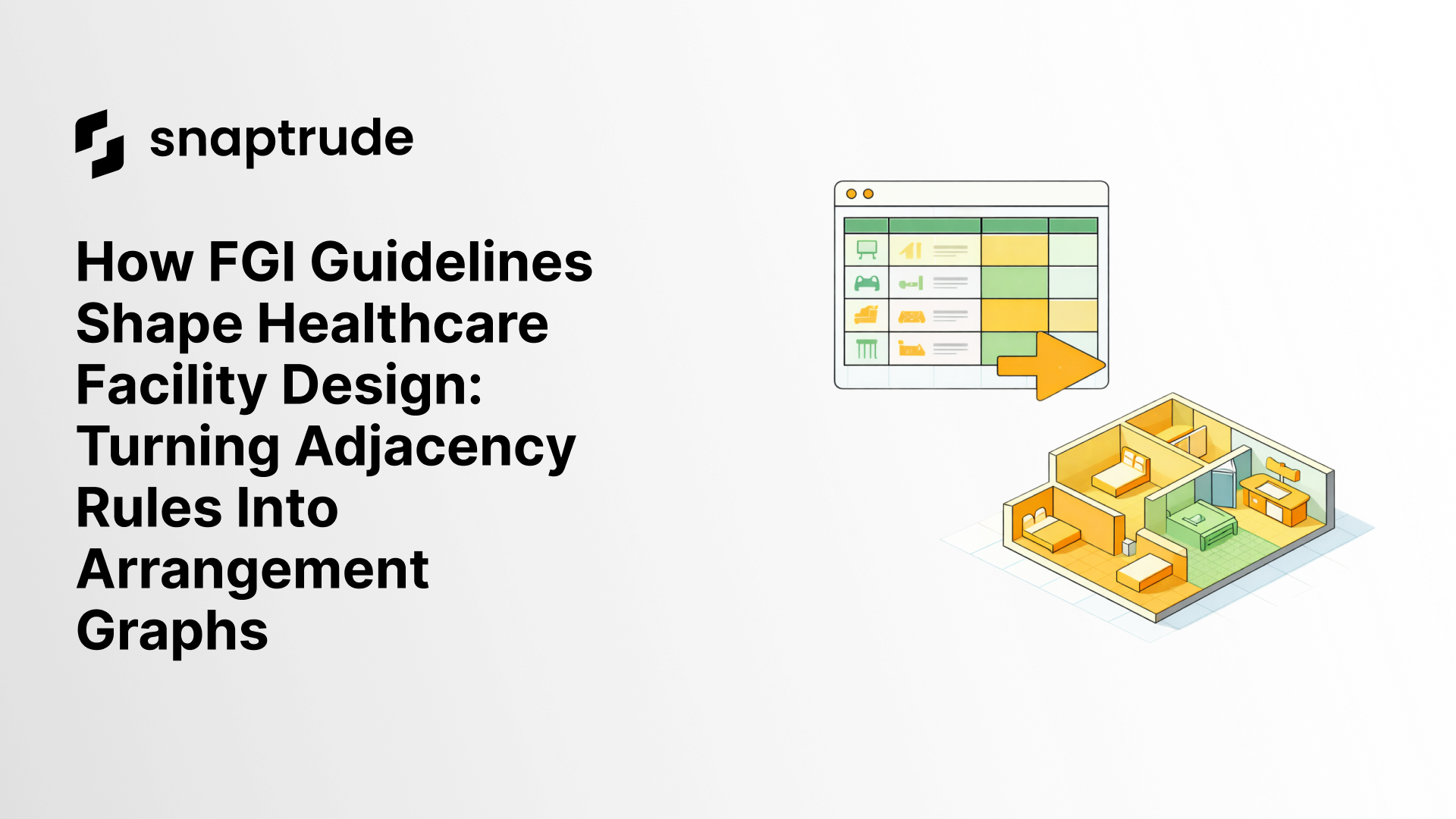
TL;DR: Healthcare facility design lives and dies by adjacency rules. FGI guidelines spell out which departments must sit next to which: the ED connects to imaging, the ICU sits near surgery, and so on through dozens of mandatory relationships, all before a single wall gets drawn. AI can now ingest those rules and generate optimized spatial arrangements, replacing weeks of manual bubble diagram work.
By the numbers
- FGI guidelines cover 200+ functional areas across hospital and outpatient facilities, each with adjacency and separation requirements
- Manual bubble diagramming for a mid-size hospital can consume 40–60 hours of senior architect time before layout even begins
- AI-generated arrangement graphs reduce initial layout iteration from weeks to hours in documented workflows
What are FGI guidelines, and why do they govern adjacency in healthcare facility design?
The Facility Guidelines Institute publishes standards for planning, design, and construction of healthcare facilities in the United States. Most states adopt FGI guidelines by reference, which means they carry the force of law for licensed healthcare construction.
The adjacency requirements inside those guidelines are not suggestions. They are spatial rules tied to patient safety, infection control, care delivery efficiency, and operational logic. The ED must be reachable from emergency vehicle drop-off without routing through general circulation. The surgical suite must separate sterile and soiled flows. Labor and delivery must connect to NICU within a defined travel path. Clean and soiled utility rooms must be separated in every inpatient wing.
Each of these is a constraint. Some constraints are absolute. Others are weighted: preferred adjacency, required separation, acceptable proximity. When you assemble a hospital, you are solving a constraint satisfaction problem across dozens of departments and hundreds of room-level relationships simultaneously. This is what makes healthcare facility design fundamentally different from commercial office or residential work.
This means every major department has to be placed relative to every other department before schematic design can start. The emergency department cannot just go wherever the site allows. It has to connect to diagnostic imaging, stay reachable from the main entrance, and maintain separation from inpatient recovery. And starting with the 2026 FGI Facility Guidelines for Hospitals and Outpatient Facilities, those requirements are more explicit than ever.
What is an adjacency matrix, and how does it represent spatial requirements?
An adjacency matrix is a structured representation of spatial relationships between departments or functional areas. Each cell in the matrix holds a value representing whether two departments should be adjacent, separated, or have no defined relationship.
The matrix format is useful because it makes the full set of constraints visible in one place. For a hospital with 30 functional departments, a full adjacency matrix has 900 cells (30 x 30). Most cells are empty or neutral. A meaningful subset carry requirement weights: required, preferred, allowed, or prohibited.
Healthcare facility planners use adjacency matrices as a design input. The matrix is derived from FGI guidelines, operational protocols, and institutional preferences specific to the client. It is then used to generate bubble diagrams and, eventually, to evaluate floor plan alternatives against the original requirements.
For a standard adjacency diagram, each department is a node. Each required relationship is a weighted edge. That graph has to be resolved before floor plate geometry becomes a real conversation.
How does manual bubble diagramming work, and where does it break down?
Manual bubble diagramming starts with an adjacency matrix and a blank page. The architect places department bubbles and draws connecting lines weighted by the strength of adjacency requirements. Required adjacencies get solid lines. Preferred relationships get dashed lines. Conflicts get noted for resolution.
The process works reasonably well for small outpatient facilities or single-department expansions. It breaks down at scale. A mid-size community hospital has 25–35 major departments. A large academic medical center might have 60+. The combinatorial space of possible arrangements grows exponentially. Manual iteration through that space, one bubble diagram at a time, is how healthcare architects have historically spent the early phases of a project.
The fundamental limitation is not drawing speed. It is cognitive. Each attempted arrangement has to be checked against the full set of constraints before you know whether it is viable. For context on BIM requirements in healthcare architecture, the compliance bar here is higher than in nearly any other building type. Missing a single required adjacency at pre-design can cascade into a major redesign during construction documents or, worse, during state review.
The AI alternative is not replacing judgment. It is handling the exhaustive search that humans are poor at: iterating through candidate arrangements until the critical relationships work, and then testing the result against site constraints and building massing: that can eat weeks of senior staff time.
And it is fragile. Every program change triggers a cascade. A new department gets added. A floor plate shifts. The owner wants a different entry sequence. Each change means re-evaluating adjacencies across all affected departments. For context on BIM requirements in healthcare architecture, the compliance bar here is higher than in nearly any other building type.
Missing a single required adjacency at pre-design can cascade into a major redesign during construction documents or, worse, during state review. One overlooked ED-to-imaging adjacency, caught during schematic review or at permitting, can force a redesign that ripples through an entire wing.
How does AI convert FGI guidelines into spatial arrangement graphs?
The new approach works in three stages.
Stage one: regulatory parsing. The AI ingests the relevant FGI sections—either as structured data from a curated database, or directly from the guideline text. It identifies all departments named in the requirements, extracts the adjacency rules that apply to each, and assigns weights: required, preferred, or prohibited. The output is a machine-readable constraint graph where nodes are departments and edges carry regulatory weight.
Stage two: constraint resolution. The system runs combinatorial search across possible arrangements, evaluating each against the full constraint set. This is where AI earns its place. The search space for a 30-department hospital is too large for manual iteration. AI-based solvers can evaluate thousands of candidate arrangements in the time it takes a human team to sketch five.
Stage three: output and review. The system returns a ranked set of compliant arrangements. The design team reviews the output, selects a starting point, and begins the spatial refinement process that requires human judgment: understanding the operational model, negotiating with clinical staff, and resolving conflicts that FGI does not fully specify.
One design team described the process during a working session with Snaptrude: "Now how do I arrange them so I could now use another AI tool which we have built in what we call a packing AI where you try to find the best layout based on the bubble diagram output." That sequence—bubble diagram output feeding directly into packing AI—is what AI-assisted adjacency workflows make possible.
The result is not a finished floor plan. It is a validated arrangement: a compliant starting point that the design team can refine rather than build from scratch over weeks.
One design team described the process during a working session with Snaptrude: "Now how do I arrange them so I could now use another AI tool which we have built in what we call a packing AI where you try to find the best layout based on the bubble diagram output." That sequence—bubble diagram output feeding directly into packing AI—is what AI-assisted adjacency workflows make possible.
The result is not a finished floor plan. It is a validated arrangement: a compliant starting point that the design team can refine rather than build from scratch over weeks.
- Adjacency rules are parsed from FGI guideline text and converted into a weighted constraint graph
- A combinatorial solver generates candidate arrangements scored against the constraint set
- The system outputs ranked spatial graphs, with the highest-scoring options presented first
- The design team reviews, picks, and modifies the best arrangement before moving to floor plate design.
This connects directly to schematic design automation and AI spatial planning workflows.
What is the architect's role when AI handles adjacency resolution?
The architect's role does not shrink. Judgment about the client's operational model, ambiguous regulatory language, and trade-offs that involve values rather than geometry stays with the design team. The combinatorial legwork is what moves to the machine.
What changes is the starting point. Instead of spending the first month of pre-design manually testing adjacency configurations, the team starts from a validated arrangement: a compliant starting point that the design team can refine rather than build from scratch over weeks.
How does this apply to specific FGI-regulated departments?
Every major department cluster in a hospital has its own adjacency logic under FGI. Some examples from the 2026 guidelines:
Emergency department. The ED must connect to diagnostic imaging, have direct access from emergency vehicle staging, and maintain separation from pediatric waiting when co-located with adult services. Contamination control zones are explicitly required.
Surgical suite. The OR suite requires separation of sterile supply from soiled instrument return. It must connect to PACU and have defined access paths for pre-op patients that do not cross post-op recovery zones. HVAC requirements tie physical layout to infection control protocols.
Intensive care unit. ICU placement must minimize transport distance to OR and imaging. Decentralized nursing stations are allowed under 2026 FGI but require specific adjacency relationships to maintain monitoring coverage.
Labor, delivery, and postpartum. The LDRP model under FGI requires that labor, delivery, recovery, and postpartum can be accommodated in the same room where possible. When not possible, travel paths between them must meet defined length and circulation constraints. NICU must be immediately adjacent when a Level II or III designation applies.
Each of these translates directly into edges in the adjacency graph. The AI parser reads those requirements and adds them to the constraint set. The constraint solver then evaluates arrangements against all of them simultaneously rather than checking each manually.
What does FGI compliance mean for arrangement graph validation?
Compliance validation works at two levels. The first is structural: does the arrangement satisfy required adjacencies and avoid prohibited proximities? This is the combinatorial check that AI handles well. The second is parametric: do the physical relationships meet the dimensional, circulation, and infrastructure requirements that FGI attaches to each adjacency?
An arrangement graph that passes structural validation may still fail parametric review. Two departments flagged as required-adjacent might be placed next to each other in the graph, but the floor plate geometry required to connect them with compliant travel paths may not fit within the available building envelope. The arrangement graph is a topology, not a floor plan. Final compliance requires both.
This is why AI-generated arrangement graphs are design inputs rather than design outputs. They remove the combinatorial bottleneck from pre-design without removing the judgment requirements from schematic and design development. Healthcare architects working with clinical workflow consultants can use compliant arrangement graphs to structure their early discussions rather than starting each stakeholder session from scratch.
How Snaptrude handles healthcare facility design
Snaptrude is a cloud-native BIM tool with a built-in adjacency and packing AI agent. Healthcare architects input their department list and adjacency requirements. The AI generates arrangement options ranked by compliance score. The design team refines the top options and moves directly to space planning within the same environment—no handoff between diagramming software and BIM.
The result is a compliant starting point in hours rather than weeks. Teams using Snaptrude on healthcare projects have reported moving from adjacency matrix to preliminary blocking and stacking in a fraction of the time required by manual methods.
Frequently asked questions
Q: What are FGI guidelines, and are they legally binding?
FGI guidelines are standards published by the Facility Guidelines Institute for the planning, design, and construction of healthcare facilities. They are adopted by reference in most U.S. states and carry the force of regulatory requirements for licensed healthcare construction. Compliance is typically verified by state health department reviewers during plan review.
Q: How does an adjacency matrix differ from a bubble diagram?
An adjacency matrix is a structured table listing all required, preferred, and prohibited relationships between departments. A bubble diagram is a visual representation of those relationships, with department circles connected by lines weighted by adjacency strength. The matrix is the input; the bubble diagram is one output format. AI systems can work directly from the matrix without requiring a pre-drawn diagram.
Q: Can AI-generated arrangement graphs be used directly in state plan review submissions?
No. AI-generated arrangement graphs are design inputs for the pre-design and schematic phases. They show topological compliance—which departments are adjacent to which—but do not substitute for construction documents, dimensional drawings, or the technical specifications required for state plan review. They reduce the time required to reach a compliant starting point, not the documentation required to demonstrate compliance.
Q: What happens when FGI requirements conflict with site constraints?
Conflicts between FGI requirements and site constraints are resolved through the design process, not by the AI. The AI system flags conflicts—cases where required adjacencies cannot be satisfied within the available building envelope or site geometry—and presents them for architect review. Resolving those conflicts requires judgment about operational priorities, phasing, and whether variances are available under state-specific adoption language.
Q: How do the 2026 FGI updates affect adjacency requirements compared to earlier editions?
The 2026 FGI Facility Guidelines for Hospitals and Outpatient Facilities includes updated requirements for decentralized nursing stations, expanded infection control provisions, and revised adjacency guidance for behavioral health units integrated into general hospital settings. Facilities designed under earlier editions that are undergoing major renovation must evaluate whether their existing adjacency model meets the applicable edition for the scope of work. CMS requires accredited facilities to follow applicable editions for new construction and major renovation. BIM tools like Snaptrude can encode these requirements directly into the design workflow.
Q: Is Snaptrude suitable for large academic medical center projects?
Snaptrude is designed for projects at any scale, including large academic medical centers with 50+ departments and complex interdepartmental adjacency requirements. The packing AI handles the combinatorial complexity regardless of project size. The constraint model scales with the number of departments and adjacency rules in the input. Design teams on large projects use Snaptrude to generate compliant starting points for individual wings or phases, then assemble those into a master blocking and stacking diagram.