Last updated:
7 Best Feasibility Study Software Solutions for Real Estate Developers (Zoning, Yield, Massing) in 2026
Ninety days is a short slip on a development calendar. On a $60M project with a 7.5% construction loan, interest runs about $375,000 a month. A 90-day delay therefore costs roughly $1.1M before anything else goes wrong.
A feasibility study is the cheapest place to catch that kind of delay. It tests zoning, yield, massing and parking before the money is committed. A consultant-led study often costs $15,000 to $30,000 and takes several weeks.
This guide compares seven tools that bring that work in-house or shorten it. We cover what each tool tests, what it costs and what you can audit. Judgment matters more than volume, so we look hardest at how each tool shows its assumptions.
Feasibility tools at a glance
Seven tools made the list. Snaptrude carries a feasibility massing into the same model the architect continues in. TestFit tests yield and parking on a parcel, and Deepblocks screens parcels with zoning, cost and pro forma data.
ArchiWise AI screens US sites for early go or no-go calls. Digital Blue Foam adds climate metrics to massing, and Higharc serves production homebuilders from lot to permit. Northspyre takes over once the deal pencils, with budgeting and cost control.
What a feasibility study has to answer
A feasibility study turns a parcel into a number your investment committee can read. That number is yield-on-cost: stabilized net operating income divided by total project cost. Every other output feeds it.
Zoning sets the envelope through height, setbacks and FAR. Massing turns the envelope into gross floor area (GFA), and the net-to-gross ratio converts GFA into rentable area. Unit mix and parking stall count then decide what the building earns and what it costs.
A good study answers five questions:
- Entitlement: What may we build, and how long will approval take?
- Gross and net area: What GFA fits, and what net-to-gross ratio applies?
- Unit mix: Which mix pencils at our target rents?
- Parking: Does the required stall count fit on the site?
- Cost per unit or per key: What does each option cost, and what is the yield-on-cost?
The entitlement question carries real cost. NAHB and NMHC research finds that regulation accounts for an average of 40.6% of multifamily development costs. Zoning approval adds 3.2% on average across all properties.
Neighborhood opposition is a separate risk. In the same research, 74.5% of respondents encountered it. Where present, it added 5.6% to cost and 7.4 months to the schedule.
NMHC's cost-of-regulations summary adds that 94% of developers must spend resources on rezoning.
Why auditability beats volume
Developers distrust three things in an AI feasibility tool. They distrust assumptions they cannot audit and volume where judgment should be. They also distrust a gap between the model and a buildable design.
A fourth worry is simpler: nobody to blame when the number is wrong.
The trust gap is measurable. A Keyway survey reported by Commercial Observer found that 44% of firms say their investment committees distrust AI-generated analysis. JLL's 2025 technology survey found 92% of occupiers running AI pilots, yet only 5% had met all their program goals.
Adoption is high and trust is not. So we weighted each tool on whether you can see, edit and defend its assumptions. We also checked how each tool reaches a pro-forma-legible number.
Prices come from vendor pages and third-party listings checked in October 2026. Confirm them before you budget, because plans change.
1. Snaptrude: Feasibility that carries into the architect's model
Fair warning: Snaptrude is our product, so we have a stake in how this entry reads. We have tried to be as direct about its gaps as about its strengths.
Snaptrude is the design OS for the AEC industry, built on a real geometric model with AI on top. For developers, that means the feasibility massing is the same model the architect continues in. Nothing is redrawn between your underwriting and the design team's start.
Snaptrude does not replace your architect. It makes sure the building you're underwriting is the building they can actually deliver.
Core features
Snaptrude imports parcel boundaries from public county records for US addresses. It tracks FAR live and calculates parcel area automatically. Terrain builds from public elevation data, with cut and fill views as the building moves.
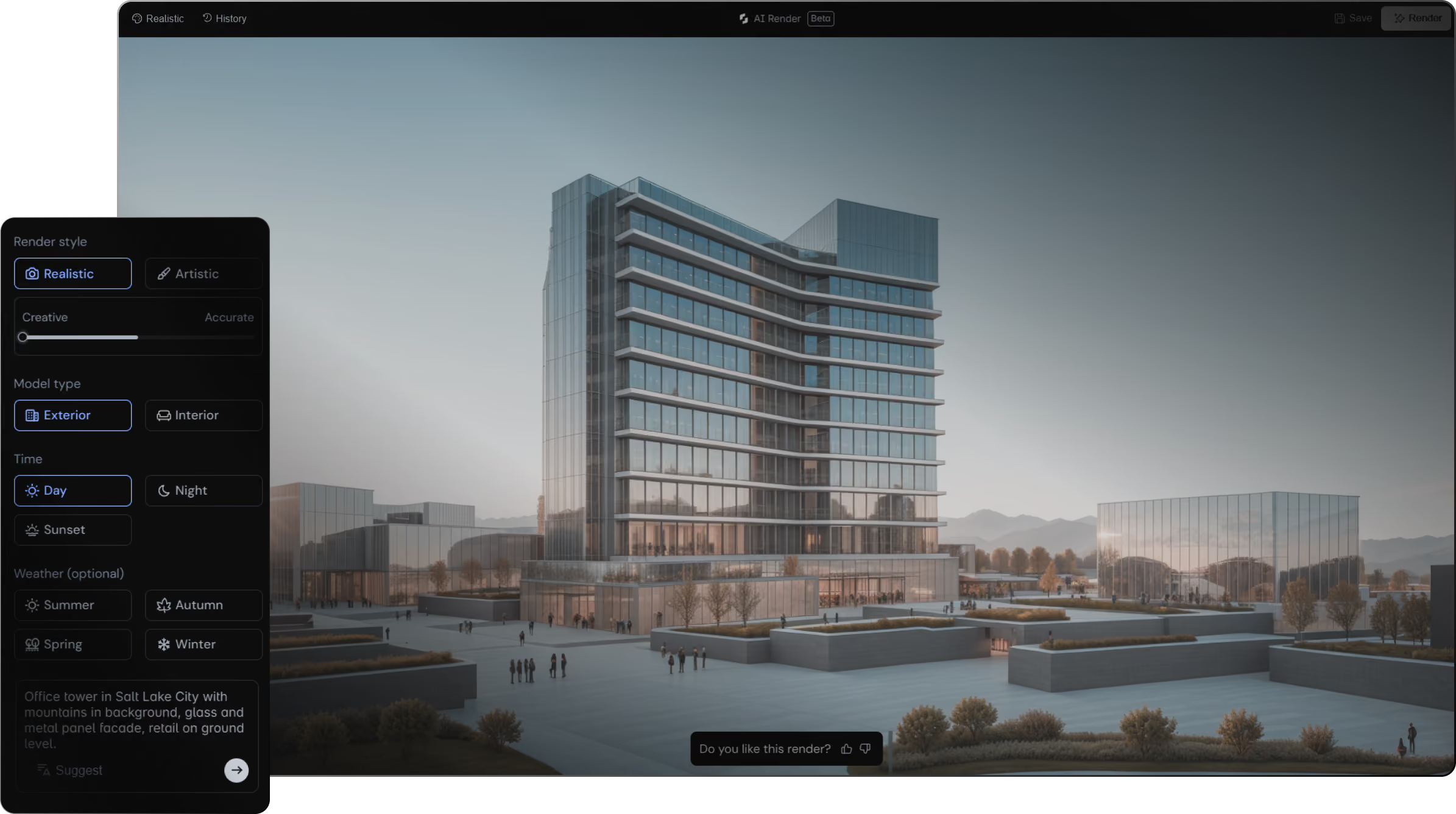
The Snaptrude universal agent turns setbacks, height limits, FAR and overlay zones into a 3D maximum volume. It is in private beta, and its output is a hypothesis until someone verifies each rule. Snaptrude says a brief becomes a zoning-checked working model in roughly 7 to 10 minutes.
Program mode keeps GFA, net rentable area, unit counts, unit mix and parking ratios tied to the geometry. A change to the massing updates those numbers. The developer workflow article explains why that shared, live view ends weeks of geometry debates and manual spreadsheet updates.
Parking gets its own test. The parking layout feasibility guide checks bays, aisles, ramps and accessible routes, and it counts only spaces that work geometrically. Snaptrude does not certify compliance or choose the governing parking rules, so your team confirms them.
Your pro forma stays in your own spreadsheet. Snaptrude supplies the GFA, rentable area, unit mix and parking counts that feed it. BIM mode then adds quantities, schedules and IFC export.
Where it shines (and where it doesn't)
It shines where the buildability gap would otherwise open. The architect opens the same geometry you underwrote, so a surprise at schematic design is less likely. Every output stays visible, editable and traceable, which answers the audit worry directly.
Real-time multi-user editing helps too. You and the architect debate the same model instead of two exported copies. Snaptrude's Brigade Group case study reports commercial test fits with costs delivered in 90 minutes, about 90% faster than before.
It falls short in several places. Snaptrude has no energy, carbon, CFD wind, noise or microclimate analysis, only sun hours and shadow studies. It is not a market-data or city-wide site-search platform, and it does not build the pro forma for you.
Its public pages also do not list every zoning jurisdiction it supports. Confirm your market in a demo. Parcel import is optimized for US addresses, so international sites need a manual CAD boundary.
Pricing breakdown
The Free plan costs $0 and includes three projects, basic BIM export and a single user. Individual costs $60 per month and adds unlimited projects. Organization costs $100 per month, billed annually, and adds teams, a license management portal and custom roles.
Enterprise is custom-priced and billed annually. It adds unlimited licenses, SSO, SAML and MFA, directory sync and open API access. Check snaptrude.com/pricing before you budget.
Notable users
Snaptrude's published case studies include Brigade Group and Square Yards. Brigade is an Indian developer with more than 70 million square feet developed.
Square Yards is a proptech company. Named customers include Studio+, MHAWorks, Dekker, Cucor Consulting, SF Architect and GNA. These are Snaptrude's own reports, so ask for references.
2. TestFit: Yield and parking on any parcel
TestFit is a real estate feasibility platform for generating and testing site plans. Developers, architects, contractors and planners use it to find a parcel's highest-value use. Its homepage promises to show "if the deal pencils before design begins."
Core features
Site Solver generates site plans with building presets, custom unit types and generative design. Parking Solver builds surface and structured layouts, with custom stalls and drive aisles. Both include a Yield Estimator.
Zoning scenarios run alongside unit mixes and parking ratios. TestFit supports multifamily, single-family, industrial, data center, retail, hotel and parking. Plans export to common BIM, CAD, spreadsheet and PDF formats.
Add-ons extend the base. Site Intelligence brings zoning and environmental data, 3D terrain with cut and fill, and power and utilities information. Pro Forma links live financials to the site plan, and you can import your own spreadsheet template.
Where it shines (and where it doesn't)
It shines on parking and yield depth. Parking is a core strength, with layout control and takeoffs in every plan. The live-linked pro forma speaks the language of an investment committee.
It falls short on cost transparency for small teams. Zoning data sits in a paid add-on, and Site Solver starts at $15,000 a year. Output is a test fit, not a BIM design, and support runs in English during US business hours.
TestFit's site lists testimonials. One developer reports initial site drafts that once took three to four weeks now take about 10 minutes. Treat that as a vendor-supplied claim and test it on your own sites.
Pricing breakdown
Parking Solver costs $195 per month, billed monthly. It includes parking automation, 2D and 3D massing, custom stalls and drive aisles, the Yield Estimator and unlimited users. Site Solver starts at $15,000 per year and adds building presets, generative design, custom unit types and an account manager.
Site Solver Portfolio starts at $20,000 per year and adds volume pricing, enterprise SSO and quarterly business reviews. Add-ons cost $150 per month for Site Intelligence, $170 for Pro Forma and $100 for MCP Connection on Parking Solver. Site Solver and above include MCP Connection.
Notable users
The vendor lists UDR, Transwestern, Prologis, Related Companies, Perkins & Will, Cushman & Wakefield and Brookfield among its customers. It spans owners, brokers, architects and municipalities. Ask which of those use the zoning add-on.
3. Deepblocks: Parcel screening with zoning and pro formas
Deepblocks is an AI platform for real estate development, founded in 2017. It analyzes parcel data, zoning rules, construction costs, market trends and demographics across more than 300 US cities. Its job is to find and rank sites before you spend design money.
Core features
Zoning analysis estimates development potential for a parcel. Site search scans thousands of properties against your criteria, such as use type, unit count and price range. It returns ranked opportunities.
The platform also generates financial projections, pro forma models and comparative site analysis. It adds construction cost estimates and market demographics. The Dev product includes 3D massing visualization, and custom API access is available on request.
Where it shines (and where it doesn't)
It shines at the top of the funnel. One case study reports 1,000 properties narrowed to two optimal sites in under a minute. That is a vendor claim, but the use case is real: fewer bad acquisitions reach your investment committee.
It falls short on transparency. The vendor claims 90% time and cost savings versus manual analysis but publishes no accuracy metrics. Data retention, model training and SOC 2 status are not public, so ask before you upload deal data.
Coverage is US only, and there is no free tier. Massing is a visualization, not a design model your architect continues in.
Pricing breakdown
A third-party listing puts Pro at $2,000 per month, with tiers not detailed. Enterprise is custom-priced. Confirm both with the vendor.
Notable users
Deepblocks cites case studies in Miami and Brooklyn and more than six institutional investors. It has raised about $4.53M. Its stated users are developers, architects and construction firms.
4. ArchiWise AI: Early go or no-go site screening
ArchiWise AI is a site selection and pre-development platform for US real estate developers. It turns parcel data, zoning codes and feasibility variables into decision support. Its page says this takes under five minutes.
The alternative it targets is two to four weeks of manual screening, zoning research and consultant back-and-forth.
Core features
The platform identifies permitted land uses and development standards. It goes beyond raw zoning records. It also provides feasibility analysis and assesses financial viability.
Teams can screen several sites at once. That makes earlier go or no-go calls possible, before consultants are engaged.
Where it shines (and where it doesn't)
It shines as a first filter. If your pipeline holds more parcels than your consultant budget can study, a fast screen is useful.
It falls short on proof. The vendor claims 99% accuracy across thousands of US municipalities. Ask for the methodology, a sample audit and the date of its zoning data.
The page does not mention massing, and it names no customers.
Pricing breakdown
ArchiWise AI lists no prices. Contact its sales team for a quote.
Notable users
The page names no customers. Its stated audience is US real estate developers. Ask for references from deals in your own market.
5. Digital Blue Foam: Climate-aware massing options
Digital Blue Foam is a web-based AI platform for early-stage urban planning and building design. It takes site coordinates and project parameters. Local regulations and BIM models are optional inputs.
Core features
The platform generates massing options with sustainability optimization. It reports carbon emissions and energy performance metrics. Wind and solar analysis, feasibility scores, cost estimates and compliance checks appear in an interactive 3D dashboard.
It integrates with common BIM and CAD tools and offers a desktop app called DBF Hub. Its API is not publicly documented.
Where it shines (and where it doesn't)
It shines when environmental performance affects value. Carbon, energy and wind metrics sit beside feasibility scores, which matters when sustainability affects asset value.
It falls short on rules and price transparency. The listing does not mention zoning specifically, so confirm how local regulations enter the analysis.
The vendor claims a 50% cut in feasibility study time and a 75% cut in BIM production time. It does not publish the methodology.
Pricing breakdown
A Free tier includes a 7-day full-access trial. Pro pricing is not published, and access runs through a waitlist. Enterprise is custom-priced for organizations of 1,000 or more people.
Notable users
The vendor reports more than 7,000 users, including Takenaka, Jacobs, AECOM, Emaar Properties and McKinsey. Those are vendor claims. Ask for a reference in your building type.
6. Higharc: From lot to permit for homebuilders
Higharc is cloud-based BIM and homebuilding AI for US and Canadian homebuilders. Builders design homes from scratch or configure market-proven plans. Every plan change produces lot-specific estimates, permit-ready construction documents and shoppable 3D visuals.
Core features
Automatic framing and code checks run as you draw. Design, sales, estimating and construction share one connected system. That makes it a feasibility tool for a specific job: testing a plan on a lot.
Where it shines (and where it doesn't)
It shines for production builders. Signature Homes reports a $30M return and a new plan from idea to permit in two weeks.
Ashlar Homes cut a new plan from concept to 3D model from three to four months down to three days. New Home Inc. reports permits 10 days faster.
It falls short outside homebuilding. It targets homebuilders, so mixed-use, multifamily or commercial feasibility sits outside its stated scope. Those results are customer reports, so test them against your own plan library.
Higharc raised a $95M Series C on June 30, 2026, led by Insight Partners. It has about 215 staff and roughly $175M raised since 2019. That funding suggests staying power, not fit.
Pricing breakdown
Higharc does not publish prices, and sales are demo-led. AEC Magazine reports that it avoids per-seat and metered charges. Ask what a full plan library costs to set up.
Notable users
Named customers include Signature Homes, Ashlar Homes and New Home Inc. They are production builders in the US market. Ask for a builder of your size.
7. Northspyre: Budgeting and cost control after the deal pencils
Northspyre is development management software covering deals, project costs and portfolio analytics. The vendor calls it the industry's only end-to-end development management platform. That is a vendor claim, and its real strength is cost control.
Core features
Budgeting uses historical cost data and benchmarks to model scenarios and check assumptions on each line. Cost forecasting aims to keep funding on time and vendors under control. Pre-development tools centralize bids, forecasts and schedules, and AI-powered insights flag scope gaps.
Construction tools track budgets, change orders and fund reallocation. Reporting covers lenders, investors and portfolios. Deal management adds financial modeling and pipeline tracking.
Where it shines (and where it doesn't)
It shines after the deal pencils. A budget that compares scenarios against actuals gives your committee an auditable trail.
The vendor claims 80% less manual work, 66% fewer cost overruns and 40% time saved per employee. We could not verify any of those figures.
It falls short as a feasibility tool. It does not model geometry or zoning, and the vendor does not list feasibility as a named feature. Pair it with a massing tool.
Pricing breakdown
Northspyre lists no prices on the pages we reviewed. Ask for a quote based on your project volume.
Notable users
Logos on its site include Core, Leggat, Aria, Hillwood, Trilogy, GMH, Oxbow, BREV and Xebec. Testimonials come from Oxbow Development Group, Watermark Properties, Windsor Stevens, Presidio Bay Ventures and Biddle BREV. These are vendor-selected, so request an independent reference.
Which tool fits your deal?
Match the tool to the decision in front of you:
What to ask before you trust a feasibility output
Ask every vendor these questions in writing, and keep the answers with the deal file:
- Assumptions: Which assumptions drive the result, and can I see and edit each one?
- Zoning source: What source and date sit behind the zoning numbers?
- Output format: Does the result end in GFA, unit mix, stall count and cost per unit or per key?
- Handoff: Can the architect open and continue the same geometry?
- Accountability: Who is accountable if the entitlement reading is wrong?
- Data handling: What are the retention, model-training and security terms for deal data?
Frequently asked questions
How much does a feasibility study cost?
A consultant-led study often costs $15,000 to $30,000 and takes several weeks. Software ranges from free tiers to plans above $15,000 a year. The right comparison is cost per deal evaluated.
Can AI replace the architect in feasibility?
No. The architect's seal is the accountability that owners and developers are buying. Software should make their work better informed, not remove them from the deal.
Which tool is best for a quick go or no-go?
Deepblocks and ArchiWise AI screen many parcels early. TestFit tests one parcel in depth for yield and parking. Snaptrude suits deals that will move straight into design.
How do I price entitlement risk?
Treat a by-right envelope as a hypothesis until planning staff confirm it. Neighborhood opposition added 5.6% to cost and 7.4 months where it occurred. Reserve contingency in the pro forma for that exposure.
What is the gross-to-net factor and why does it matter?
It converts net program area into gross building area. A factor of 1.25 turns 80,000 net square feet into 100,000 gross. A wrong factor shifts your cost per unit and your parking count.
Do these tools cover environmental analysis?
Digital Blue Foam reports carbon, energy, wind and solar metrics. Snaptrude has no energy, carbon, CFD wind, noise or microclimate analysis, only sun hours and shadow studies. Use a specialist tool for detailed performance work.
Final take: judgment first, volume never
Pick Snaptrude when the feasibility model should continue into design without a rebuild. Pick TestFit for deep yield and parking tests, and Deepblocks or ArchiWise AI for early parcel screening. Pick Digital Blue Foam for climate metrics, Higharc for production homes and Northspyre for budget control.
Whatever you choose, keep your architect in the loop. Software cannot replace the person who signs and seals the building.
Want a feasibility model your architect can continue? Try Snaptrude today to explore and ship your feasibility model and report.