Last updated:
BIM Software Release Testing Matrix: Prove Connected Workflows Are Ready
TL;DR
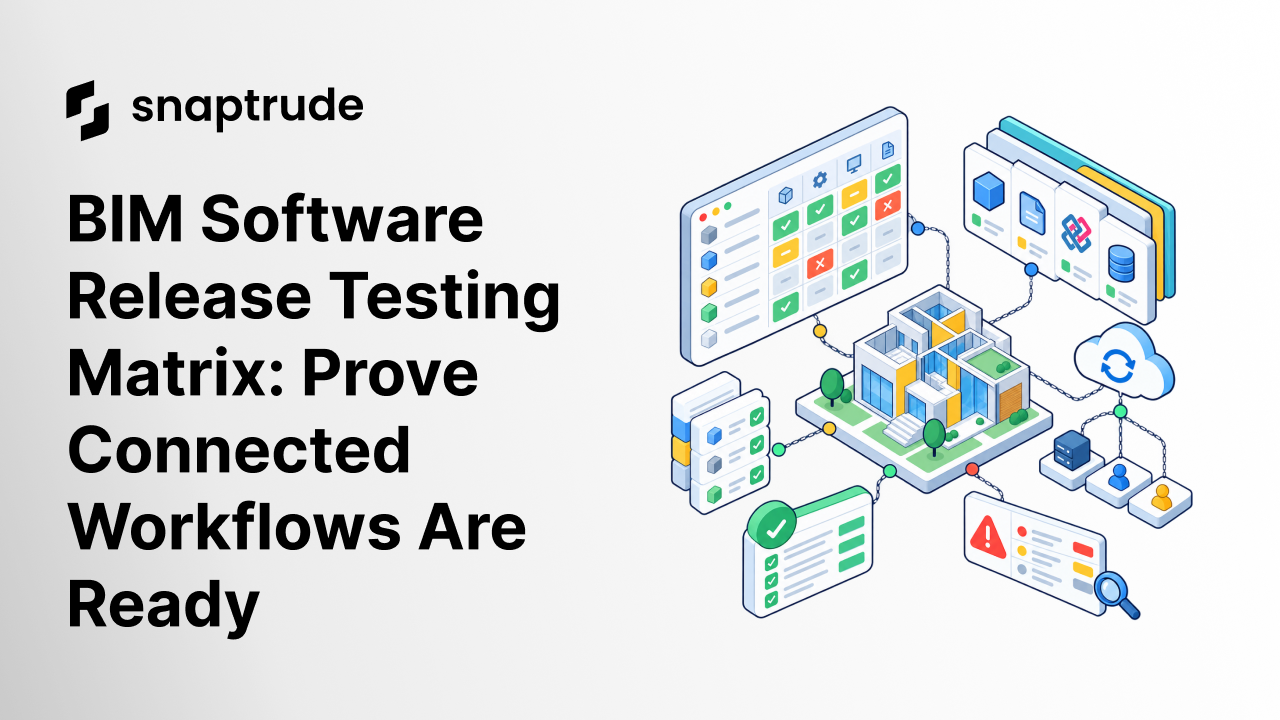
A BIM software release testing matrix proves readiness across feature, integration, system, acceptance, stress, and production checks. Map each critical user workflow to its dependencies, representative model, expected state, owner, defect disposition, and release evidence so isolated success cannot hide a broken connected path.
What is a BIM software release testing matrix?
A BIM software release testing matrix is a decision artifact that links critical workflows with the levels and types of evidence required before release. Rows represent user paths or risks. Columns represent component checks, integrations, end-to-end behavior, acceptance, non-functional conditions, production smoke tests, owners, and defect decisions.
The matrix solves a common release problem. One feature can pass on its own while the complete workflow still fails. An import may succeed, but selection is unusable. A geometry edit may display correctly, but quantities or views do not update. A template may apply, but an exception creates unexpected relationships. Each team can show green tests while the user still reaches a broken state.
ISTQB's Foundation Level syllabus distinguishes component, component-integration, system, system-integration, and acceptance testing. It explains that component-integration testing focuses on interfaces between components, system-integration testing covers interfaces with other systems or services, and acceptance testing demonstrates readiness for deployment and fit with business needs. (ISTQB Certified Tester Foundation Level Syllabus v4.0.1)
For BIM software, those levels should be organized around real model tasks. The artifact is not the list of tests. It is the coverage map that shows how feature evidence adds up to release confidence.
Why does a BIM software release testing matrix need workflows?
Users experience sequences. They import, navigate, select, edit, collaborate, save, document, export, and reopen. A release can preserve each command while breaking the sequence between them. That is why the matrix should begin with critical outcomes rather than with the organizational chart or codebase.
Define each workflow with:
• User and project objective
• Representative model or safe fixture
• Preconditions and accepted starting state
• Ordered actions and meaningful variations
• Dependent features, services, and outputs
• Expected intermediate and final state
• Performance, reliability, and recovery conditions
• Evidence required for release
Include ordinary work and edge cases. A rectangular room or small model may prove basic behavior but hide the conditions that matter in practice. Irregular boundaries, repeated elements, mixed object types, collaboration, and successive edits often reveal failures that a happy-path test does not.
This does not mean testing every combination. Rank workflows by consequence, frequency, change exposure, reversibility, and detection difficulty. A broad model-state change that is hard to detect deserves deeper coverage than a local, visible, reversible display preference.
Use a structured BIM software evaluation to identify the production tasks that should become release workflows.
Try Snaptrude with a representative model and record the complete path your team must trust, from first input to editable output.
How should the BIM software release testing matrix be structured?
Keep the matrix readable enough for a release meeting. Link to detailed cases and automated results rather than putting every assertion in one sheet.
Add columns for owner, environment, last result, open defects, and disposition. Use stable identifiers so the matrix can link a failed release check to the exact case, run, model fixture, and corrective change.
The matrix should distinguish “not run” from “passed,” and “passed with accepted limitation” from an unconditional pass. Ambiguous cells create false confidence.
Which test levels belong in BIM release testing?
Use the test levels to answer different questions:
1. Component: Does one operation behave correctly across valid and invalid inputs?
2. Component integration: Do closely connected functions exchange state correctly?
3. System: Does the complete product workflow reach the expected result?
4. System integration: Do import, export, identity, permissions, or external services behave at their boundaries?
5. Acceptance: Can the intended user complete the production job with acceptable output and recovery?
Then add non-functional coverage across representative workflows. Measure interaction, navigation, selection, repeated editing, save, export, resource use, reliability, security, accessibility, and recovery where applicable. A speed improvement should never be accepted without checking visual and model correctness.
NIST's Secure Software Development Framework is focused on security, but its operating principle applies: secure practices should be integrated into each software-development lifecycle rather than treated as a separate phase. It provides a common vocabulary that producers and purchasers can use. Include security tests and vulnerability dispositions in the same release evidence without pretending they replace functional, usability, or model-integrity checks. (NIST SP 800-218)
How should teams handle open defects before release?
A defect count is not a release decision. Ten cosmetic issues and one undetected model-state error are not equivalent. Every open defect that touches the matrix needs an explicit disposition.
Use these fields:
• Affected workflow and acceptance rule
• Severity of the user outcome
• Frequency or known trigger
• Detectability before harm
• Reversibility and recovery path
• Scope of affected model state
• Workaround and its validation
• Owner and target decision date
• Decision: fix, defer, disable, accept, or block
• Person authorized to accept residual risk
Do not let a workaround remain verbal. Add it to the relevant acceptance case and verify that the intended user can apply it without privileged knowledge. If a defect is deferred, the matrix should show which workflow evidence is conditional and how the limitation will be communicated.
Read why preserving constraints matters in AI-assisted architecture when a release changes automated or generative model behavior.
What should a production smoke test cover?
A production smoke test is a small, safe confirmation that critical paths operate in the deployed environment. It is not permission to experiment with customer data or publish a test artifact. Use controlled fixtures and reversible actions.
Choose a few high-signal checks:
1. Authenticate with the intended role and permissions.
2. Open or import a safe representative model.
3. Navigate, select, and make one reversible edit.
4. Verify a dependent view, schedule, quantity, or model state.
5. Save or persist, reopen, and confirm the accepted result.
6. Check alerts, logs, or traces for silent errors.
7. Roll back or clean up the fixture.
Record the deployed version, time, operator, fixture, result, and correlation identifiers. A failed smoke test should have a stop rule. Repeatedly retrying until one run passes can erase the evidence that the release is unstable.
How do you keep the matrix useful over time?
Treat the matrix as a maintained release contract. Add a row when a new workflow becomes critical or a meaningful failure escapes. Remove or merge rows when they no longer represent distinct risk. Keep representative fixtures small enough to run but realistic enough to expose the behavior users care about.
Review these questions after each release:
• Which failure escaped the matrix, and why?
• Which tests produced no useful decision evidence?
• Which representative model no longer reflects current work?
• Which manual acceptance check can become deterministic?
• Which automated check still needs human judgment around usability?
• Which open limitation was communicated and later closed?
The aim is not maximum test volume. It is traceable confidence. A smaller matrix with clear outcomes, stable fixtures, and explicit ownership is more useful than thousands of passing checks that do not map to a production task.
How does Snaptrude fit into a release testing matrix?
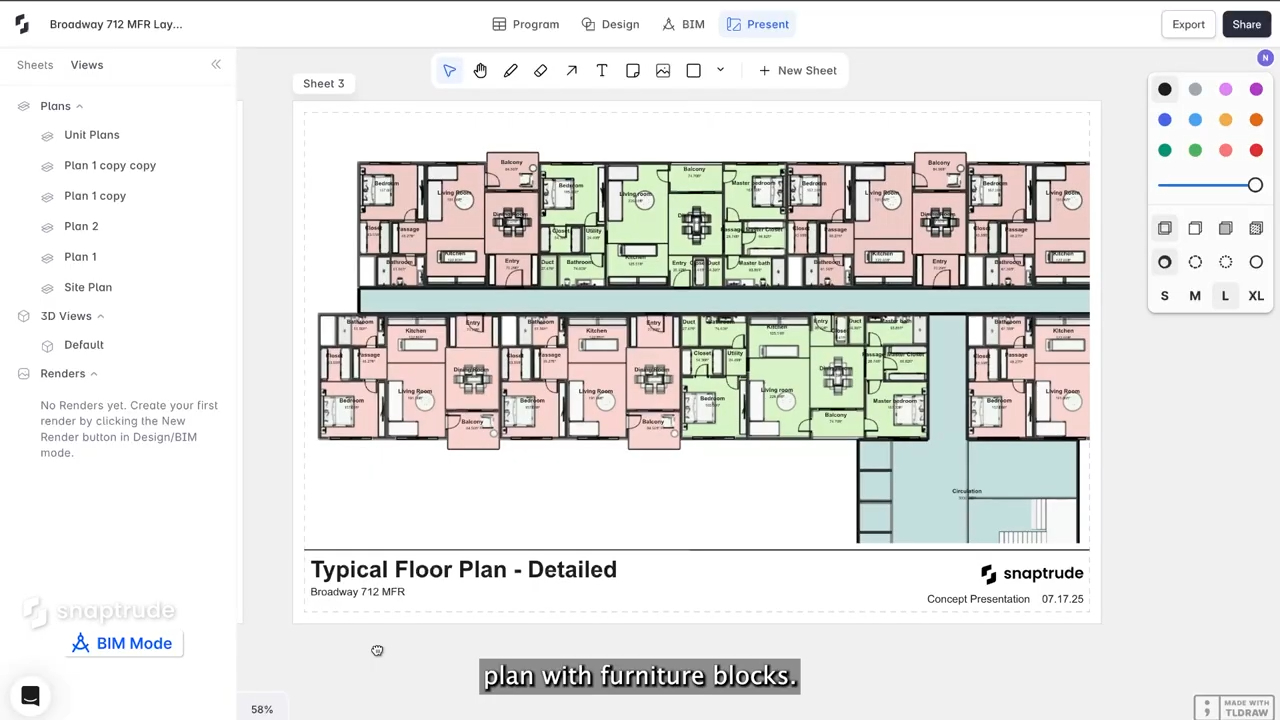
Snaptrude is a web-based architectural design platform with real-time multiplayer collaboration. Its four modes connect program requirements and areas, concept modeling, BIM elements and quantities, documentation, and presentation. It supports Revit, Rhino, DWG, IFC, and PDF export paths as documented product capabilities.
Those connected capabilities can inform representative acceptance workflows. A team might test a program adjustment through editable geometry and a live presentation view, or a BIM change through schedules and export. The exact matrix should reflect the features the team plans to use.
This article does not claim a particular internal Snaptrude release process, defect rate, or performance result. It provides a vendor-neutral method for evaluating connected BIM releases with evidence proportional to user risk.
References
Certified Tester Foundation Level Syllabus v4.0.1: International Software Testing Qualifications Board, 2024 edition. Defines component, integration, system, and acceptance test levels and their distinct purposes.
Secure Software Development Framework Version 1.1: NIST SP 800-218, February 2022. Supports integrating secure-development practices into the lifecycle and using a shared vocabulary for producers and purchasers.
AI RMF Core: NIST AI Resource Center. Supports contextual testing before deployment, regular operational testing, documentation, and monitoring for AI-enabled workflows.
FAQ: Frequently Asked Questions
Q: What is the minimum BIM software release testing matrix?
A: Start with the five to ten workflows whose failure would most disrupt users or damage accepted model state. For each, record component, integration, system, acceptance, non-functional, and production evidence, plus owner and defect disposition. The matrix can link to detailed tests. Its job is to reveal missing coverage and support a release decision, not to contain every test instruction.
Q: How is a release matrix different from a test plan?
A: A test plan explains scope, approach, environments, resources, and execution. A release matrix maps critical user workflows and risks to the evidence that must pass across test levels. The matrix is a compact decision view. It can point to several plans and suites while showing whether the complete release contract is satisfied, conditional, untested, or blocked.
Q: Should every BIM feature have an end-to-end test?
A: Not every isolated setting needs its own full path. Prioritize features that cross model state, integrations, collaboration, persistence, documentation, or export. Group local behavior into component tests, then cover representative combinations in end-to-end workflows. Use risk, frequency, reversibility, and detection difficulty to decide depth. The matrix should make those choices visible rather than implying universal coverage.
Q: Can automated tests replace BIM acceptance testing?
A: Automation can verify geometry, data, relationships, file results, performance bounds, and repeatable state transitions. Human acceptance is still valuable where usability, design judgment, visual communication, or practical review effort determines whether output is useful. Define each role. A manual check should have a clear question and evidence, while a deterministic rule should be automated when reliable and maintainable.
Q: Why include production checks in a BIM software release testing matrix?
A: Test environments cannot reproduce every deployment dependency, permission, configuration, or operational path. A safe production smoke test confirms that a few critical workflows work after deployment. It should use controlled fixtures, reversible actions, explicit cleanup, and a stop rule. It does not replace pre-release testing and should never expose customer work to unnecessary test activity.
Q: How can a team apply the matrix to Snaptrude?
A: Select the Snaptrude capabilities the team intends to use, such as programming, concept modeling, multiplayer collaboration, BIM documentation, or export. Build representative workflows that cross those boundaries, define expected editable state, and record acceptance and recovery evidence. Do not rely on a feature list alone. Use familiar project conditions while keeping test fixtures safe and permissioned.
Try Snaptrude with one representative workflow and turn every release assumption into a named check, owner, and acceptance result.