Last updated:
Automated Space Planning Benchmark: Test Layout Quality, Not Speed
TL;DR
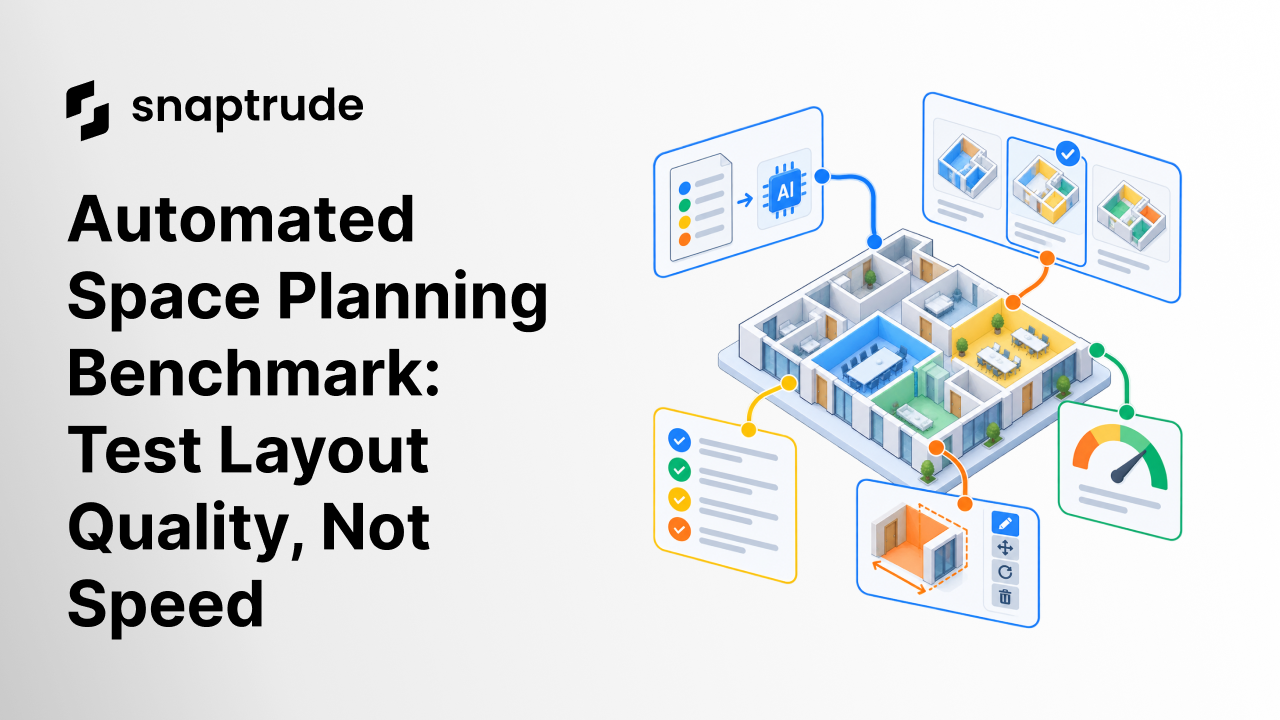
An automated space planning benchmark should measure whether a generated layout solves the architectural job, not merely how fast it appears. Test representative programs and boundaries, then score adjacency, access, usable geometry, circulation, constraint compliance, editability, runtime, and recovery separately. Keep a fixed reference set, record every configuration, and reject speed gains that make the plan harder to trust or change.
What should an automated space planning benchmark measure?
An automated space planning benchmark is a repeatable test of architectural quality, model usability, and system behavior across a defined set of inputs. It asks whether the output meets the brief, respects the boundary, creates workable circulation, and remains editable. Runtime matters, but it is only one column in the scorecard.
Start with the decision the benchmark must support. A product team may need to compare solver versions. A design technology group may need to approve a workflow for practice. A project team may need to decide whether a generated option is credible enough for discussion. Each decision needs a stable test set, an explicit pass threshold, and a named reviewer.
Separate outcome metrics from process metrics. Outcome metrics describe the plan: program fit, adjacency, boundary placement, access, circulation, geometry, and usable area. Process metrics describe the experience: generation time, failure rate, correction effort, editability, and recovery after an invalid input. A fast result with trapped rooms or broken geometry is not a successful result.
See how adjacency analysis can make program relationships explicit before generation.
Try Snaptrude with one representative program and build a reviewable model-based benchmark.
Which cases belong in an automated space planning benchmark?
Do not build the benchmark from one idealized rectangle. Choose a small set that exposes different failure modes while remaining practical to run after every meaningful change.
Use real distributions of room counts, areas, and adjacency density, but remove private project data from a reusable benchmark. Preserve the structural difficulty of the problem without retaining client names, addresses, program labels, or confidential standards.
Freeze the inputs once the set is accepted. A moving test set makes version comparisons unreliable. New edge cases can enter a secondary challenge set until the team decides they should become part of the permanent baseline.
How do you score architectural layout quality?
Use independent measures so one strong result cannot conceal another failure. A practical scorecard includes:
Treat hard constraints and preferences differently. A room outside the boundary is usually a hard failure. A less-than-ideal department arrangement may be a scored preference. If both are collapsed into one percentage, a high average can bless an unusable plan.
Measure the distribution, not only the mean. Record the worst case, median, variability, and failure count for each metric. A workflow that produces excellent results four times and a broken result once may be inappropriate for an unattended path even if its average looks strong.
How should teams compare speed with quality?
Set a quality floor before ranking runtime. First discard any run that violates a hard constraint or produces an uneditable result. Compare speed only among outputs that clear the same acceptance threshold.
Run the benchmark several times under controlled conditions. Record the application version, test-set version, machine or browser environment, solver configuration, input seed if applicable, and start and end times. If generation is nondeterministic, preserve the individual results. One unusually good run is not evidence of dependable behavior.
Use a tradeoff table during review:
The relevant measure is time to a reviewed, editable option. Generation time may be only a small part of that path. A result that needs twenty minutes of cleanup is slower in practice than one that takes an extra minute to generate and passes review.
See why architects should remain the authors of AI-assisted design decisions.
How do you review editability and recovery?
Open the generated model and perform a fixed correction script. Move a boundary, change a room target, alter an adjacency, delete and restore an opening, and regenerate one zone. Confirm that unrelated areas remain stable and that the changed objects retain meaningful identity and data.
Then test recovery. Supply an impossible program, a malformed input, and a boundary that cannot support the minimum requirements. The workflow should identify the conflict, preserve prior valid work, and allow a reviewer to correct the input. A silent compromise is more dangerous than an explicit failure because the output can look finished.
Review both local and global consequences. Correcting one doorway should not rearrange an accepted department unless the relationship requires it. Regenerating one zone should not erase manual work elsewhere without a clear warning. Record the expected scope of every operation before testing it.
How can Snaptrude fit into the benchmark?
Snaptrude's verified capabilities include AI-assisted space planning, area calculations, adjacency planning, connected program data, BIM objects and data, parametric concept modeling, real-time collaboration, drawings, schedules, quantities, and documented export formats. These capabilities can support a model-based benchmark in which reviewers inspect both spatial outcomes and editable building elements.
Do not convert product capability into a guaranteed result. Define the benchmark around your building types, office standards, and delivery requirements. Confirm current product behavior with a representative project, keep an architect in the review loop, and validate any downstream Revit, IFC, DWG, Rhino, or PDF exchange separately.
Explore how program strategy changes the space-planning question.
FAQ: Frequently Asked Questions
What is an automated space planning benchmark?
An automated space planning benchmark is a fixed set of programs, boundaries, metrics, and review steps used to compare generated layouts. It measures architectural quality and workflow reliability, not only runtime. A useful benchmark includes ordinary cases, difficult geometry, conflicting inputs, and a correction sequence so teams can test what happens after the first result.
How many layouts should a benchmark include?
Start with the smallest set that represents materially different failure modes. Six to twelve cases can be more informative than dozens of similar rectangles. Include a baseline, an irregular boundary, a dense program, multiple departments, repeated room types, and invalid input. Add cases only when they reveal a new architectural or operational risk.
Which space-planning metrics should be pass or fail?
Hard requirements such as boundary containment, required rooms, valid access, closed geometry, and protected exclusions should usually be pass or fail. Preferences such as secondary adjacency, compactness, or perimeter access can use weighted scores. Document the distinction before testing, since changing weights after seeing results makes comparisons difficult to trust.
Should runtime be part of the quality score?
Track runtime beside quality rather than allowing it to cancel a failure. Establish a minimum quality and editability threshold, discard runs below it, then compare speed among passing outputs. Also record correction time. The fastest generator may produce the slowest reviewed option when architects must repair relationships, geometry, or model data afterward.
How often should a layout benchmark run?
Run the permanent baseline after any change that could affect generation, geometry, model objects, or correction behavior. Run it before a workflow is approved and at regular intervals during operation, consistent with NIST's test-and-monitor approach. Keep the same inputs and environment metadata so results remain comparable across versions over time.
Can a benchmark prove that every generated plan is safe to use?
No. A benchmark estimates behavior across representative cases; it does not replace project review, code analysis, accessibility review, engineering, or professional judgment. Treat it as an acceptance gate and regression detector. Every project output still needs review against the actual brief, site, jurisdiction, office standards, and downstream delivery requirements today.