Last updated:
AI Building Design: Architects as Authors, AI as Assistant
TL;DR AI won't replace architects - it handles tedious computational work. Architects maintain creative authorship while AI manages layout generation, area tracking, and design iteration. The partnership frees time for context interpretation, client communication, and aesthetic judgment. Cloud-native tools enable 10 design options in hours. Snaptrude augments architects with AI space planning, live metrics, and real-time collaboration.
By the Numbers
- 41% of architects are already using AI building design tools, and 54% of practices expect to be using AI within two years, indicating rapid adoption driven by time pressure and efficiency demands.
- 44% of architects cite increased productivity as the primary AI building design benefit, 39% mention automating mundane tasks, and 36% focus on producing informed design options through computational exploration.
- 78% of architects want to learn more about AI in architecture, but 78% simultaneously expressed concerns about reliability, indicating enthusiasm tempered by practical questions about implementation and trust.
- Only 8% of architecture firm leaders report fully integrating AI building design into practice, despite 41% of individual practitioners already experimenting, showing lag between individual adoption and institutional integration.
- The global architectural design software market is projected to grow at 13.96% CAGR through 2030, driven largely by AI integration and cloud-native capabilities demanded by design teams.
The Role Architects Cannot Be Replaced In
Machine learning excels at pattern recognition, optimization, and computation. Given a set of constraints and objectives, AI can explore thousands of design variations faster than humans can sketch. But where AI cannot substitute for architects is the interpretation of context. A program spreadsheet tells AI the dimensions and adjacencies. Only an architect can look at a site and understand the light patterns, neighborhood character, pedestrian flows, and social dynamics that should shape design.
Similarly, AI cannot maintain client relationships. Clients need to be heard, to feel understood, and to see their needs reflected in design. An architect spends time in conversation understanding what the client actually wants underneath what they say they want. AI also cannot make aesthetic judgments - a design can satisfy all functional constraints and still be ugly. Finally, architects must maintain ethical and community-impact thinking: how does this building affect neighborhood economic diversity, housing affordability, and climate goals? These require value judgment and ethical reasoning that AI cannot provide.
The Vision: Architects in Control, AI Building Design in Service
Imagine a design workflow where the architect maintains complete authorship while AI handles everything computational. The program arrives as a spreadsheet - upload it and AI building design generates a 3D model with space blocks organized by department. Circulation is automatic. Adjacencies are enforced. Areas are exact. The architect reviews the generated layout and keeps it as the base, or adjusts constraints and regenerates in seconds.
Next, the architect sketches a massing form representing the overall shape. AI sees the form, understands the intent, auto-suggests how to divide it into floors, calculates gross to net ratios, and generates floor plans that respect the massing while organizing the program efficiently. The architect wants to explore options - instead of redrawing each variation, they adjust parameters. AI generates ten design options simultaneously, each showing areas, floor plates, circulation distance, and cost implications. In one afternoon, they've explored design spaces that would take a week of manual drafting.
All of this happens under the architect's control. The architect makes the creative decisions. The architect decides whether an AI suggestion is worth accepting or needs modification. What changes is that tedious computational work gets delegated to an assistant that never gets tired and never makes arithmetic mistakes.
How Snaptrude Delivers AI Building Design as Augmentation
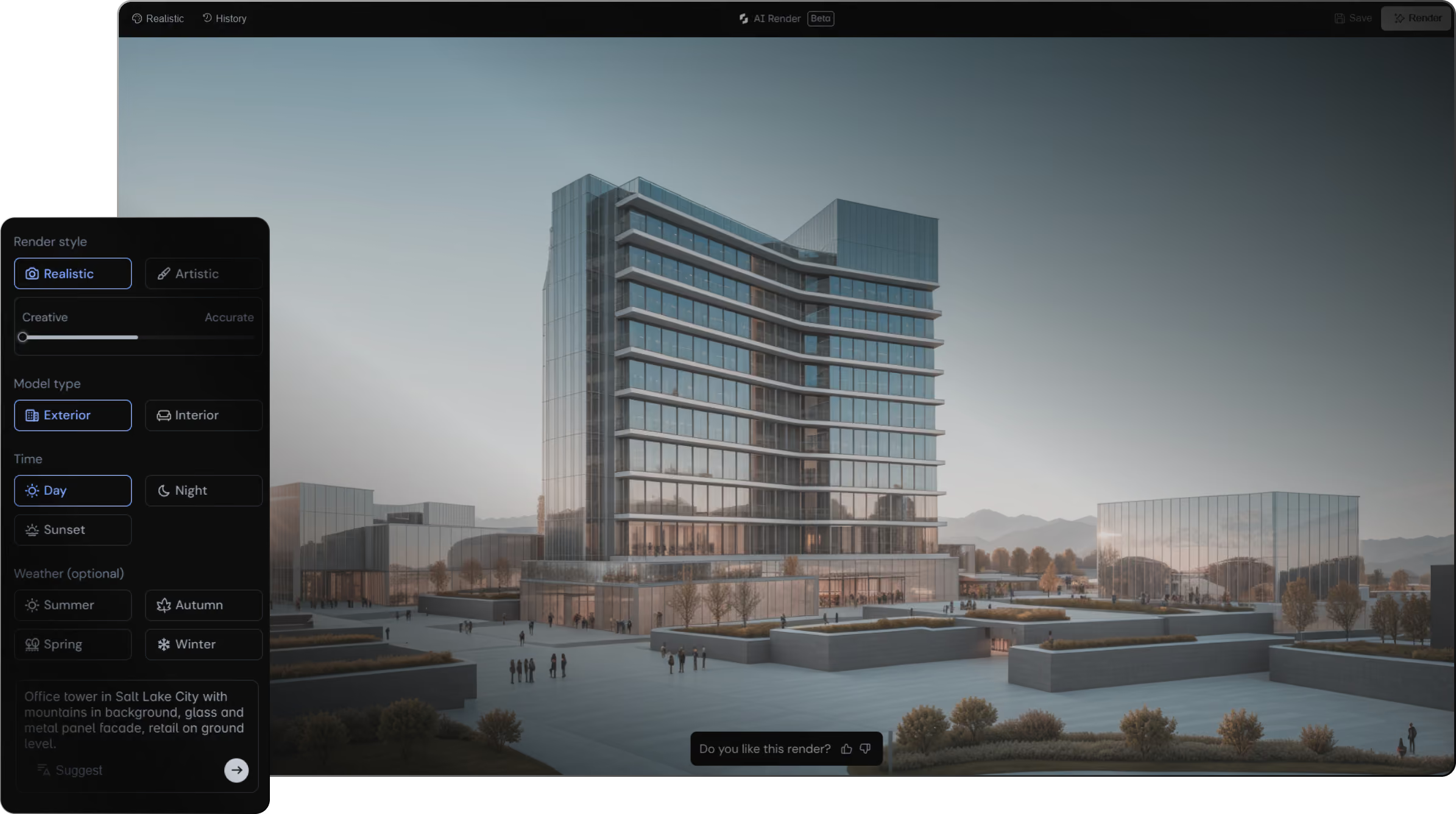
Snaptrude is an AI-powered, cloud-native BIM software design tool that puts this vision into practice. Paste a client spreadsheet into Snaptrude's Program Mode and the AI Program Creator generates a 3D layout with proper spaces, adjacencies, and areas - no manual data entry required. Create design options with different massing schemes and Snaptrude's AI tracks areas independently across each option, letting architects compare ten design directions in minutes instead of days. When consultants ask for updated areas or schedules, Snaptrude's live calculations propagate changes instantly instead of requiring manual reconciliation.
The key difference: Snaptrude's AI building design runs continuously on live data. Architects don't invoke separate AI features; they work naturally, and the system assists contextually. Unlike Revit with AI plugins, Snaptrude's cloud-native architecture means AI reasoning is built into every operation, not bolted on.
Reclaiming Time for Design Thinking
The practical impact is time recovery. Currently, a significant portion of an architect's day is consumed by work that's necessary but not creative - updating schedules because a room dimension changed, recalculating areas after a geometry adjustment, exploring whether a setback violation exists, creating multiple presentation options, coordinating with consultants who modeled the same areas in separate software.
By conservative estimate, this computational and coordination work occupies 25-40% of design time, depending on project phase. For a senior architect billing $150/hour, that's $15,000-$24,000 per year of capacity spent on tasks that don't require their skill or judgment. In 2026, as competition intensifies around design innovation and speed, this time recovery becomes a competitive differentiator. Leading firms are already recruiting on the basis of offering modern AI-augmented workflows that respect architects' time.
The Constraints That Matter
The vision of architects as authors with AI building design assistants only works if certain conditions are met. First, the AI must be trustworthy - if the system generates floor plans with hidden conflicts or calculates areas incorrectly, the architect has to verify every output. Second, the data must be continuous - if architectural decisions in the 3D model don't automatically update schedules and cost estimates, the AI assistance becomes incomplete. Third, the AI must understand context - generic AI models trained on thousands of building types can suggest layouts, but without understanding the specific building's constraints, suggestions are mediocre. Fourth, the interface must make architectural sense - AI that requires prompts in arcane syntax will never be trusted.
The Adoption Path
The adoption path starts with specific, high-value tasks. AI that checks zoning compliance saves time and prevents errors. AI that generates preliminary layouts from a program saves days of drafting. AI that simulates ten design variations and shows cost and schedule impacts simultaneously accelerates decision-making. These specific AI building design capabilities work today with current AI maturity.
As systems mature, delegation becomes more comprehensive: from zoning checks and layout generation, to structural and systems preliminary design, to automated coordination and clash detection. The firms that move first gain competitive advantage through recovered time and better designs. Within 10 years, it will be industry standard.
AI Building Design: Autonomous vs. Augmentation
| Aspect | Generic AI Tools | Revit + AI Plugins | AI Augmentation (Snaptrude) |
|---|---|---|---|
| Design Authorship | AI generates independently; architect approves | Limited AI capabilities | Architects maintain creative control |
| Program Interpretation | Generic patterns only | Requires manual setup | AI assists with layout; architect decides |
| Design Options | Single solution or generic variations | 1-2 options (time-consuming) | 10+ options in minutes |
| Time to Iteration | Hours per direction | Hours (file duplication) | Minutes per option |
| Context Understanding | Limited to training data | Revit constraints limit reasoning | Learns from architect's feedback |
| Architect Role | Approval/rejection only | Manual integration of AI results | Active design thinking partner |
| Trustworthiness | Requires verification of every output | Medium (plugin reliability varies) | Reliable on routine tasks |
Related reading
- Top 18 AI Tools for Architects in 2026
- AI Architecture Software: Why Generic AI Generates Generic Buildings
- AI Architecture Software: Why Architects Still Trust Excel Over AI
- AI Agents for Architectural Programming: What They Do and Why We Built Them
FAQ
Q: Will AI eventually be good enough to design buildings autonomously?
A: Technically, a system could theoretically optimize a building for cost and function - algorithms could generate thousands of variations and select the one with best cost/area efficiency ratio. But that misses the fundamental point of architecture. Buildings serve communities and embody cultural values, environmental commitments, and human aspirations that can't be quantified in an optimization algorithm. Whether a design is good requires judgment: Does it enhance neighborhood character? Does it create community gathering spaces? Does it feel human-scaled and welcoming? These questions require understanding people, culture, and place - domains where AI will remain a tool, not a substitute.
Q: How do I know if AI building design is actually saving my firm time?
A: Track it methodically. Before implementation, spend one week measuring time on specific tasks: sketching layouts, drafting floor plans, coordination, and re-entry. Also measure design velocity - options explored per week. After implementing AI tools, measure the same metrics over 2-4 weeks. Good AI should show both meaningful time savings and increased design exploration - 10 options in the same 40-hour week instead of 2-3 is the goal. Snaptrude users typically report 15-20 hours per week recovered within 4 weeks of adoption.
Q: What if the AI building design makes a mistake that costs the firm money?
A: Use systems from vendors with professional liability insurance, clear warranty terms, and documented testing protocols. AI can make errors - algorithms can miscalculate areas or misunderstand adjacency constraints. But so can architects; human errors are systematic (fatigue-related mistakes, inattention during repetitive tasks). Field experience shows AI errors are usually less frequent in routine tasks because AI doesn't experience fatigue or distraction. Professional responsibility suggests: verify AI outputs on critical tasks initially, then gradually trust the system as it proves reliable.
Q: Does using AI building design diminish the craft of architecture?
A: It depends on what you mean by craft. If craft means tedious hand-drafting of consistent details across hundreds of sheets, then yes, AI diminishes that work - because there are better uses of time and it's not where architectural value lives. If craft means the thoughtful integration of context, program, technology, and aesthetics into a coherent design that serves communities and endures, then AI actually increases craft by freeing time for it. An architect freed from 25 hours per week of area reconciliation and file management can spend that time visiting sites, understanding neighborhoods, sketching alternatives, refining details, and communicating with clients.
Q: How does this change the relationship between architect and client?
A: Good AI-augmented design tools strengthen client relationships. Because you can explore more options with the same effort (10 options in a week instead of 2-3), clients see more of your thinking and feel confident you've done thorough exploration. Because you can update presentations in real time during meetings, clients feel heard immediately instead of waiting for next week's revised drawings. Because you can show cost and schedule implications instantly, clients make better-informed decisions. The question isn't whether to adopt AI building design - it's when and how. Try Snaptrude free and experience how AI partnership accelerates design thinking.