Last updated:
AI Cost Tracking for Architecture Firms: Count Accepted Work
TL;DR
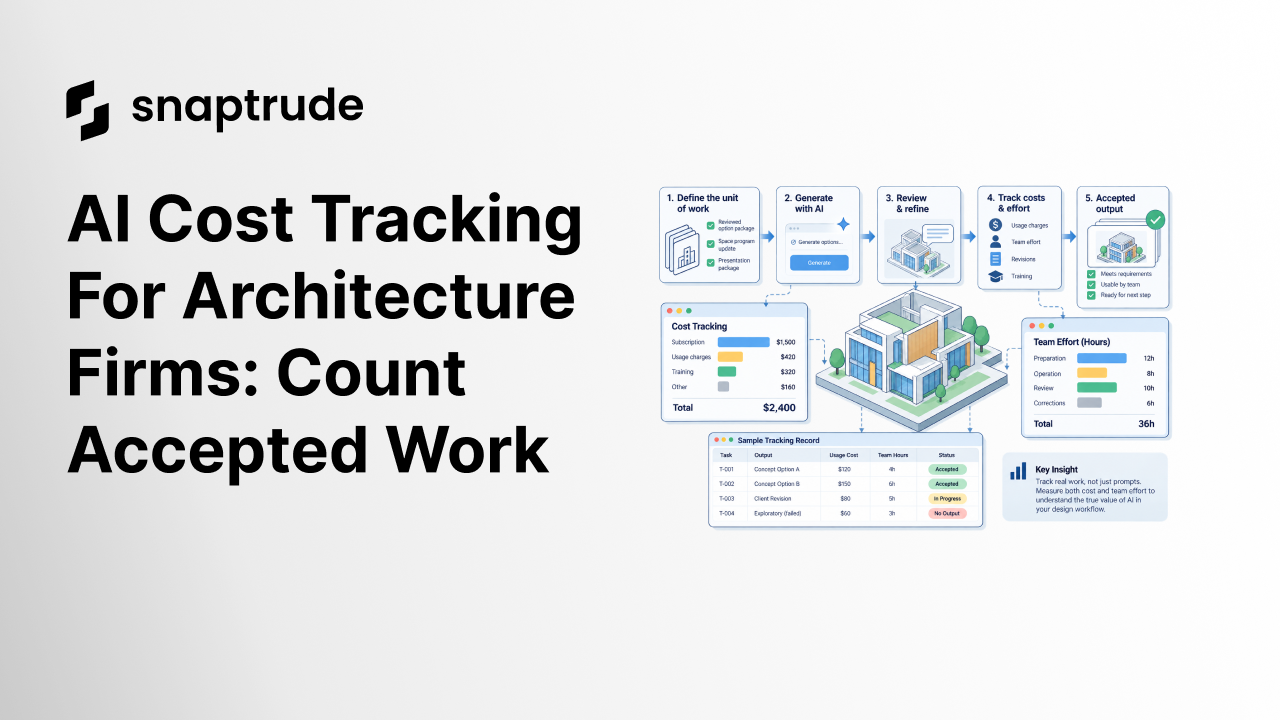
AI cost tracking for architecture firms starts with a consistent unit of accepted work, such as a reviewed option package, rather than a count of prompts. Record the usage charges, allocated subscriptions, preparation, review, and rework required to produce it. Report cash expenditure and staff effort separately so additional design capacity does not become an unsupported savings claim.
Why does AI cost tracking for architecture firms need a common unit?
A common unit makes different billing arrangements comparable at the workflow level. A token, a credit, a subscription seat, and a project allowance describe how vendors charge. None, by itself, tells a principal what the team completed.
Define the unit around a decision or deliverable your practice recognizes. A reviewed concept option, an accepted space-program update, or a checked presentation package can work. Keep the scope specific enough that two entries represent comparable work. One rendered image and one editable model are different outputs even when both are called a design option.
Write an acceptance definition next to the unit. For example, an option package might require a model, area summary, comparable views, and a record of unresolved assumptions. This is an illustrative definition, not a claim about any firm's delivery standard.
You can still record generation counts. They help explain consumption and diagnose repeated attempts. The accepted deliverable gives those counts a purpose: how much activity was required to produce work the team could actually use?
What belongs in the cost ledger?
Keep a cash view and an effort view, linked by the same task identifier. The cash view records invoices and attributable usage. The effort view records the people and time needed to prepare, operate, review, correct, and hand over the result.
For usage charges, preserve the original billing unit and the applicable rate or invoice period. If the provider reports credits, retain credits. Convert them to cash using the actual purchased allowance and its terms, not a guessed exchange rate. Show included usage and additional charges separately when necessary to reconcile the invoice.
For subscriptions, document how you allocate shared cost. A dedicated pilot seat might be assigned entirely to the pilot. A shared account serving several projects needs a declared allocation rule. Unused capacity can remain visible as an unallocated cost; silently distributing it across successful outputs may conceal the reason spending rose.
In the effort view, distinguish preparation, operation, review, and correction. Include the receiving person's time when the claimed benefit extends through handoff. If someone rebuilds the output in another tool, that work belongs to the workflow being assessed.
Record training separately so readers can see both initial adoption effort and recurring execution effort. The broader burden of maintaining a software stack is discussed in our platform proliferation article. This ledger addresses a narrower question: what resources did this defined output consume?
How should AI cost tracking for architecture firms handle failed attempts?
Include failed attempts in the resources consumed by the task. Count only outputs that satisfy the stated acceptance conditions in the denominator.
Suppose several attempts produce an attractive image but none produces the required editable model. The workflow consumed resources, yet it produced zero accepted deliverables under that definition. Report the spend, effort, and failure reason. Cost per accepted deliverable is undefined when the denominator is zero; it is not zero, and it should not disappear from the report.
Use a stable task identifier to connect retries, changed prompts, manual fixes, and the final accepted result. Otherwise each attempt can look inexpensive while the complete workflow remains costly.
Count revisions consistently. If a client asks for a changed brief after accepting the first output, the next task may deserve a new identifier. If the team is fixing errors against the original brief, those corrections remain part of the original task. State that rule before comparing tools or reporting trends.
Do not select only the fastest successful run. Keep the range and explain why attempts differed. A ledger should make poor results understandable, including cases where the tool was applied to an unsuitable task.
Try Snaptrude on a task with a defined, reviewable output.
What does a practical tracking table look like?
Use a small record that can be reconciled to billing and reviewed by the project team. These fields provide a starting point to adapt to your firm's reporting process.
Add links to the accepted artifacts rather than copying sensitive project content into the ledger. Keep access appropriate to the team that needs to review the record.
Use consistent units for time and currency. When comparing periods, document any exchange-rate or allocation changes. If a billing report arrives later than the design work, mark the record provisional and reconcile it once the charge is known. Estimated and invoiced costs should remain distinguishable.
How do you calculate cost per accepted deliverable?
Divide attributable workflow cash expenditure by the number of accepted deliverables with the same scope. Report staff effort alongside it. If you also calculate a management estimate of labor cost, label the rate and avoid counting the same expense twice in a combined total.
Here is a purely hypothetical example in an unspecified currency. It is not a vendor price, customer result, or forecast.
A team allocates 40 currency units of usage and 20 of subscription cost to a task batch. Six attempts produce two accepted packages. The attributable cash expenditure is 60 units, so the cash cost per accepted package is 30 units. If preparation, operation, review, and correction total four staff hours, effort per accepted package is two hours.
The six attempts explain activity; the two accepted packages describe usable output. Compare that result with another workflow only if package scope and acceptance requirements match. A cheaper image-only output would require a separate category.
For a batch with no accepted packages, show 60 units spent, four hours used, and zero accepted outputs. Leave the ratio uncalculated. That outcome deserves investigation even though it cannot be expressed as a normal unit cost.
How do you separate capacity from financial savings?
Describe what changed before assigning a financial value. Reduced effort can create capacity for another task, more options, or more careful review. Those are meaningful outcomes, but each has a different relationship to cash expenditure and revenue.
If a task takes fewer hours while staffing and other expenses remain unchanged, the direct observation is freed capacity. If the team spends that capacity exploring additional options, record the additional scope. Do not simultaneously claim those same hours as eliminated cost.
Track realized changes separately when they occur: an avoided external charge, a reduced overtime payment, or additional paid scope actually delivered. Use the firm's normal financial process to determine how those changes affect margin. This guide does not supply rates, pricing advice, or an ROI forecast.
Our article on the learning curve in architecture software discusses adoption effort. For an actual decision, replace illustrative assumptions with your own measured task records and reviewed financial data.
Where does Snaptrude fit into this measurement?
Snaptrude supports connected programming, 3D concept modeling, BIM, and presentation workflows. A team can define a task across those capabilities and measure the effort needed to produce an accepted result. Real-time collaboration can also let the reviewer inspect the work with the person who created it.
The ledger proposed here is an external measurement method. It does not imply that Snaptrude supplies a token-cost dashboard, automatic expense allocation, or guaranteed savings. Use current invoices for spending and record the actual workflow your team performs.
Where the task includes an external handoff, inspect the relevant supported Revit, Rhino, DWG, or IFC export. Count the result as accepted only after the receiving team confirms the requirements that matter. That keeps the cost comparison connected to continued design work.
Frequently Asked Questions
Q: What is AI cost tracking for architecture firms?
A: It is a method for connecting AI-related spending and staff effort to defined architectural work. Keep the provider's billing units, allocated subscription charges, preparation, review, corrections, and accepted outputs in a linked record. The goal is a comparison the project team can inspect. It should distinguish actual expenditure from estimated labor value and possible future financial benefits.
Q: Should firms compare AI tools by token price?
A: Token price can help explain a bill, but it is insufficient for comparing complete design workflows. Different tools may need different inputs, retries, review, or rebuilding to produce an equivalent result. Preserve the original usage units, then compare attributable cost and effort per accepted deliverable. Keep unlike outputs in separate categories, even when vendors use similar names for them.
Q: How should unused subscriptions be allocated?
A: Choose an allocation rule that reflects the evaluation and disclose it. A dedicated pilot subscription can be assigned to that pilot, while shared subscriptions may require a consistent split across tasks or projects. Keep unused capacity visible rather than hiding it in successful outputs. Reconcile the allocation to actual spending and use the same method across comparisons and reporting periods.
Q: What happens when no generated outputs are accepted?
A: Report the resources consumed and the reasons the outputs failed acceptance. Cost per accepted deliverable is undefined with zero accepted outputs, so leave the ratio uncalculated. Do not substitute generated images or attempts for the required result. The failed batch still belongs in the evaluation because it reveals a limit, an input problem, or a task that needs redesign.
Q: Does Snaptrude provide the cost ledger described here?
A: This guide proposes a tracking method a firm can maintain alongside its tools; it does not claim a native Snaptrude cost-allocation dashboard. Use your billing records and measured staff effort. Snaptrude's connected programming, modeling, BIM, and presentation capabilities provide workflows to evaluate, while the accepted-output definition and financial interpretation remain explicit decisions for the team conducting the assessment.
Q: What should count as an accepted Snaptrude output?
A: Define acceptance according to the task, such as a reviewed concept model or a presentation package with checked information. If the scope includes an external handoff, verify the relevant supported export in the receiving application. Ask the next team member to continue the work. Count any required correction or rebuilding before treating the original task as complete and accepted.
Evaluate one Snaptrude workflow using an accepted-output record.