3.48.0
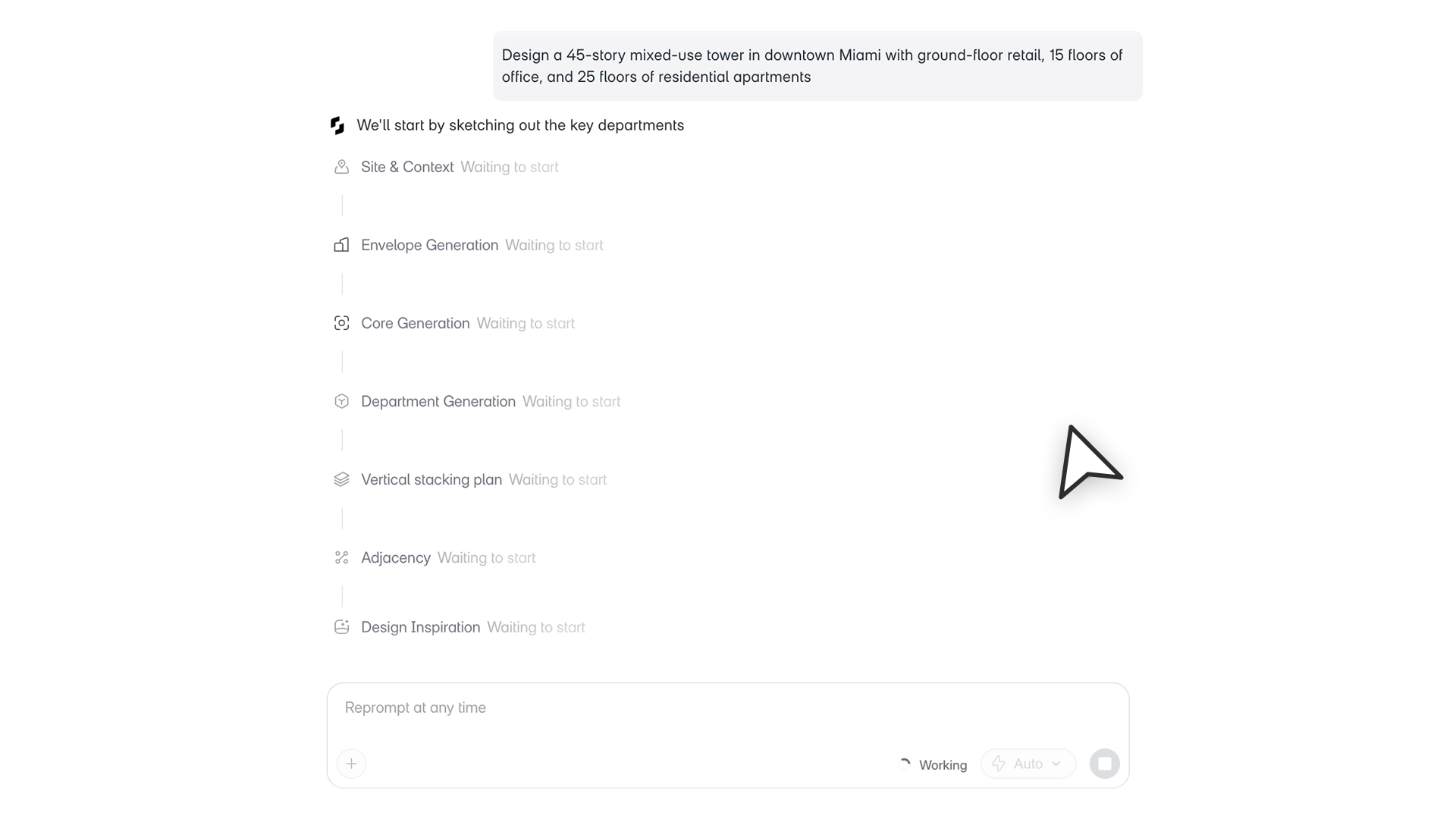
"This release restructures how the AI pipeline thinks about your building. Departments are the right level of detail for early design, and the new stages give you a clearer building structure before you start refining."
– Amy Kim, Product Specialist
What's New
The AI stack now operates entirely on department objects, removing space-level generation from the core pipeline. This simplifies geometry processing and improves performance, especially on larger projects.
Three new stages have been added to the pipeline: Massing Generation, Core Generation, and Pack. Together, they define the building's form, circulation, and department layout earlier in the workflow.
The full pipeline is now:
Site → Envelope → Core → Department Generation → Department Storey Assignment → Adjacency → AI Inspiration → Pack (optional)
Space-level workflows are still available through Program Mode dropdown agents when you need detailed program development.
Envelope now produces two outputs: a buildable envelope placed on the site, and a massing model placed near the canvas origin as a reference for the building form.
The Area panel defaults to Gross Area + Departments.
Site Analysis Improvements
Site Analysis is now significantly more accurate for US projects. Building codes are extracted from official government sources through live web search, supplementing the existing Zoneomics integration.
More accurate building codes (US)
All key regulatory fields now return more precise values with additional detail when available. Zoning, FAR, height limits, setbacks, and buildable area are pulled with better accuracy.
Web search from official sources
Site Analysis now performs live web search and pulls building codes directly from official municipal sources (e.g., Municode). This runs alongside Zoneomics to cross-reference and fill in gaps.
Full source transparency
The Chain of Thought now includes direct links to government pages, with specific chapter names and section numbers. You can verify exactly where each building code was sourced from.
Reprompt adherence
Follow-up corrections now work as expected. When you reprompt with updated inputs, Site Analysis reflects those changes in its output.
Why We Built This
Departments over spaces
Processing spaces alongside departments increases the geometry the AI has to handle. As projects grow, this slows things down. Most users don't need space-level detail during early design, so departments are a better level of abstraction for the pipeline to work with.
Massing, Core, and Pack
These stages give you a clearer building structure earlier in the process.
- Massing defines the building form.
- Core establishes circulation and service areas.
- Pack arranges departments within the envelope (optional).