Last updated:
Your Firm Already Has the Answers. Now You Can Use Them.
Every architecture firm carries years of embedded intelligence.
Standard classroom sizes refined over multiple schools.
Typical department breakdowns for healthcare projects.
Unit mixes that worked. Efficiency ratios that didn’t.
That experience lives across folders, drives, spreadsheets, PDFs, Revit files, and old Snaptrude projects. When a new project begins, teams rarely start from zero. But retrieving and synthesizing what already exists takes time. Someone opens past models. Someone scans old programs. Someone rebuilds a template from memory.
That effort is invisible, but it’s constant.
Knowledge is built to change that.
Bringing your collective experience into the design process
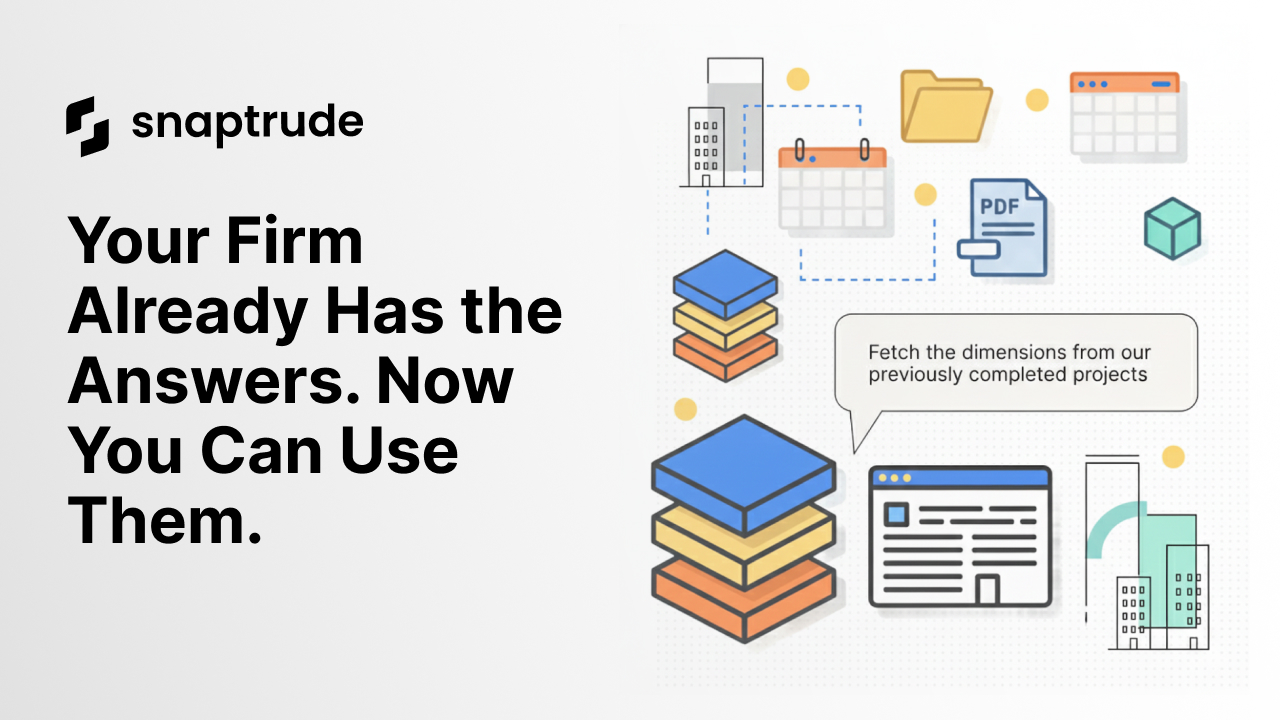
Knowledge allows firms to connect their cloud storage directly to Snaptrude. Google Drive, Sheets, Dropbox, Box, and existing Snaptrude projects can now be queried through a single interface.
Snaptrude processes those files and makes them usable by AI.
Instead of hunting through folders, teams can ask direct questions:
- What classroom sizes have we typically used?
- How did we structure departments in our last three hospitals?
- What were the net-to-gross ratios on similar projects?
Snaptrude scans previous programs and returns structured answers, referencing the source files it used. You can query a single project or multiple projects at once. Responses come back as tables or clear summaries, ready to use.
This turns scattered files into a searchable layer of institutional memory.
From research to program, in one flow
The real shift happens when research connects directly to action.
Let’s say you’re starting a new K–12 project. Instead of defaulting to generic standards, you can ask Snaptrude to research classroom areas and capacities from your past schools. It summarizes typical room types, sizes, and counts used across your own projects.
From there, you can move into Program Mode and ask Snaptrude to generate a new program grounded in that data.
Departments, spaces, and areas are already populated based on your firm’s previous work.
Program creation becomes anchored in what you’ve actually built, not just industry averages.
For a commercial developer, that might mean pulling efficiency benchmarks across mixed-use projects. For healthcare, it could mean referencing past department allocations and stacking strategies. For education, it ensures new programs reflect proven classroom standards.
The starting point changes depending on what you’re optimizing for. The intelligence behind it stays consistent.
Why this matters
Architecture firms are not short on experience. They are short on accessible, connected context.
Knowledge reduces time spent searching across folders. It removes the need to reopen models just to extract numbers. It allows teams to ask higher-level questions that span documents and designs.
More importantly, it keeps research inside the same environment where decisions are made.
Instead of copying data from one tool into another, insight flows directly into design.
Knowledge turns Snaptrude into a living memory of your firm’s work.
And as we continue building toward reducing early-stage design friction, this is a foundational step. Because truly better workflows build on what you already know.