Last updated:
Parametric Facade Rationalization: From Variation to Fabrication
TL;DR
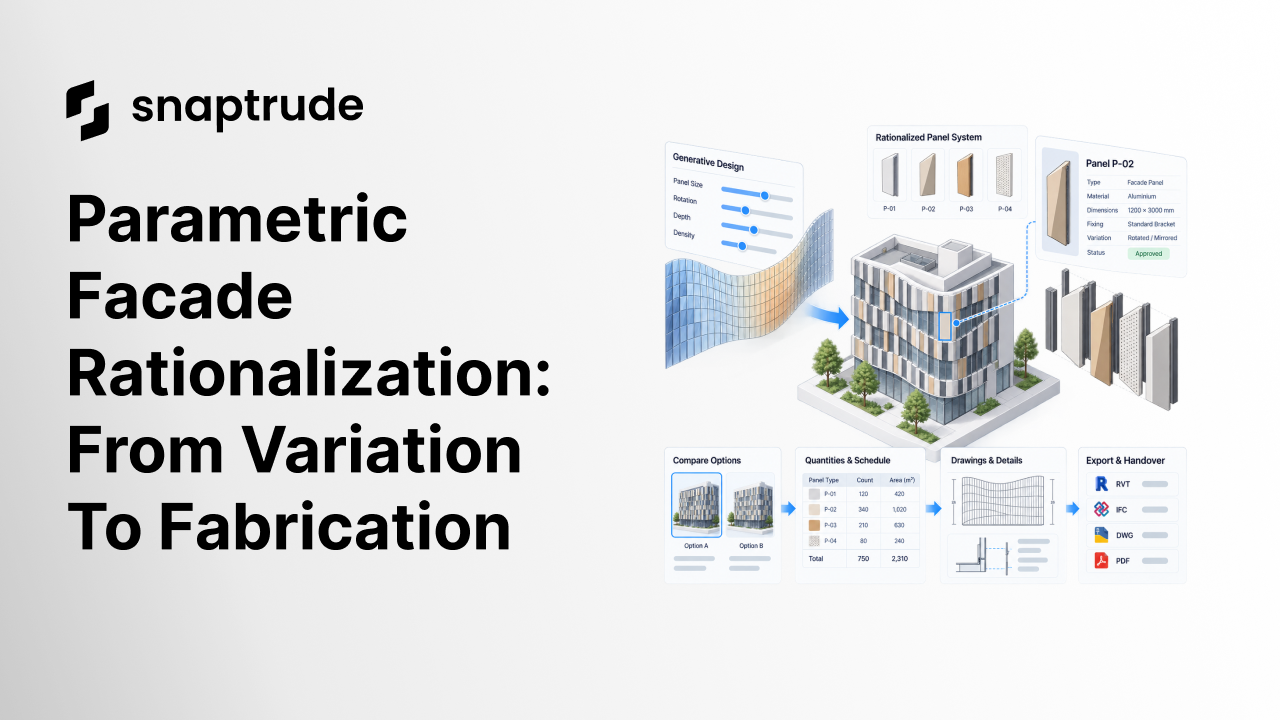
Parametric facade rationalization converts a visually varied facade into a controlled system of panel families, interfaces, materials, and rules that can be documented and built. The goal is not to remove variation. It is to concentrate variation where it adds design value while making repetition, tolerance, quantity, and change explicit.
What is parametric facade rationalization?
Parametric facade rationalization is the process of translating a generative surface or pattern into a limited, intentional set of buildable components. It preserves the governing design idea while reducing avoidable uniqueness in panel geometry, connections, materials, and documentation.
The problem usually begins innocently. A script varies aperture, depth, rotation, perforation, or module size across a surface. The result looks coherent because every element follows the same equation. Production does not experience the equation. It experiences thousands of parts, labels, drawings, tool paths, tolerances, replacements, and installation decisions.
That gap is where rationalization belongs. It asks five practical questions:
A rationalized system may still appear highly varied. A small library can be distributed, mirrored, rotated, colored, or perforated according to rules. The important shift is that every resulting condition belongs to a named family or an approved exception.
How does parametric facade rationalization begin with design intent?
Start by writing the facade idea without naming the software operation. “Randomize panels” is an instruction, not an intent. “Create denser screening near exposed work areas while preserving outward views” gives the team something it can test.
Separate variables into three groups:
Then create a baseline. Record the original geometry, visual views, area, panel count, unique geometry count, material assumptions, and any performance result that matters. Rationalization without a baseline becomes taste. With a baseline, it becomes a comparison.
Do not assume the most mathematically faithful solution is the best architectural solution. A script can preserve every variation perfectly and still create a poor building process. The model should help the team see that tradeoff early, while changing the rule is still cheap.
Explore generative design as a reviewable architectural process.
How should parametric facade rationalization create panel families?
Cluster by the variable that matters to production, not only by visual similarity. Two panels may look almost identical but require different frames, openings, or edge conditions. Conversely, one panel family may create several visual effects through orientation or finish.
A useful panel family record contains:
Build the smallest credible family set, then test the visual loss. If the facade becomes visibly repetitive, add the next family where it creates the highest perceptual value. This is more controlled than beginning with every generated result and trying to consolidate later.
Use a naming system that survives handoff. “Panel 27” says little. A name that encodes family, edge condition, orientation, and revision makes schedules and issue reports easier to interpret. Keep the name stable even if a displayed description changes.
Which facade rationalization approach fits the project?
Choose the approach by comparing the project’s visual priority, performance criteria, fabrication method, schedule, replacement strategy, and tolerance for custom documentation. There is no universal correct family count. The defensible number is the smallest set that meets the accepted design and delivery criteria.
How do you validate a rationalized facade before fabrication?
Validate the system at four scales.
At the building scale, compare silhouette, pattern density, key views, corners, and transitions against the baseline. Review from realistic distances, not only in a close model view.
At the zone scale, inspect pattern repetition, alignment, adjacency, and the transition between facade conditions. A good global gradient can still produce awkward local clusters.
At the component scale, verify dimensions, openings, material, orientation, edge type, attachment, and tolerance. Confirm that the family definition matches its scheduled instances.
At the information scale, reconcile the model, panel schedule, elevation tags, detail references, quantities, and fabrication output. A correct shape with a stale ID is not a coordinated result.
Use a representative mock-up before finalizing the rule. It should include a typical field condition, a boundary, a corner or transition, and at least one difficult tolerance stack. Record which criteria the mock-up validates. Approval of appearance does not automatically approve drainage, attachment, or dimensional coordination.
For each design change, rerun the comparisons that can be affected. Moving one attractor or changing one panel limit can alter quantities, family distribution, elevations, and interfaces. The review plan should follow the dependency, not the team’s memory.
Compare design options before accepting a system-wide edit.
How does Snaptrude support parametric facade rationalization?
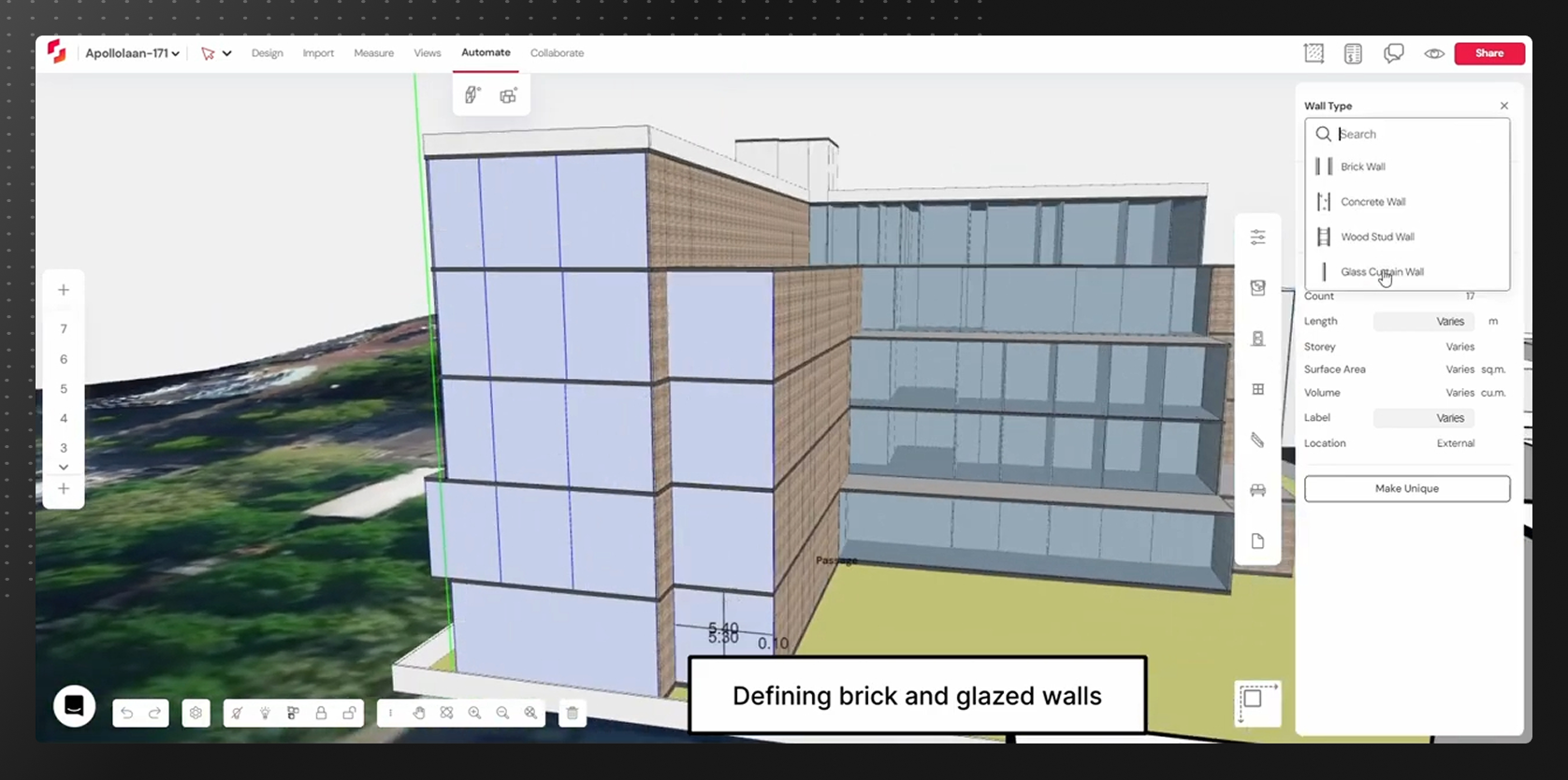
Snaptrude supports parametric 3D concept modeling, materials, quantities, schedules, derived drawings, real-time visualization, and exports including Revit, Rhino, DWG, IFC, and PDF. These verified capabilities can help a team keep the design model, visible result, quantity logic, and downstream handoff closer together while a facade system evolves.
That does not mean Snaptrude automatically determines the correct family count, engineering tolerance, fixing detail, or fabrication strategy. Those decisions depend on the project, consultants, manufacturer, procurement route, and accepted performance criteria. Use the model to make the rules and consequences legible, then validate specialist requirements with the responsible parties.
The strongest workflow is not “generate, then document.” It is a loop: define intent, generate, cluster, compare, coordinate, test, and update. Keeping those stages connected gives the architect more room to explore because the downstream cost of a decision is visible sooner.
See how Snaptrude connects concept modeling and BIM information.
FAQ: Frequently Asked Questions
Q: What does parametric facade rationalization mean?
A: Facade rationalization means reducing a complex design into a manageable system of repeatable components, interfaces, and rules. It does not require making every panel identical. A rationalized facade can preserve gradients, porosity, depth, color, and rhythm while assigning each condition to a documented family, tolerance, or approved exception that teams can coordinate and fabricate.
Q: How many unique facade panels should a project use?
A: There is no universal target. Start with the smallest family set that preserves the accepted visual and performance intent, then add types only where the difference is meaningful. The right number depends on fabrication method, material, tolerance, documentation capacity, replacement strategy, schedule, and budget. Measure both perceived variation and production burden before approving the set.
Q: When should facade rationalization happen?
A: Begin during concept design as soon as a generative rule produces repeatable facade geometry. Early work can remain approximate, but the team should identify protected variables, fixed interfaces, and likely family logic. Refine the system before design development locks structure, envelope performance, procurement, and details. Waiting until fabrication transfers design decisions into expensive production rework.
Q: Does rationalization reduce design quality?
A: It can if the team simplifies geometry without defining what must be preserved. A better process establishes a visual and performance baseline, clusters flexible differences, and compares the result at building, zone, and component scales. Rationalization often improves design clarity because it forces the team to identify which variations carry meaning and which are accidental output from a script.
Q: Can Snaptrude generate a complete fabrication-ready facade automatically?
A: The verified product facts support parametric concept modeling, materials, quantities, schedules, drawings, visualization, and several export formats. They do not establish automatic fabrication engineering for every facade system. Teams should coordinate manufacturer data, tolerances, attachments, waterproofing, structural requirements, and file needs with the responsible specialists before treating any model as fabrication-ready.
Q: How should teams review a facade system in Snaptrude?
A: Use model views, materials, quantities, schedules, and derived drawings to compare family distribution and key conditions, then export to the required downstream workflow. Keep a baseline view and a family matrix beside the review. Confirm current object and export coverage for the chosen system, and validate specialist calculations outside the model where project requirements demand them.
Try Snaptrude to connect early design decisions with model data and review outputs.