Last updated:
How a Modular Expert Streamlines Concept Design with Snaptrude
For architects managing complex developments, the transition from a spreadsheet of requirements to a 3D concept is often the most tedious part of the process. You need to visualize massive scale quickly without getting lost in technical details too early.
This is the exact challenge Ivan, an architect and project manager based in Riga, Latvia, faced. Specializing in offsite prefabricated buildings - from wooden frames to pre-cast concrete, Ivan leads major projects, including a recent 5-star spa resort in Montenegro. To keep up with the demands of large-scale modular construction, he needed to evolve his tech stack.
The "Legacy Software" Trap
Like most professionals in the industry, Ivan’s daily workflow relied heavily on the traditional Autodesk suite, Revit, AutoCAD, and Inventor. While powerful, he found the environment "fragmented, disorganized, and complicated."
The main issue wasn't just the difficulty; it was the lack of automation. "It’s a lot of handwork," Ivan explains. He found that traditional tools for massing and feasibility studies were often "stuck" in the past, requiring too much manual input for early-stage conceptualization.
A New Workflow: From Excel to 3D Instantly
Ivan recently applied Snaptrude to a 20,000 sqm mixed-use residential project in Montenegro. His objective was to move from a spatial program to a visual model without the headache.
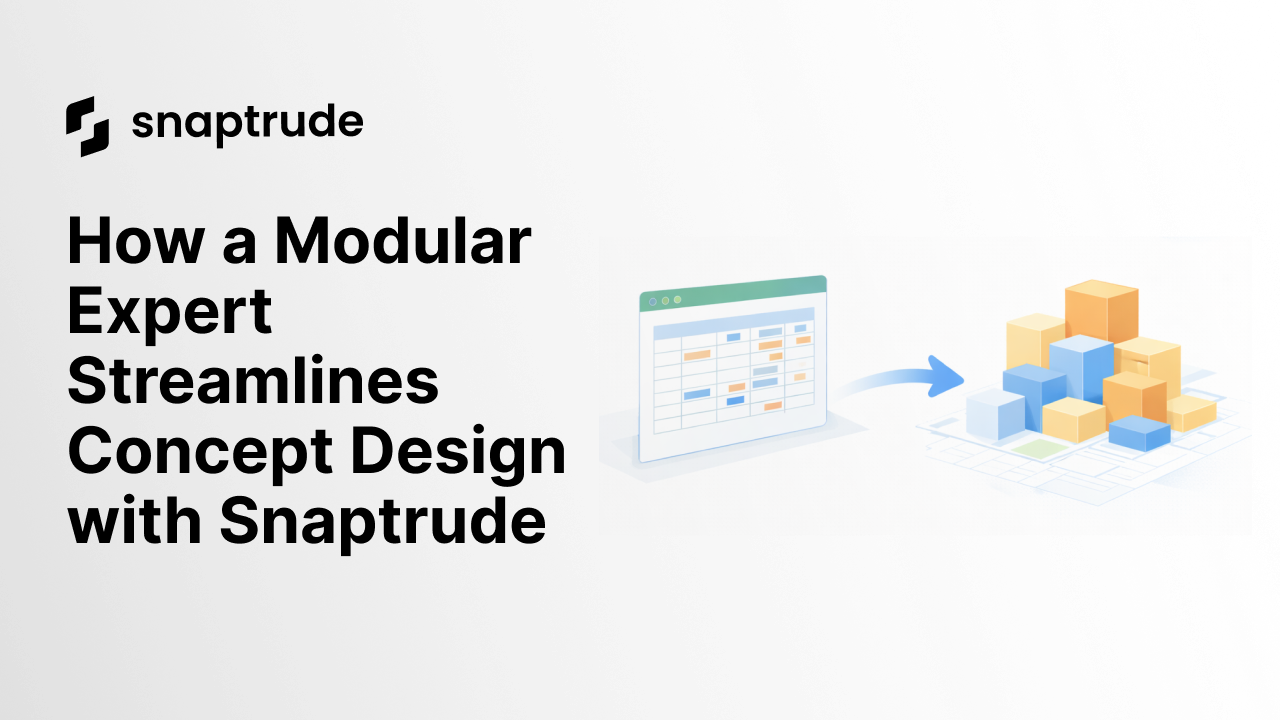
"We quickly assembled our program, which was first put down in an Excel sheet," Ivan says. By using Snaptrude, he was able to instantly translate that data into 3D. "We played with these boxes and volumes... it allowed us to quickly assemble our spatial program."
This workflow bridged the gap between data and design. Instead of manually modeling every block from scratch in legacy software, he could focus on the arrangement and flow of the complex, turning feasibility studies into a fluid, creative process.
Efficiency in Feasibility
For Ivan, the value of integrating AI and modern tools into his workflow comes down to return on investment; both in money and time.
Comparing modern AI-assisted tools to traditional high-end rendering setups (like 3ds Max combined with V-Ray), Ivan notes the massive difference in accessibility. He realized that for feasibility studies and massing models, Snaptrude offered a way to automate the "heavy lifting," making the design process faster and more cost-effective than maintaining expensive, complex legacy licenses for every conceptual task.
The Future of AI in Architecture
Ivan has a bold vision for the future. He believes the ultimate goal of AI isn't just to make modeling faster, but to change how we interact with computers entirely - moving away from "rotating the mouse" toward direct visualization of imagination.
However, for the immediate future, his hope is for AI to take over the tedious technicalities. "I wish that mundane tools... things like referencing, documentation, and compliance... those were the parts AI would do for me," he says.
Ivan sees a future where tools like Snaptrude handle shop drawings and local regulations automatically, allowing architects to focus purely on the "fun part" of design.
Ready to automate your feasibility studies?