Last updated:
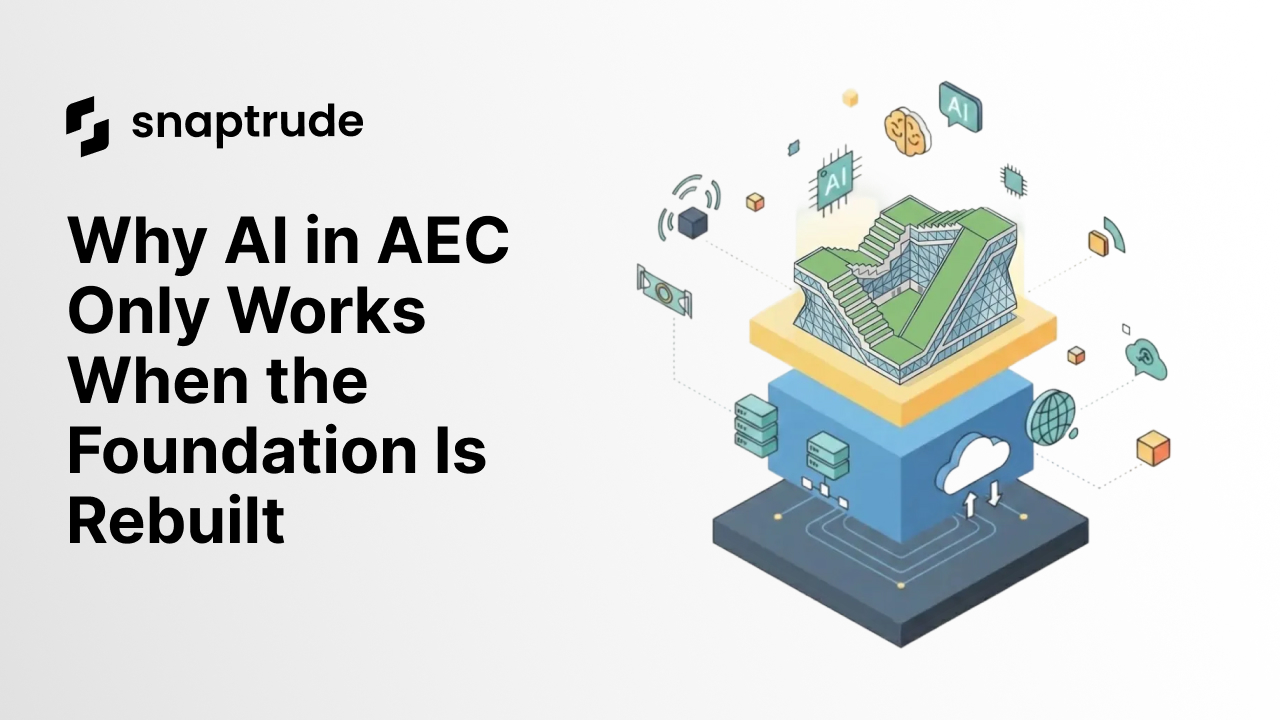
Why AI in AEC Only Works When the Foundation Is Rebuilt
Over the last few months, we have been heads down at Snaptrude. Our AI workflows are seeing real, sustained usage from architects and real estate teams, not just curiosity clicks or one-off experiments. As that traction has grown, it has forced us to think more deeply about what is actually changing in the AEC industry and what is simply being repackaged.
The analogy that keeps resurfacing for us is Tesla and the way electric vehicles reshaped the automotive industry.
Tesla did not just build an electric car
It is tempting to describe Tesla as a company that replaced gas engines with batteries. But that framing undersells what really happened.
Tesla rebuilt the car around a completely new technological foundation. Software, electronics, and data systems were no longer secondary components. They became the core of the vehicle. Everything else was designed around that decision.
What makes this interesting is that despite all this new technology, the end product still had to function as a real car. It needed to be reliable, precise, and usable across a wide range of conditions. A modern electric drivetrain means nothing if the vehicle only works in ideal scenarios.
Tesla could have built a golf cart instead. Narrowly scoped, easier to perfect, and useful in controlled environments. But they chose a harder path: build something that works on every road.
Foundations matter more than features
The real breakthrough with Tesla was not electrification itself. It was what electrification enabled.
Once the car became software-first, capabilities like over-the-air updates and autonomous driving were no longer bolt-on features. They emerged naturally from the underlying platform. The new foundation made new behavior possible.
This distinction is critical when we talk about AI in architecture, engineering, and construction.
AI struggles when it is layered on top of legacy BIM tools that were never designed for it. Disconnected data, brittle file formats, and siloed workflows limit AI to surface-level assistance. You get faster drafting or smarter autocomplete, but not real design intelligence.
Why AI in architecture needs a modern design platform
At Snaptrude, we didn’t start with the question, “Where can we add AI to BIM?”
We started with a more fundamental question: what would a design authoring tool look like if it were built today, cloud-first, collaborative by default, and deeply data-aware?
That led us to build a unified design platform where geometry, BIM data, program, stories, and constraints all live in one continuously synced environment. The model is not just shapes on a canvas. It is structured intent that AI can understand and reason about.
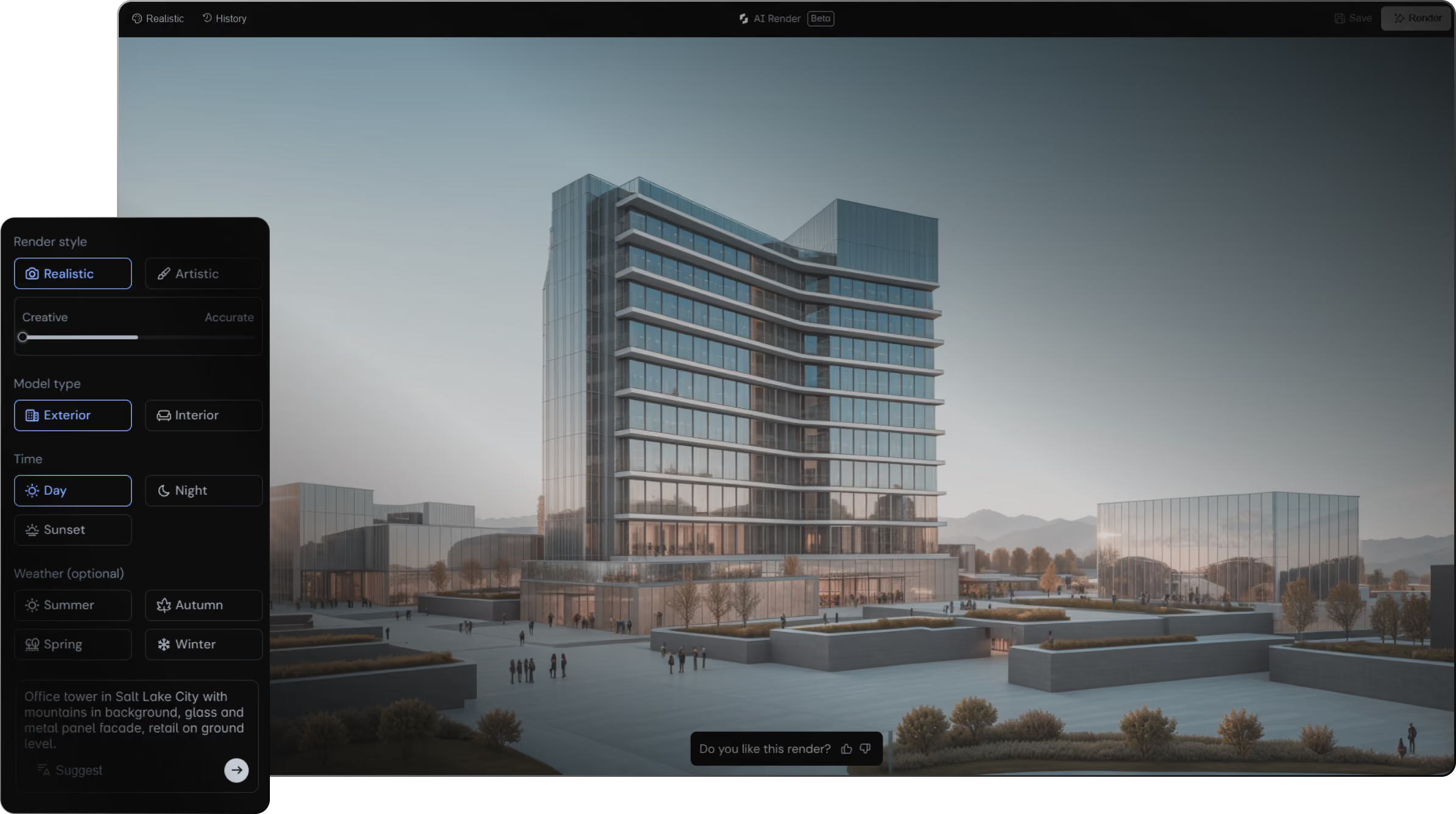
This is what allows Snaptrude AI to go beyond prompts and suggestions. The AI workflow can analyze site context, generate architectural programs, assign stories, dimension spaces, and explain its decisions because the platform itself was designed to support that level of context.
AI in Snaptrude is not a feature that was added later. It is native to how the system works.
From cloud-first BIM to AI-native workflows
This is not the first long-term bet we have made.
Eight years ago, Snaptrude committed to being cloud-first when most BIM tools were still desktop-bound. Two years ago, we made a similar bet on AI-native workflows, well before it was obvious how generative AI would fit into architectural design.
Those decisions are connected. A cloud-based, real-time, collaborative BIM platform is what makes AI viable in the first place. Without that foundation, AI remains constrained to narrow use cases.
Golf carts versus real-world design tools
Purpose-built tools are not inherently bad. In fact, they can be extremely effective at solving specific problems quickly.
But the AEC industry does not operate in controlled environments. Real projects involve zoning codes, evolving briefs, imperfect data, stakeholder feedback, and constant iteration. Architects need design software that can handle ambiguity and scale without breaking.
AI that only works for narrow scenarios will inevitably plateau. AI that is built into a robust, general-purpose architectural design platform continues to improve as the platform evolves.
The shift is already underway
We are starting to see a clear divide in how AI is being applied in AEC.
On one side are tools that add AI as a layer on top of existing workflows, often framed with familiar metaphors and incremental speed gains. On the other are platforms that rethink the foundation entirely and let new workflows emerge from that decision.
If you are building or evaluating the next generation of architectural design software, a useful question is not whether it is “the Figma for BIM.”
A better question is whether you are building a golf cart for a specific course, or a car designed to work reliably on every road the AEC industry demands.