Last updated:
Why early design keeps getting stuck and what we changed
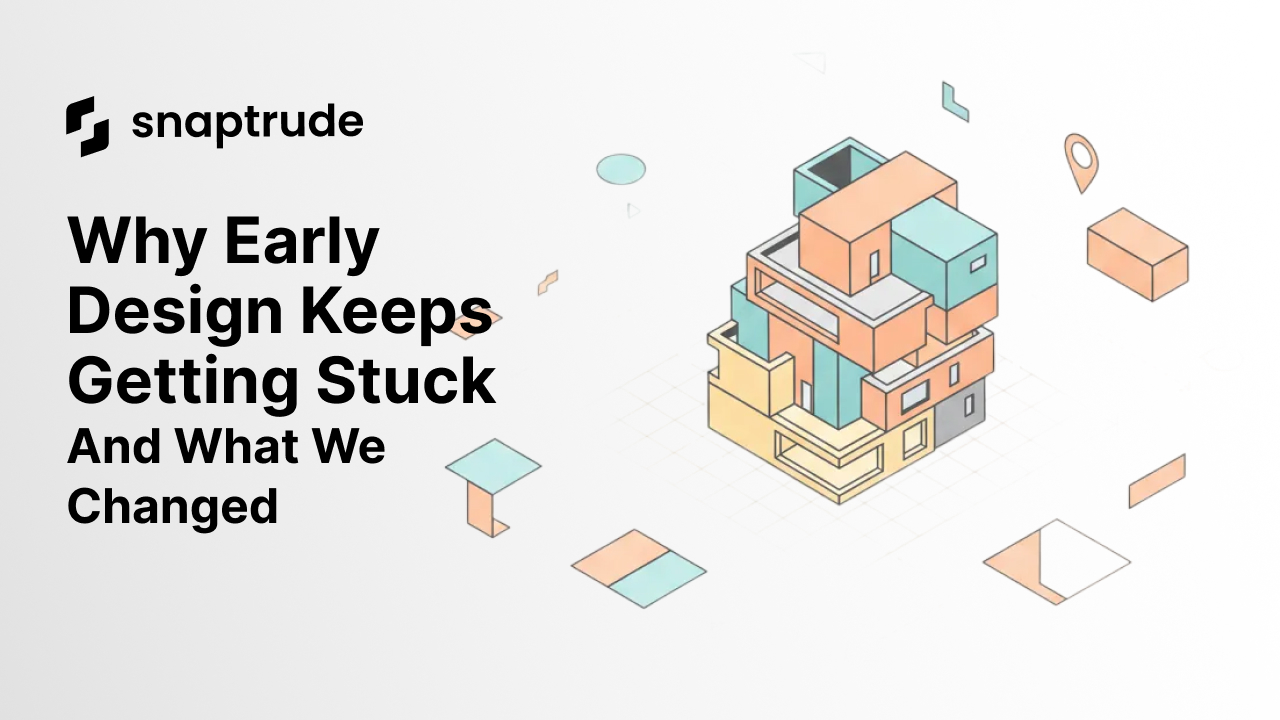
Most architectural projects don’t begin with floors, schedules, or programs. They begin with form. A volume responding to a site edge, a silhouette shaped by context, a mass that feels right before anyone knows exactly how many storeys it should have.
Very early on, though, that intuition starts getting translated into structure. Storeys get defined. Floor heights and counts get assumed. Not because teams are ready to commit, but because the workflow asks them to. And once those assumptions are in place, changing direction takes work. Geometry needs to be adjusted. Stacks need to be rebuilt. What should be light iteration starts to feel heavier than it needs to be.
Over time, this creates a familiar pattern inside firms. Teams still explore, but they do so more cautiously. Options narrow earlier. Reviews happen on fewer variants, not because better ideas aren’t there, but because producing and validating them takes time.
This isn’t a failure of design thinking. It’s a mismatch between how architects think in early stages and how tools expect decisions to be made.
In practice, form and logic don’t arrive in neat phases. Architects shape an envelope and gradually test what it could become. What if this were taller? What if the floor heights shifted? What if the same form supported a different stacking strategy? These are reasonable questions to ask early, but many workflows treat storeys as a fixed starting point rather than something that can stay flexible.
That rigidity adds friction. Not enough to stop work entirely, but enough to slow exploration and make iteration feel more costly than it should.
This is the broader workflow challenge we’re focused on at Snaptrude: reducing the stickiness that creeps into early design, so teams can move fluidly between intuition and validation.
Split Volume is one lever in that direction.
It allows teams to shape a building envelope once and explore different storey configurations from it, instead of rebuilding geometry each time assumptions change. Floor counts, heights, and stacking logic can stay flexible while area performance updates in real time. The goal isn’t to replace decision-making, but to make it easier to test decisions while they’re still reversible.
This keeps intent alive longer. It allows side-by-side comparison of options. And it gives senior reviewers something more concrete to react to, without forcing teams to lock things down too early.
Another point where early design often slows is right after massing. Programs may exist, sometimes generated quickly, sometimes refined through experience, but fitting them into a real building becomes the next checkpoint. Teams spend time validating something they already believe in conceptually.
By allowing departments and spaces to be packed directly into the building envelope, we’re trying to bring that validation forward. Not as a final answer, but as an early signal. Something that helps teams understand whether an idea is plausible before they invest deeply in refining it.
For designers, this means fewer redraws and more continuity between thinking and testing. For project architects, it means earlier confidence that ideas can work. For principals and senior managers, it means seeing more grounded options sooner, without overburdening teams.
At Snaptrude, we see Split Volume and Pack in Envelope as part of a larger effort to make early design less brittle. We’ll keep returning to this core problem as we build more of the workflow around it, because the real solution isn’t a single feature. It’s a set of connected tools that let architects explore, validate, and evolve ideas without unnecessary friction.
Early design should feel open, not sticky. Our job is to keep pushing it in that direction.