Last updated:
Why architects should stop thinking about "schematic design phase"
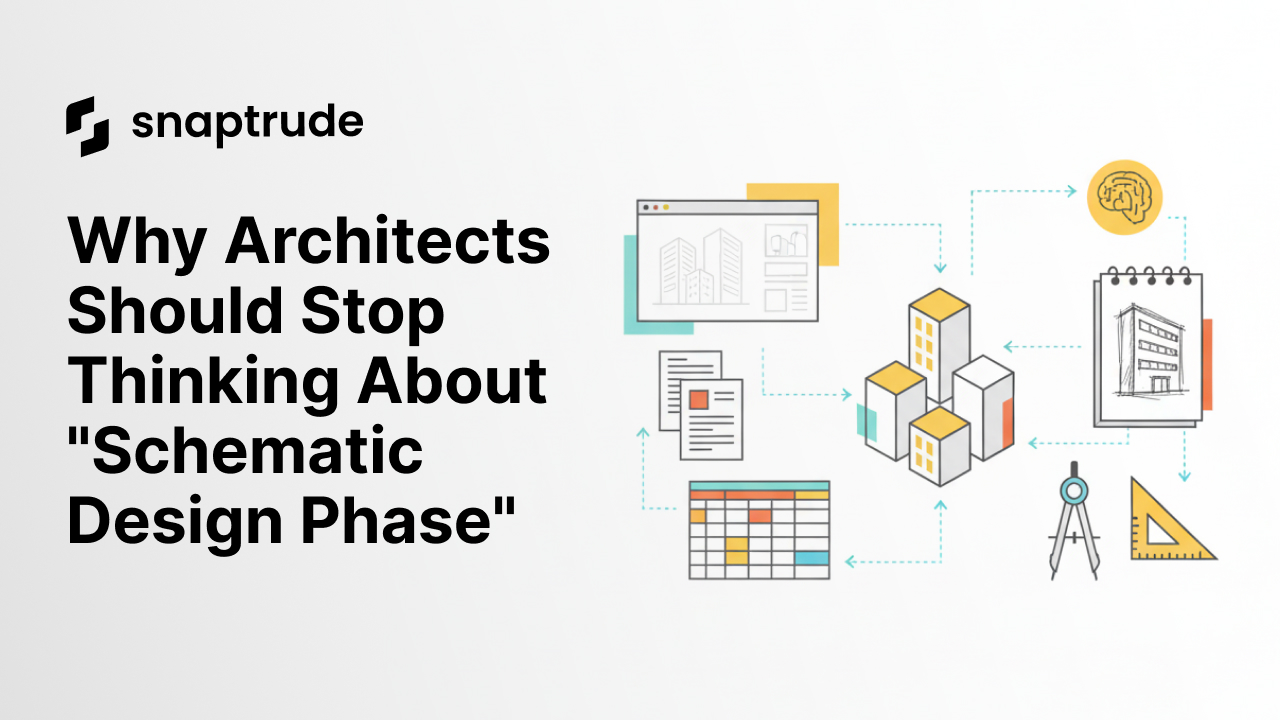
The industry treats "schematic design" as a distinct phase requiring distinct tools. We sketch in one app, model in another, document in a third. And at each transition, we lose data and restart work.
Here's the thing: this phase boundary isn't a technical necessity. It's a design choice by software vendors who built tools for isolated workflows.
Think about what happens in practice. You spend two weeks in SketchUp exploring massing options. The client approves a direction. Now you open Revit and start over by redrawing the same geometry, re-entering program data, reconstructing design intent. You've moved from "schematic" to "design development," which somehow means throwing away everything you learned and starting fresh.
Architects have accepted this as normal. We plan billable hours around it. We scope projects assuming this data loss is inevitable.
It's not.
The future isn't better schematic design tools. It's continuous design from concept to construction where the phase distinction disappears entirely.
What makes this possible isn't just cloud storage or real-time collaboration. It's architecture that maintains data continuity. When your massing study already contains room objects with program data, adjacency relationships, and material assignments, you're not doing "schematic design", you're building a BIM model at the appropriate level of detail for the decisions you're making right now.
We're seeing this with our paid customers. They're importing Revit models, simplifying them to room objects for fast iteration, making design decisions, then resolving back to LOD 300 detail. No phase transition. No data loss. No redrawing.
The conversation shouldn't be "how do we speed up schematic design." It should be "why are we still accepting this phase boundary at all?"
When design intent flows continuously from program through construction documents, the 60-80% of billable time we spend on coordination and rework starts to disappear. Not because we're working faster in each phase, but because the phases stop fighting each other.
And that changes what's possible.