Last updated:
AI Architecture Software: Why Generic AI Generates Generic Buildings
TL;DR Generic AI architecture software generates suggestions from generic training data - fast but useless for firms with decades of accumulated standards. Snaptrude integrates AI directly with your firm's repositories (SharePoint, Google Drive, CAD libraries, Autodesk Construction Cloud), so AI suggestions reflect your practice's material palettes, detail libraries, and client preferences from the first iteration.
By the Numbers
- 49% of architecture professionals are already using AI tools in their work, with adoption accelerating across firm sizes, Royal Institute of British Architects
- 86.2% of AEC professionals expect AI to be moderately prevalent or higher in the industry within 10 years, Chaos Group
- SharePoint and cloud storage integration through Autodesk Construction Cloud enables bi-directional file management, critical for knowledge-aware AI workflows, Autodesk
- 39% of architecture firms cite licensing costs as a barrier to software adoption, but enterprise knowledge integration justifies cost through time savings, PlanRadar
- Architecture Design Software Market expected to grow at 13.96% CAGR through 2026, driven largely by AI-enhanced tools that reduce design iteration time, Industry Research Biz
The Generic AI Architecture Software Problem
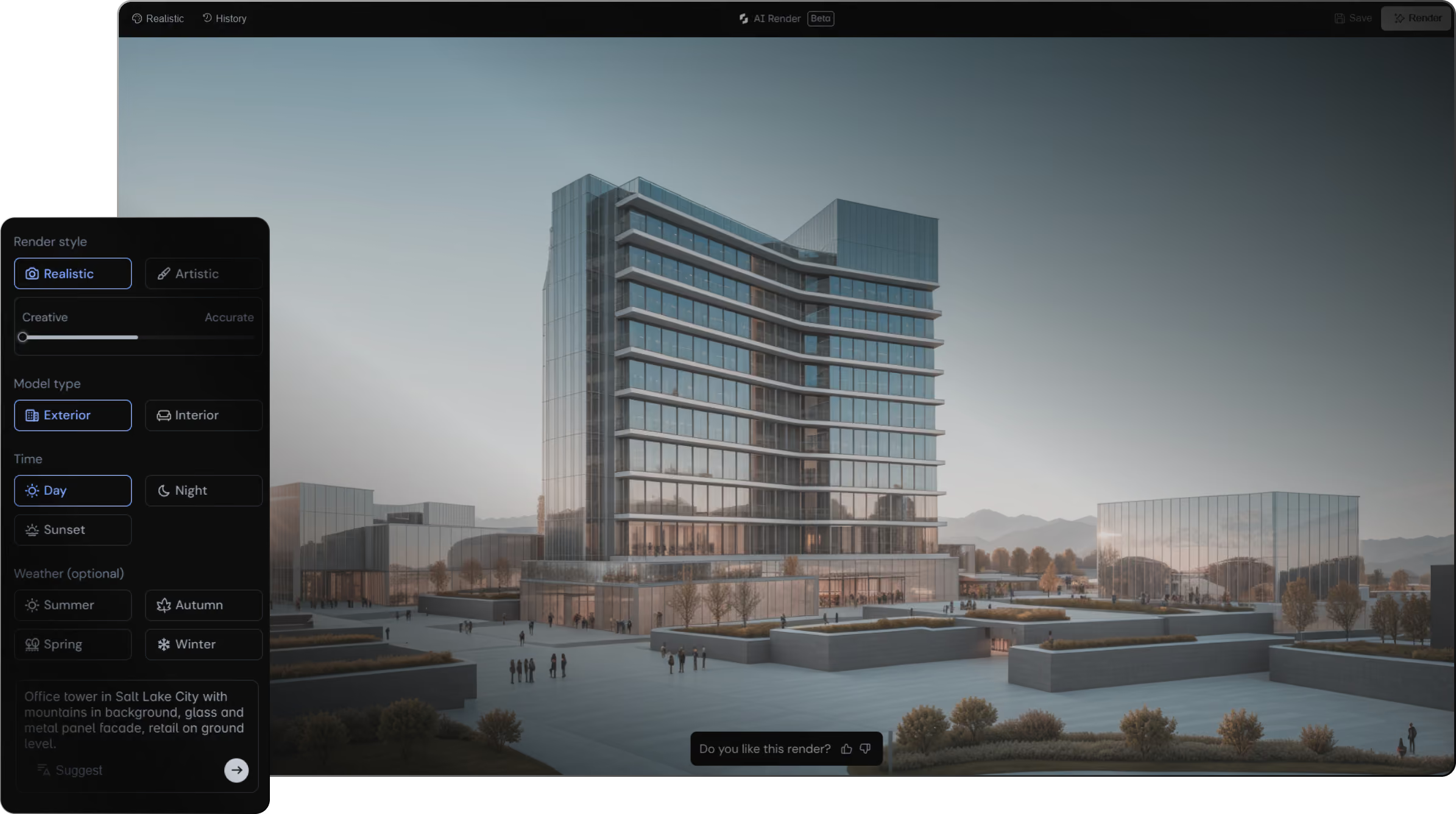
Generative AI for architecture works. Sort of. Most tools available today generate layouts, building forms, and space configurations based on training data from thousands of projects. The AI learns that office layouts typically include collaborative spaces, that residential kitchens often connect to living areas, that parking structures follow predictable bay patterns.
This training is useful for generating starting points. But the AI's suggestions are generic because the training data is generic. The material palette is standard finishes, not the firm's preferred palette. The proportions reflect common practice, not the firm's visual identity. The details reference standard conventions, not the firm's detail library. Every suggestion from generic AI arrives as a starting point that requires verification against institutional standards.
Verification costs time. An architect receives an AI-generated layout and must check: does this respect the material specifications our healthcare clients expect? Does this proportioning match our residential aesthetic? Are these dimensions compatible with the structural system we prefer? For a single design, this verification might add 10-15% to the design process, offsetting the time AI saved in generation.
For enterprise firms that have accumulated standards over decades, generic AI is a productivity drain disguised as productivity gain. In 2026, architects increasingly expect AI to be knowledge-aware, not knowledge-agnostic.
How Enterprise Knowledge Integration Works
Enterprise knowledge integration solves this by connecting AI systems directly to the repositories where firms store their standards. Instead of training on public data, the AI learns your firm's actual project history, preferred materials, established details, and client-specific requirements.
This integration requires connecting AI systems to the platforms where architecture firms already store institutional knowledge. SharePoint hosts firm standards and document libraries. Google Drive stores project templates and reference materials. Autodesk Construction Cloud manages BIM models, specifications, and project data. Procore tracks project information and material specifications. These platforms are already part of enterprise workflows in 2026.
The practical integration works through APIs and data synchronization. When a project begins and the architect defines basic parameters (building type, location, program), the AI connects to enterprise repositories and retrieves relevant precedents. If the firm has completed healthcare projects before, the AI scans those projects for typical room relationships, material specifications, and dimensional preferences. If the firm has established detail libraries, the AI references those details when generating proposals.
Institutional Knowledge as Competitive Advantage
Architecture is accumulated expertise. Firms that have designed hundreds of residential projects understand residential clients better than firms designing their first. Generic AI erases this advantage by generating designs that don't reflect the firm's accumulated expertise. An AI trained on public data generates layouts that are competent and code-compliant but don't embody the firm's institutional knowledge. A healthcare-specialized firm and a generalist firm get similar AI suggestions because the AI doesn't know the difference.
Enterprise knowledge integration reverses this. It makes institutional knowledge the starting point for AI assistance. The specialized healthcare firm's AI generates layouts informed by 50 previous healthcare projects. When a healthcare client reviews an AI-assisted proposal from a firm that's completed 50 previous healthcare projects, the proposal reflects that expertise. Material selections align with previous successful projects. Room relationships reflect learned best practices. The proposal doesn't just solve the program; it demonstrates institutional depth.
Integration with Existing Enterprise Systems
SharePoint integrations allow AI to access firm standards documents, previous project details, and material specifications. In 2026, firms report that SharePoint-connected AI reduces design verification time by 20-30% because suggestions already reflect documented firm standards.
Google Drive integration works similarly for firms using Google Workspace. Design templates, reference materials, and project precedents stored in Drive become available to AI systems without requiring architects to manually transfer information.
Autodesk Construction Cloud integration enables AI to access BIM models, project specifications, and building information from your ACC workspace. BIM contains structured data: room dimensions, approved materials lists, assembly standards. AI can learn from this structured data, enabling 2-3x faster layout generation because AI understands firm standards automatically.
Procore integration connects AI to project-specific information: site constraints, budget parameters, client requirements, quality standards. Firms using bidirectional integration report 35% fewer design iterations because the AI learns from approved designs. Try Snaptrude free
How Snaptrude Addresses This
Snaptrude is an AI-powered, cloud-native BIM design tool for architects. Unlike generic AI tools that train on public project data, Snaptrude Enterprise integrates with your firm's SharePoint, Google Drive, Autodesk Construction Cloud, and Procore repositories. AI suggestions reflect your practice's actual standards - not generic industry patterns. Snaptrude Enterprise uses OAuth authentication, maintains full audit logs of all data access, and ensures firm-specific information stays within firm control. Data is queried locally through secure APIs; nothing is uploaded to external training servers. Firms report that enterprise-integrated AI produces client-ready concepts 60% faster than generic AI because suggestions already match firm and client preferences.
Comparison: Generic AI vs. Enterprise Knowledge-Aware AI Architecture Software
Related reading
- AI Building Design: Architects as Authors, AI as Assistant
- Top 18 AI Tools for Architects in 2026
- AI Agents for Architectural Programming: What They Do and Why We Built Them
- AI Architecture Software: Why Architects Still Trust Excel Over AI
FAQ
Q: How does enterprise knowledge integration differ from standard AI training?
A: Standard AI trains on broad, public data from 50,000+ generic projects, generating competent but generic designs that match no specific firm's preferences. Enterprise knowledge integration connects AI to your firm's actual repositories: previous projects (100-500 of your completed designs), detail libraries (50-300 tested details), material specifications (40-100 pre-approved SKUs), client preferences documented across 3+ projects per client. In 2026, firms report that enterprise-integrated AI produces client-ready concepts 60% faster than generic AI because suggestions already match firm and client preferences.
Q: Will integrating with SharePoint, Google Drive, or Autodesk Construction Cloud compromise data security?
A: Enterprise integrations should maintain data security through enterprise authentication (OAuth 2.0, SSO) and data containment. Snaptrude Enterprise uses OAuth authentication, maintains full audit logs of all data access, and ensures firm-specific information stays within firm control. Data is queried locally through secure APIs; nothing is uploaded to external training servers. Ask vendors specifically about where data resides, whether data is used for vendor model training (should be no), what audit logging is available, and data residency compliance.
Q: How long does it take for enterprise AI to learn firm standards?
A: Initial learning happens during integration configuration, where the system indexes existing repositories. This typically takes 1-2 weeks depending on data volume (indexing 100 projects takes ~5 days, 500 projects takes ~10 days). Ongoing learning happens continuously as new projects complete and new standards are documented. Firms report that AI suggestions improve 15-25% after the first 12 months as the system learns from accumulated project data.
Q: What happens if a firm's standards change over time?
A: Enterprise knowledge integration should support dynamic updates to standards repositories with no manual intervention. When a firm adopts new materials, updates detail libraries, or changes specifications, the AI learns these changes immediately on next query. The system doesn't freeze firm knowledge at integration time; it evolves with the firm. In 2026, firms updating standards quarterly find that their AI keeps pace with business changes without requiring reconfiguration.
Q: Can enterprise knowledge integration work across multiple office locations?
A: Yes, with significant advantage. If offices share repositories (cloud-based SharePoint, Google Drive, Autodesk Construction Cloud), enterprise AI can access shared standards across all locations instantly. This ensures all offices reference the same firm standards while allowing local project flexibility. Multi-office firms using shared repository AI report 20% faster project startups because new projects immediately inherit firm standards rather than each office recreating them locally.