Last updated:
Collaborative BIM Software: Cloud Tools for a $15.78T AEC Industry

TL;DR Construction is a $15.78T industry with 30-year productivity decline while other sectors improved. Legacy BIM software (Revit, ArchiCAD) prevents real-time collaboration and data continuity. Cloud-native BIM platforms eliminate coordination overhead. Snaptrude delivers 20-40% productivity recovery through AI-powered design. Early movers capture competitive advantage.
By the Numbers
- Global construction industry market size was valued at $15.78 trillion in 2024, expected to reach $20.44 trillion by 2029 at a CAGR of 5.6%.
- U.S. construction labor productivity fell by more than 30% from 1970 to 2020, while overall U.S. economic productivity doubled over the same period, per the Richmond Federal Reserve.
- Productivity in U.S. construction has declined at an average pace of 0.6% per year since 1965, while productivity in the wider economy grew at about 1.6% annually.
- In 2012, 57% of construction professionals reported productivity improvements, but by 2023, only 23% reported improvements while 45% said productivity had declined.
- Construction professionals spend more than 14 hours per week on non-optimal tasks like searching for files, resolving formatting issues, and reconciling outdated information.
The Productivity Paradox
A single statistic tells the story of why BIM software is critical to construction's future: productivity has fallen continuously for 30 years while nearly every other major industry saw massive gains. Between 1965 and 2020, construction labor productivity declined at 0.6% annually. The broader U.S. economy grew at 1.6% per year over the same period. Manufacturing, logistics, financial services, retail - all transformed through technology. Construction didn't.
This isn't because construction work got harder or because contractors got lazier. The problem is that the BIM software tools they use to coordinate, design, and plan haven't kept pace with the rest of the economy. Meanwhile, the industry keeps growing: $15.78 trillion spent globally in 2024, $20.44 trillion expected by 2029. If construction productivity had merely matched economy-wide productivity growth over the last 30 years, the industry would be delivering 47% more output with the same effort.
Why BIM Software Architecture Matters
The core reason construction productivity stagnates is BIM software architecture. Architects still use Revit, released in 2000. ArchiCAD, released in 1985, still dominates certain regions. AutoCAD, released in 1982, is still the primary tool for many practices. A typical architecture project touches dozens of software systems - program requirements in Excel, preliminary designs in SketchUp or Rhino, the BIM model in Revit, cost estimating in spreadsheets, coordination via email attachments. Every transition between BIM tools is a translation problem. Data formats don't align. Information is lost in export. Someone manually re-enters dimensions. A consultant's design decision creates a conflict that no one notices until construction starts.
The Cost of Disconnection
More than $177 billion is lost annually in U.S. construction due to rework, searching for information, and communication breakdowns. Rework alone accounts for 12% of total project costs on average. But there's a deeper problem: when BIM tools don't talk to each other, architects optimize for the tools instead of optimizing for the building. Teams avoid exploring alternatives because iteration is expensive. In 2026, as the industry accelerates digital adoption, firms that modernize their BIM software will gain measurable competitive advantage over those still managing fragmented systems.
The Opportunity for First Movers
If a firm can reduce time spent on BIM tool coordination and manual rework by even 20%, the savings are directly profitable. At a typical architecture salary of $100,000 annually, a 20% efficiency gain across a 20-person office is $400,000 recovered. But the real opportunity is larger: firms that fully embrace cloud-native, AI-integrated BIM design workflows can explore more options in the same timeline, take on more complex projects with the same team, and deliver higher quality design with fewer rework cycles. Teams using cloud-native BIM software report one fewer design review cycle per project because changes propagate instantly. Time spent searching for files or reconciling versions drops by 40% or more.
What Modernization Looks Like
Updating BIM software doesn't mean replacing every tool at once. It means establishing a technology strategy that connects the tools that matter. Program requirements and spatial data should live in a system that talks to the design model and the cost estimate. The design model should be accessible to consultants without file-based handoffs. Presentations and documentation should reference the live design model instead of being static exports.
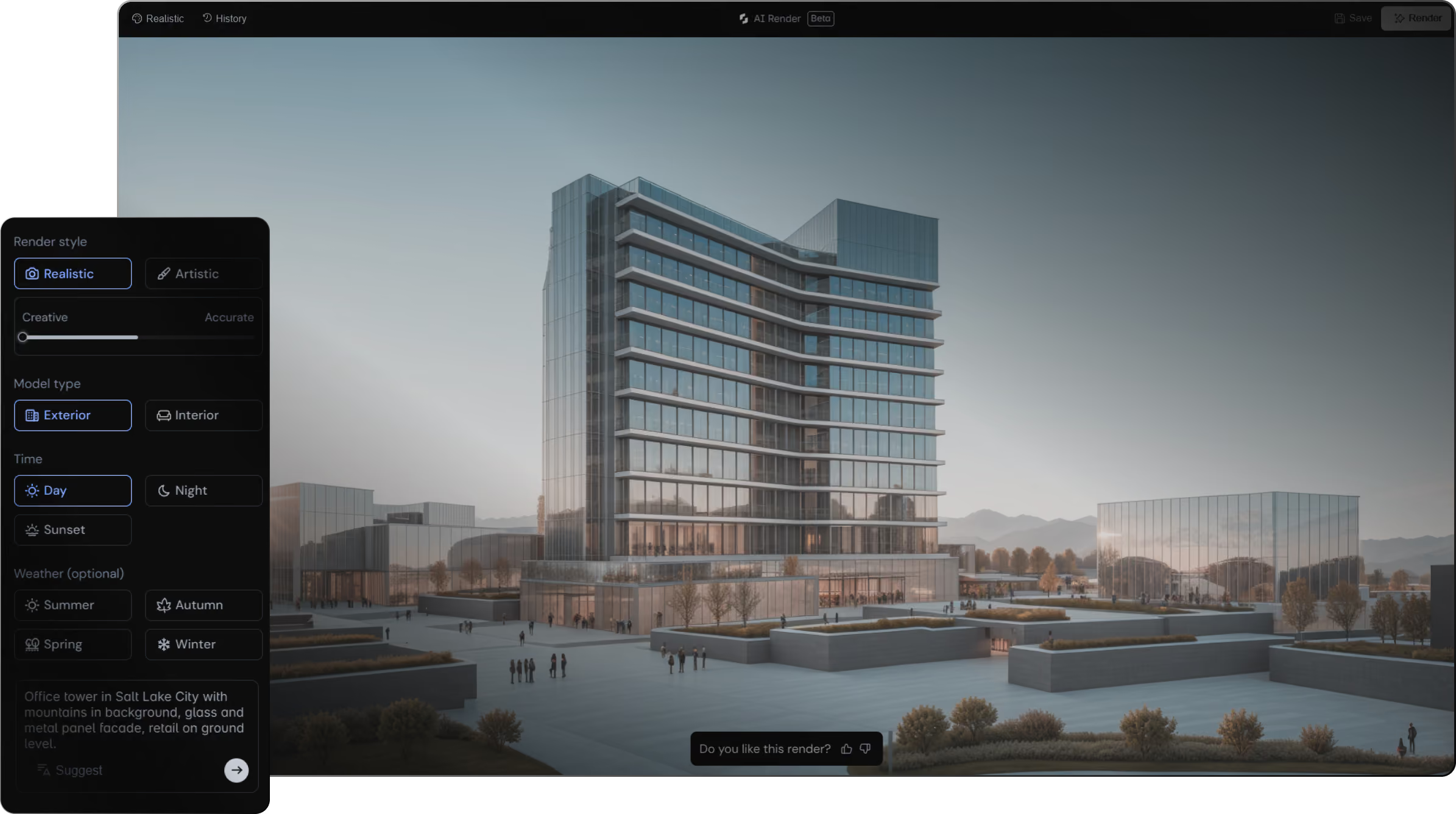
Snaptrude is an AI-powered, cloud-native BIM design tool for architects that delivers all three capabilities - genuine real-time collaboration, data continuity, and AI-first capability - in a single platform. Unlike legacy tools (Revit, ArchiCAD) that manage fragmented workflows, Snaptrude connects program requirements, design geometry, cost models, and schedules bidirectionally so changes cascade automatically. Teams using Snaptrude recover 20-40% of billable capacity previously consumed by coordination overhead.
Comparison: Legacy BIM vs. Cloud-Native BIM Software
What This Means for the Industry
The firms and companies that capture value in construction over the next decade will be those that modernize their BIM software stack first. Every project started on a cloud-native BIM platform instead of Revit offers lead time to explore more options, spend less on rework, and deliver higher quality. For architects specifically, the shift is radical in its return to what attracted people to architecture: when you're not managing files and resolving format conflicts, you can focus on design thinking. Start your BIM software transformation today - try Snaptrude free and see the productivity gains for yourself.
FAQ
Q: Is the productivity decline really due to BIM software, or are there other factors?
A: Multiple factors contribute, including regulation, complexity, supply chain challenges, and material cost volatility. But the 30-year trend is uniquely hard to explain without pointing to stagnant BIM software tools. Every other major industry faced similar regulations and complexity yet improved productivity dramatically through technology modernization. Finance moved from isolated trading systems to cloud platforms. Manufacturing integrated design with production planning. Logistics connected suppliers and delivery tracking in real-time. Construction companies still move data via file attachments and email. Cloud-native BIM software finally enables the integration that other industries achieved decades ago.
Q: We've invested heavily in Revit training. Should we abandon it?
A: No. Revit remains the industry standard for construction documentation with unmatched depth in detail libraries and scheduling systems. The question is what you use for design phases where collaboration and iteration matter most. Most forward-thinking practices adopt a phased approach: use Revit for CD phase where its documentation depth is essential, use cloud-native BIM software like Snaptrude for SD and DD phases where rapid exploration and AI-assisted space planning drive project velocity. One 40-person architecture firm reports they maintained Revit expertise while moving SD/DD to cloud-native tools, resulting in 35% faster concept design and 25% fewer coordination issues during CD.
Q: How much can cloud-native BIM software actually improve productivity?
A: Field studies consistently show 20-40% recovery in time spent on coordination, searching for information, and manual rework. For a 30-person firm, that translates to 3-4 additional full-time equivalents of recovered capacity per year. Design productivity in terms of design iterations per week improves 30-50% when iteration cycles are tighter. Snaptrude users report 15-20 hours per week recovered on average, with some practices reporting as high as 25 hours per week during early design phases with heavy program iteration.
Q: If cloud-native BIM software is so beneficial, why hasn't adoption been faster?
A: Switching costs are extraordinarily high. Teams need retraining and a typical 4-8 week productivity dip as architects relearn muscle memory. Existing templates, standards, detail libraries, and institutional knowledge require reworking. But adoption is accelerating, particularly among firms founded in the last 10 years and among large practices opening new offices with opportunity to establish cloud-first workflows. New graduates entering the workforce expect BIM tools to work like Google Docs - instant sync, zero merge conflicts, accessible from anywhere.
Q: What's the first step for a firm considering modernization to cloud-native BIM?
A: Start with data collection and honest accounting. Audit where your team actually spends time - use time tracking for one week across 5-10 projects and categorize work as design thinking vs. coordination overhead. You'll typically find 10-15 hours per architect per week consumed by coordination and rework. Once you quantify the real cost, the ROI of cloud-native BIM software becomes obvious. Pilot with a low-risk project: start with the earliest design phases on one project where iteration and collaboration are highest-value. Most firms that start small and scale systematically report full adoption within 18 months, with ROI visible by month 6.