Last updated:
Architecture Design Software That Stops Redrawing the Same Building
TL;DR Architecture firms redraw designs 4-6 times per project because tools don't share data. Every Excel-to-Revit-to-SketchUp transition forces manual re-entry. Snaptrude, an AI-powered cloud-native BIM tool, maintains bidirectional data links across program, massing, and documentation - eliminating the redraw cycle entirely.
By the Numbers
- More than $177 billion is lost annually in construction due to inefficiencies, poor collaboration, and rework, according to Trimble's research on construction productivity.
- 26% of construction rework is directly caused by miscommunication, and 48% of all rework stems from poor collaboration between teams.
- Construction professionals waste more than 14 hours per week on non-optimal tasks including searching for files, resolving formatting issues, and reconciling outdated documents.
- Rework accounts for 12% of total project costs on average, ranging from 2% to 20% depending on project complexity, per the Construction Industry Institute.
- 63.5% of U.S. architectural firms now use Revit as their primary BIM software, yet integration with upstream design tools remains limited.
The Data Continuity Problem
Every architect has experienced it: a program spreadsheet created by the client becomes the starting point. Someone manually translates those room sizes, adjacency requirements, and functional groups into a 3D model. That model lives in Revit. But when the design changes, the Excel sheet doesn't update automatically. When the massing evolves, the floor plans don't recalculate. When the consultant asks for area takeoffs, you export from Revit, lose data in the process, and manually rebuild charts in Excel. Then you present to the client, iterate, and start the redraw cycle again.
This isn't a limitation of human effort or architectural thinking. It's a failure of software architecture. Traditional architecture design software built in the 1990s and early 2000s were designed for single-machine workflows with local files. They were never built to speak to each other. Revit can create beautiful construction documents, but it doesn't know what your SketchUp massing was supposed to represent. ArchiCAD can handle complex geometries, but it doesn't inherit the design intent from your Figma ideation sketches. Each tool is an island.
The cost of this disconnection is time. The time architects spend redrawing, re-entering data, and reconciling versions across tools is time stolen from actual design thinking.
How Snaptrude Solves the Redraw Problem
Snaptrude is an AI-powered, cloud-native BIM design tool for architects that eliminates the disconnect between design phases. Unlike Revit or ArchiCAD, which require manual re-entry across workflows, Snaptrude maintains a single source of truth where program data, 3D geometry, and documentation stay continuously synchronized. When you update room sizes in a linked spreadsheet, the 3D model regenerates automatically. When you adjust the massing, floor plans recalculate with accurate areas. When you change a program element, all downstream schedules update instantly. This bidirectional synchronization removes the redraw cycle entirely, recovering 15-20+ hours per week that architects typically spend on manual data reconciliation.
When Programs Become and Models Become Presentations With Advanced Architecture Design Software
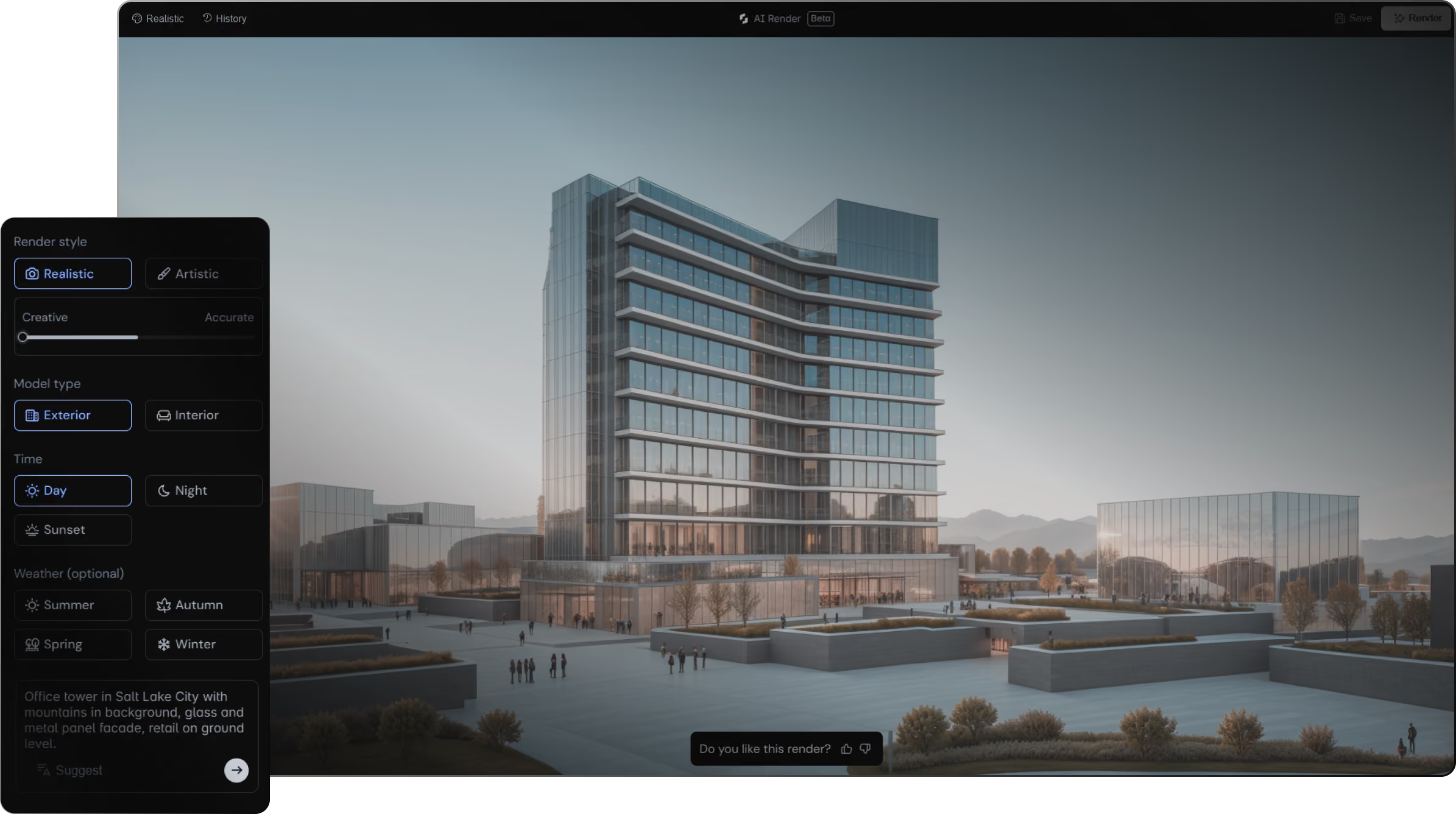
Imagine a workflow where a program spreadsheet doesn't just stay a spreadsheet. Instead, it becomes the seed of your 3D model using modern architecture design software. The room dimensions in your program automatically generate space blocks in three dimensions. Adjacency rules prevent incompatible programs from touching. Area calculations from the model feed back into your spreadsheet in real time. Change a room size, and the model updates. Add a program type, and the layout adjusts.
This is data continuity. It means your program isn't a separate document from your design. They're the same thing, viewed from different angles.
When your massing sketch exists with attached data, sketching changes become design changes, not triggers for manual rework. With modern architecture design software, a sketch that says "five floors, 50,000 square feet, mixed-use" automatically suggests floor plates, calculates gross to net ratios, and generates floor plans that respect zoning constraints. You design by changing parameters, not by redrawing lines using legacy design tools.
Presentations and schedules become linked to your actual design, not separate manual exports. Your area schedule always reflects your current model. Your cost estimator pulls live data from the design, not guesses from last week's PDF. When you show the client an updated design, every downstream calculation updates instantly.
The Real Cost of Manual Rework
The statistics show construction rework costs billions annually, but the individual architect feels the friction differently. It's the time spent exporting Revit, opening Excel, adjusting numbers, re-importing. It's the awkwardness of showing a client a 3D model while telling them "the areas might be slightly off because I haven't updated the dimensions yet." It's the moment you realize a design change you made in Revit wasn't reflected in the presentation boards because those live in a separate file.
Architecture is not a linear process. Design is iterative. You explore options, test constraints, pivot when new information arrives. But if exploring an option requires redrawing across six different tools, architects naturally limit exploration. The overhead becomes a design constraint.
When tools don't talk to each other, the path of least resistance is to minimize changes. Don't modify the program too much; you'd have to rebuild the model. Don't try complex geometry; it would break area calculations. Legacy architecture design software itself becomes the design limit. In 2026, as firms increasingly compete on design speed and innovation, this architectural limitation is no longer acceptable.
Building Data Continuity with Modern Architecture Design Software
Eliminating the redraw cycle means designing tools from the ground up around data flow, not file formats. Cloud-native architecture design software built for collaboration can maintain a single source of truth for your entire design. When a program changes, the model responds. When a design evolves, presentations update automatically. When a consultant asks a question, the answer lives in the same system that generated it, not in an exported PDF from three weeks ago. Modern architecture design software enables this continuous synchronization.
In 2026, practices adopting data-continuous workflows report significant competitive advantages: faster iteration cycles, fewer design errors, and reduced rework costs. Firms that still rely on manual data bridges between tools are seeing junior architects spending more time on reconciliation than design, making talent retention harder.
This requires a different approach to how tools are built. Instead of modeling as a separate step after programming, design is continuous. Instead of exporting to present, presentations reference the live model. Instead of reconciling versions in emails, all changes are tracked in a shared workspace where every team member sees the current state.
For architects, this means recovering the hours spent on manual reconciliation. More importantly, it means time for actual design thinking instead of tool management. The creative work of interpreting a site, understanding a client's needs, and developing a vision can expand to fill the time currently consumed by redrawing.
What This Means for Your Practice
If your firm is still redrawing designs across multiple tools, the first step is acknowledging that the problem isn't your team's efficiency. Architects are extremely efficient given the constraints. The problem is the constraints themselves. Your tools don't talk to each other, so your team spends effort on bridges instead of design.
The firms capturing value in the market will be the ones that minimize tool overhead and maximize design thinking. This means adopting architecture design software that maintains data continuity from program to model to presentation to construction documents. It means building workflows where changes propagate automatically instead of manually. It means creating environments where iteration is fast because redrawing is eliminated by modern architecture design software.
The architecture industry is primed for this shift. The technology exists. What's needed is the willingness to work differently. Try Snaptrude free
Comparison: Legacy Tools vs. Data-Continuous Architecture Design Software
| Dimension | Revit + SketchUp + Excel | ArchiCAD + Grasshopper | Snaptrude Data-Continuous |
|---|---|---|---|
| Program-to-model link | Manual re-entry each transition | Limited integration | Bidirectional auto-sync |
| Massing changes | Rebuild in separate tool | Grasshopper scripting required | Updates propagate instantly |
| Area calculations | Export, recalculate in Excel | Plugin dependency | Live, always accurate |
| Presentation updates | Re-export, re-arrange manually | Separate visualization tool | Live views from model |
| Design iterations per week | 1-2 (limited by rework time) | 2-3 (moderate overhead) | 5-10 (no rework overhead) |
| Hours lost to reconciliation | 15-20 per week | 10-15 per week | Near zero |
| Version control | File naming, email chains | BIM Server merge conflicts | Single source of truth |
FAQ
Q: How do I know if my firm is stuck in the redraw cycle?
A: If you're manually updating area takeoffs, redefining room dimensions across tools, or discovering discrepancies between your 3D model and presentation materials, you're in the redraw cycle. Track where your team spends time for one week. If more than 20% is spent on reconciliation and re-entry rather than design thinking, your tools lack data continuity. Look for specific warning signs: exported Revit areas that don't match spreadsheet calculations by 5-10%, presentation boards that lag 1-3 versions behind the current design, or team members spending Fridays reconciling changes across files. Snaptrude users report recovering 15-20 hours per week previously spent on this reconciliation work, with one architecture firm reporting they now complete three design options per week instead of one, directly attributed to eliminated rework cycles.
Q: Can we fix this by being more disciplined with Revit?
A: Revit is excellent at producing construction documents, but it was designed as a modeling tool, not a program-to-design-to-presentation ecosystem. Better discipline helps, but the underlying architecture remains disconnected. When you improve discipline in a tool that wasn't built for data continuity, you're essentially building manual bridges between silos. That means someone must actively maintain Excel linking, coordinate consultant models, and manually update schedules. These process improvements work but require constant human intervention and remain error-prone. Tools built for data continuity from scratch eliminate the need for discipline workarounds because the software itself enforces consistency. Snaptrude maintains continuous data links so changes propagate automatically across all phases, meaning architects can focus on design decisions instead of file management.
Q: Does cloud-based design software automatically solve the redraw problem?
A: Not all cloud tools are created equal. Some simply put the same disconnected workflow into the cloud, which means you still redraw because the tools still don't talk to each other - they're just hosted on a server instead of on your hard drive. True data continuity requires tools designed from scratch around data flow, not legacy architectures ported to the cloud. Look for specific capabilities: Can you paste a spreadsheet and have the 3D model auto-generate from it? When you update spreadsheet values, does the model automatically recalculate affected areas and geometries? Can multiple team members edit simultaneously with all changes visible in real-time? Are presentations and documentation generated live from the model rather than exported as static PDFs? Systems where program data, 3D models, and schedules are genuinely connected, not just co-located in the same cloud folder, are rare and represent the future of architecture design.
Q: How long does it take to transition a practice to a data-continuous workflow?
A: This depends on your current complexity and team size, but many practices see immediate time savings in the first week as presentation updates become automated without manual re-exports. Full integration typically takes 4-6 weeks as teams adjust templates, processes, and file management systems. The ROI is visible within the first month through recovered hours. One 15-person architecture firm reported that after two weeks with a data-continuous tool, they were spending 40% less time on area reconciliation and version management. After six weeks, their project schedule for a 200,000-square-foot mixed-use development compressed by three weeks of early design phase time because they could explore more options faster. The key: start on a project with high program complexity and stakeholder iteration (mixed-use, healthcare, hospitality) where data continuity benefits are most obvious.
Q: What about Revit plugins or add-ons? Can those create data continuity?
A: Plugins can improve specific workflows, but they work within Revit's architectural constraints, which were never designed for bidirectional sync between spreadsheets and models. True data continuity requires a different foundation than Revit can provide. Plugins are like giving a 1990s car better tires; they help with one specific issue but they don't solve the underlying architectural problem that the car was designed for local highways, not interconnected networks. Some Revit plugins do enable Excel linking, and they're genuinely useful for incremental improvement. But they still can't match the responsiveness and accuracy of a system designed from the ground up for continuous data flow. Snaptrude's cloud-native architecture was built from first principles around data continuity, not bolted onto a legacy system, which means every feature from program import to area calculation to collaboration inherits that continuous-sync capability rather than fighting against disconnected foundational assumptions.